
Building muscle can seem complicated when you’re just starting out.
You may have seen complicated workout routines, athletes eating huge amounts of food, people discussing supplements you have never heard of, and conflicting advice about how many sets and repetitions you should do.
It can leave you wondering: What should a beginner actually do to build muscle?
The good news is that gaining muscle doesn’t require a complicated program. If you’re new to strength training, your body can respond remarkably well to consistent resistance exercise, adequate nutrition, and proper recovery.
This Ultimate Beginner Muscle Building Guide breaks the process down into simple, practical steps. You’ll learn how muscle growth works, how to structure your workouts, what to eat, how much protein you need, how to progressively increase your training, and which mistakes could hold you back.
Whether you’re training in a commercial gym in Islamabad, Lahore, Rawalpindi, Karachi, or anywhere else in Pakistan, the fundamentals remain the same.
You don’t need to become an expert overnight.
You need a good plan, patience, and the discipline to follow it.
Beginner Tip: Your first goal shouldn’t be to lift as much weight as possible. Your first goal should be to learn good technique and build a consistent training habit.
What Actually Makes Muscles Grow?
Before worrying about supplements or advanced workout routines, understand the basic principle behind muscle growth.
When you perform resistance exercises, your muscles experience mechanical tension and other training-related stresses. Your body then adapts to the training stimulus by repairing and strengthening the muscle tissue.
Over time, consistently challenging your muscles can lead to muscle hypertrophy, meaning an increase in muscle size.
Three things matter tremendously:
1. Resistance Training
You need to give your muscles a reason to adapt.
This comes from exercises such as:
- Squats
- Bench presses
- Rows
- Pull-downs
- Overhead presses
- Lunges
- Romanian deadlifts
- Curls
- Triceps extensions
2. Nutrition
Your body needs energy and nutrients to support training and recovery.
Protein provides amino acids needed for muscle protein synthesis, while carbohydrates and fats provide energy and other essential nutrients.
3. Recovery
Your body needs time between challenging workouts to recover and adapt.
That’s why training harder isn’t always better.
Train → Recover → Adapt → Repeat.
That’s the basic cycle behind successful muscle building.

How Long Does It Take to Build Muscle?
One of the first questions beginners ask is:
“How quickly can I gain muscle?”
There isn’t one number that applies to everyone.
Your results depend on factors such as:
- Training experience
- Genetics
- Age
- Nutrition
- Sleep
- Training consistency
- Starting body composition
- Exercise technique
- Recovery
Beginners often make noticeable improvements in strength relatively quickly because their bodies are adapting to a new training stimulus.
Visible muscle growth takes longer.
This is why you shouldn’t judge your progress after one or two weeks.
Instead, think in terms of months rather than days.
Your First Few Months Should Focus On:
- Learning proper technique
- Building consistency
- Establishing a sustainable diet
- Getting enough protein
- Improving strength
- Tracking workouts
- Getting enough sleep
Don’t compare your first month to someone’s fifth year.
You’re at a different stage of the journey.
The 5 Foundations of Beginner Muscle Growth
If you remember nothing else from this guide, remember these five principles.
| Foundation | What It Means |
|---|---|
| Resistance Training | Challenge your muscles consistently |
| Progressive Overload | Gradually increase training demands |
| Protein & Nutrition | Give your body nutrients needed for growth |
| Recovery | Allow your body time to repair and adapt |
| Consistency | Follow the process long enough to see results |
Most beginners spend too much time looking for a secret exercise or supplement.
There isn’t one.
The basics work when you actually do them consistently.
Step 1: Set a Realistic Muscle-Building Goal
Before starting a muscle-building program, establish what you’re trying to accomplish.
Your goal might be:
- Build your first noticeable amount of muscle
- Become stronger
- Improve your physique
- Gain healthy body weight
- Develop specific muscle groups
- Become more athletic
Avoid vague goals such as:
“I want to get huge.”
Instead, create measurable goals.
For example:
Weak goal:
“I want bigger arms.”
Better goal:
“I want to follow a structured strength program three times per week and progressively improve my upper-body exercises over the next 12 weeks.”
The second goal gives you something you can actually control.
Step 2: Choose the Right Training Frequency
You don’t need to train seven days a week to build muscle.
For a beginner, three full-body strength sessions per week can be an excellent starting point.
For example:
| Day | Training |
| Monday | Full Body |
| Tuesday | Rest / Light Activity |
| Wednesday | Full Body |
| Thursday | Rest |
| Friday | Full Body |
| Saturday | Optional Light Cardio |
| Sunday | Rest |
This schedule gives you enough training stimulus while allowing recovery between sessions.
As you become more experienced, you can experiment with different training schedules.
Step 3: Focus on Compound Exercises
Compound exercises involve multiple joints and muscle groups.
They are particularly useful for beginners because they allow you to train several major muscles efficiently.
Important Compound Exercises
Chest
- Bench Press
- Dumbbell Press
- Push-Ups
Back
- Lat Pulldown
- Pull-Ups
- Seated Cable Row
- Dumbbell Row
Legs
- Squats
- Leg Press
- Lunges
- Romanian Deadlifts
Shoulders
- Overhead Press
- Dumbbell Shoulder Press
These exercises can form the foundation of a beginner muscle-building program.
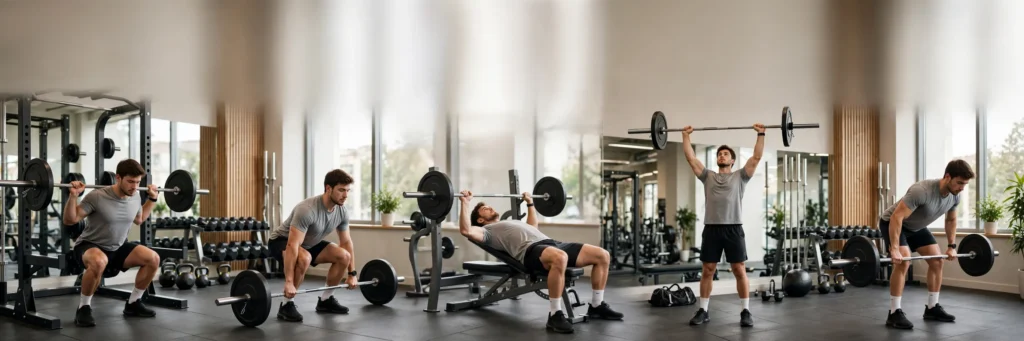
Step 4: Learn Proper Exercise Form
Don’t rush to increase the weight.
A heavier dumbbell doesn’t automatically mean a better workout.
Poor technique can reduce the effectiveness of an exercise and increase the chance of injury.
When learning a new exercise:
- Start with a light resistance.
- Learn the movement pattern.
- Practice controlled repetitions.
- Keep your range of motion appropriate.
- Ask a qualified trainer for feedback when necessary.
- Increase resistance gradually.
A Simple Rule
Technique first. Weight second.
If you can’t control the movement, the weight is probably too heavy.
Step 5: Understand Sets and Repetitions
Two terms you’ll hear constantly in the gym are sets and reps.
Repetition
One complete movement is one repetition.
For example, performing one complete dumbbell curl equals one rep.
Set
A group of repetitions performed together is a set.
For example:
3 sets × 10 reps
means you perform 10 repetitions, rest, and repeat that sequence three times.
For muscle-building training, a variety of repetition ranges can be effective when sets are sufficiently challenging and performed with appropriate technique.
Beginners don’t need to obsess over finding one “perfect” rep range.
Instead, prioritize:
- Good form
- Appropriate resistance
- Consistent training
- Gradual progression
Step 6: Start With a Simple Beginner Muscle-Building Workout
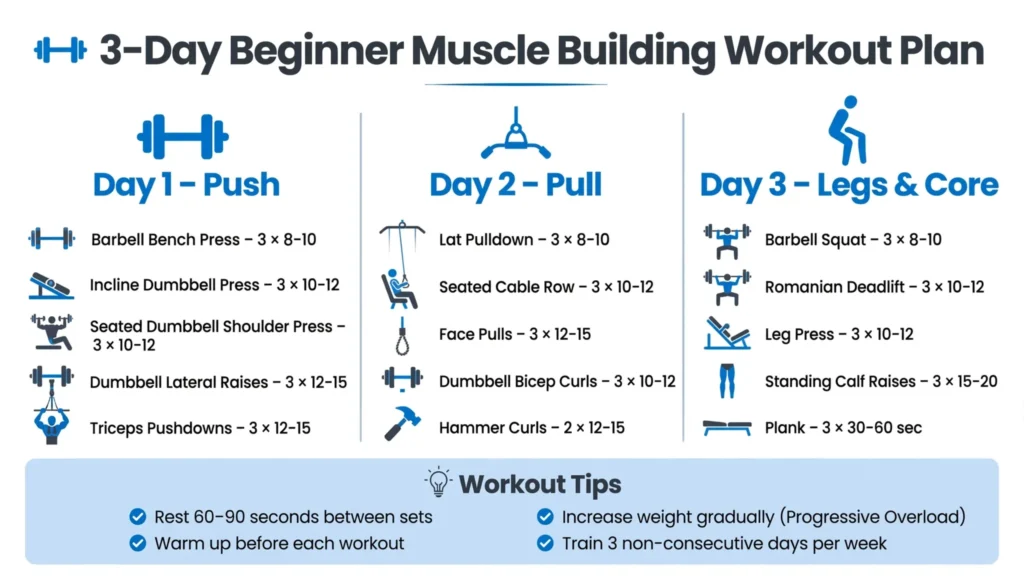
Here’s a straightforward three-day routine that can serve as a starting framework.
Day A
| Exercise | Sets | Reps |
| Goblet Squat | 3 | 8–12 |
| Dumbbell Bench Press | 3 | 8–12 |
| Lat Pulldown | 3 | 8–12 |
| Dumbbell Romanian Deadlift | 2 | 8–12 |
| Dumbbell Curl | 2 | 10–15 |
| Triceps Pushdown | 2 | 10–15 |
Day B
| Exercise | Sets | Reps |
| Leg Press | 3 | 8–12 |
| Machine Chest Press | 3 | 8–12 |
| Seated Cable Row | 3 | 8–12 |
| Dumbbell Shoulder Press | 2 | 8–12 |
| Leg Curl | 2 | 10–15 |
| Calf Raise | 2 | 10–15 |
Day C
| Exercise | Sets | Reps |
| Squat Variation | 3 | 8–12 |
| Incline Dumbbell Press | 3 | 8–12 |
| Lat Pulldown or Assisted Pull-Up | 3 | 8–12 |
| Romanian Deadlift | 2 | 8–12 |
| Lateral Raise | 2 | 10–15 |
| Biceps Curl | 2 | 10–15 |
You can alternate A/B/A one week and B/A/B the next.
Rest Between Sets
A practical starting point is around 1–3 minutes, depending on the exercise and how demanding the set is.
For larger compound movements, you may need longer rest periods to maintain good performance.
Step 7: Understand Progressive Overload
This is one of the most important concepts in muscle building.
Your muscles need a reason to adapt.
If you perform exactly the same workout with exactly the same resistance forever, your body eventually has less reason to continue adapting.
Progressive overload means gradually increasing the demands placed on your body.
This doesn’t always mean adding more weight.
You can progress by:
- Increasing weight
- Performing more repetitions
- Adding a set
- Improving technique
- Increasing range of motion where appropriate
- Improving control
- Reducing unnecessary rest in suitable exercises
Example
Week 1:
Dumbbell Bench Press
10 kg × 10 reps
Week 2:
10 kg × 12 reps
Week 3:
12 kg × 10 reps
The exact progression will vary from person to person.
The important idea is:
Give your body a manageable reason to improve.
Beginner Tip: Don’t Chase the Weight Stack
If you can lift a heavier weight only by swinging, jerking, or changing your technique, you’re not necessarily progressing.
A controlled set with excellent technique is more valuable than a sloppy set performed just to impress someone.
Step 8: Learn How Hard Your Sets Should Feel
Beginners often make one of two mistakes:
Mistake 1: The weight is so light that the exercise provides little challenge.
Mistake 2: The weight is so heavy that technique breaks down.
A useful concept is repetitions in reserve (RIR).
If you finish a set and believe you could have performed about three more good repetitions, that’s roughly 3 RIR.
Beginners generally don’t need to take every set to complete muscular failure.
Leaving a small number of good repetitions in reserve can help you maintain technique and manage fatigue while learning.
Step 9: Eat Enough Protein
Training gives your muscles a reason to grow.
Nutrition supplies the materials your body needs to support that process.
Protein is especially important.
Protein-rich foods include:
- Eggs
- Chicken
- Fish
- Milk
- Yogurt
- Cottage cheese
- Lentils
- Chickpeas
- Beans
- Lean beef
- Soy products
For exercising individuals, a commonly recommended protein intake for supporting muscle growth is approximately 1.4–2.0 grams of protein per kilogram of body weight per day, depending on individual circumstances and goals.
For example, someone weighing 70 kg could fall around:
98–140 grams of protein per day.
You don’t need to hit the exact same number every day. Think of it as a useful range rather than a magic target.
If you have kidney disease or another medical condition that affects your diet, speak with a qualified healthcare professional before significantly increasing protein intake.

Step 10: Don’t Forget Carbohydrates and Healthy Fats
Muscle building isn’t just about protein.
A balanced diet also needs carbohydrates and dietary fats.
Carbohydrates
Carbohydrates can provide energy for training.
Good options include:
- Rice
- Oats
- Potatoes
- Whole-grain bread
- Fruits
- Whole-grain roti
Healthy Fats
Healthy dietary fats provide energy and support normal body functions.
Sources include:
- Nuts
- Seeds
- Olive oil
- Avocado
- Eggs
- Fatty fish
Instead of eliminating entire food groups, aim for a balanced diet that provides enough energy and nutrients to support your goals.
Step 11: Decide Whether You Need a Calorie Surplus
If your goal is gaining body weight and muscle, you may need to consume more calories than you burn.
This is commonly called a calorie surplus.
However, bigger isn’t necessarily better.
A very large surplus can lead to unnecessary fat gain alongside muscle.
A more controlled approach is usually easier to manage.
If You’re Naturally Very Lean
A modest calorie surplus may help support muscle and weight gain.
If You Have Higher Body Fat
You may not need to deliberately increase calories. Depending on your goals and training experience, you may be able to improve body composition while maintaining or carefully adjusting calorie intake.
Your starting strategy should depend on your individual situation.
Quick Muscle-Building Nutrition Guide
| Nutrient | Main Role | Food Examples |
| Protein | Muscle repair and growth | Eggs, chicken, fish, lentils |
| Carbohydrates | Training energy | Rice, oats, potatoes, fruit |
| Fats | Energy and normal body functions | Nuts, seeds, olive oil |
| Water | Hydration | Water, milk, other fluids |
Step 12: Get Enough Sleep
You can have an excellent workout plan and a balanced diet, but consistently poor sleep can make recovery harder.
Most adults should aim for 7–9 hours of sleep per night.
A good sleep routine can support:
- Recovery
- Energy
- Training performance
- Focus
- Overall health
Improve Your Sleep
Try to:
- Maintain a consistent bedtime
- Keep your bedroom comfortable and dark
- Limit excessive screen use before bed
- Avoid relying on caffeine late in the day
- Create a relaxing nighttime routine

The Beginner Muscle-Building Formula
If the entire first part of this guide had to be reduced to one formula, remember:
Resistance Training + Progressive Overload + Protein + Enough Calories + Sleep + Consistency = Muscle-Building Foundation
You don’t need to make every workout perfect.
You need to repeat the right habits for long enough to allow your body to adapt.
Common Beginner Muscle-Building Mistakes
Before moving forward, make sure you aren’t falling into these traps.
❌ Changing Programs Every Week
Your body needs time to adapt.
❌ Lifting Too Heavy
Strength comes with practice. Don’t sacrifice form for numbers.
❌ Training Only the Muscles You See
Don’t neglect your back, legs, and posterior chain simply because chest and arms are more visible.
❌ Eating Randomly
Muscle building requires adequate nutrition—not simply eating anything you can find.
❌ Ignoring Sleep
Recovery is part of the program.
❌ Expecting Results in Two Weeks
Muscle building is a long-term process.
❌ Comparing Yourself to Social Media
Lighting, posing, genetics, training history, and sometimes photo editing can dramatically change how physiques appear online.
Focus on your own progress.
Quick Summary
Before moving to the next part, here’s what you should know:
- Train consistently with resistance exercises.
- Learn proper technique before chasing heavier weights.
- Use progressive overload over time.
- Eat enough protein and overall nutrition.
- Don’t ignore carbohydrates and healthy fats.
- Get 7–9 hours of sleep when possible.
- Give your muscles enough time to recover.
- Track your workouts and progress.
- Be patient.
Building muscle isn’t a 30-day challenge.
It’s a skill and lifestyle that improves with practice.
Ultimate Beginner Muscle Building Guide: Training, Nutrition & Progress
Building muscle becomes much easier when you stop looking for a single “best” workout and start understanding how the pieces fit together.
In Part 1, we covered the fundamentals: resistance training, progressive overload, protein, calories, sleep, and consistency.
Now let’s take those principles and turn them into a practical system you can actually follow.
How to Structure Your Weekly Muscle-Building Routine
A good beginner program should train the major muscle groups regularly without creating so much fatigue that you can’t recover.
You don’t need to spend two hours in the gym every day.
For most beginners, 3–4 strength-training sessions per week provide plenty of opportunity to make progress.
Here are three practical approaches.
Option 1: Full-Body Training
This is excellent for someone completely new to resistance training.
| Day | Workout |
|---|---|
| Monday | Full Body |
| Tuesday | Rest |
| Wednesday | Full Body |
| Thursday | Rest |
| Friday | Full Body |
| Saturday | Walking / Optional Cardio |
| Sunday | Rest |
You train your major muscle groups during every session.
Option 2: Upper/Lower Split
Once you’re comfortable with the basics, an upper/lower routine can work well.
| Day | Workout |
|---|---|
| Monday | Upper Body |
| Tuesday | Lower Body |
| Wednesday | Rest |
| Thursday | Upper Body |
| Friday | Lower Body |
| Saturday | Rest |
| Sunday | Rest |
Option 3: Three-Day Push/Pull/Legs
Another possibility is:
- Push: Chest, shoulders, triceps
- Pull: Back, biceps
- Legs: Quads, hamstrings, glutes, calves
However, beginners shouldn’t assume that a more complicated split is automatically better.
The best routine is one that allows you to train consistently and recover properly.
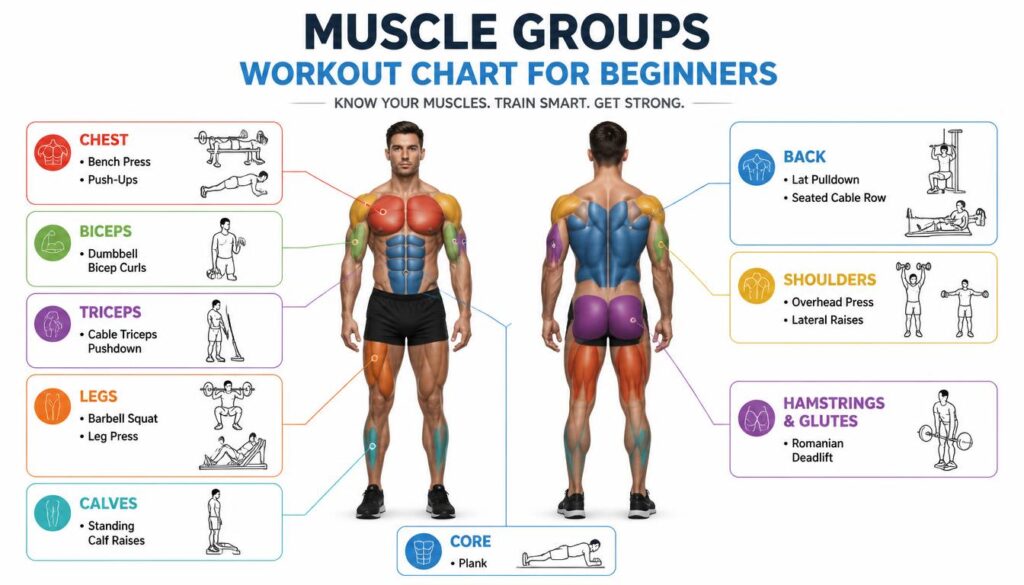
How to Train Each Major Muscle Group
A balanced muscle-building program should include movements for your entire body.
Chest
Useful exercises include:
- Barbell bench press
- Dumbbell bench press
- Incline dumbbell press
- Machine chest press
- Push-ups
- Cable flyes
You don’t need all of them.
Choose a few movements that you can perform comfortably and progressively improve.
Back
Your back includes several different muscles, so use both vertical and horizontal pulling movements.
Examples:
- Lat pulldown
- Pull-ups
- Assisted pull-ups
- Seated cable rows
- One-arm dumbbell rows
- Chest-supported rows
Shoulders
For complete shoulder development, consider movements such as:
- Overhead press
- Dumbbell shoulder press
- Lateral raises
- Rear-delt flyes
Don’t make the mistake of training only front delts. Pressing exercises already involve them heavily.
Legs
Leg training shouldn’t be skipped just because your goal is a bigger upper body.
Important movements include:
- Squats
- Leg press
- Lunges
- Bulgarian split squats
- Romanian deadlifts
- Leg curls
- Calf raises
Strong legs also help create a balanced physique.
Arms
You don’t need dozens of isolation exercises.
For biceps:
- Dumbbell curls
- Barbell curls
- Hammer curls
For triceps:
- Cable pushdowns
- Overhead extensions
- Close-grip pressing movements
A combination of compound and isolation exercises is generally enough.
How Many Sets Should a Beginner Do?
There’s no single number of sets that guarantees muscle growth.
Your ideal training volume depends on your experience, exercise selection, recovery, and ability to progress.
For a beginner, starting with a moderate amount of weekly training volume is usually smarter than immediately doing extremely high-volume workouts.
A simple starting point might look like:
- 2–3 working sets per exercise
- Around 5–8 exercises per workout depending on the session
- 3–4 training days per week
- Gradual increases as you adapt
If you’re constantly exhausted, sore, and your performance is falling, more training isn’t necessarily the answer.
Beginner Tip
Start with less than you think you need.
You can always add training volume later.
It’s much easier to increase a manageable program than to recover from a program that’s unnecessarily demanding.
How Many Reps Should You Do to Build Muscle?
Muscle growth can occur across a relatively broad range of repetitions when the sets are challenging and technique remains sound.
For practical purposes, beginners can use:
- 5–8 reps: Heavier compound work
- 8–12 reps: A convenient range for many exercises
- 10–15 reps: Many isolation exercises
- 12–20 reps: Suitable for some smaller-muscle movements
Don’t get obsessed with one specific rep range.
If you’re doing 10 controlled repetitions today and eventually progress to 12 with the same weight, that’s useful progress.
How Long Should You Rest Between Sets?
Rest periods depend on the exercise and intensity.
A practical guide:
| Exercise Type | Approximate Rest |
|---|---|
| Heavy compound movement | 2–3+ minutes |
| Moderate compound exercise | 1.5–3 minutes |
| Isolation exercise | 1–2 minutes |
| Very demanding sets | As needed for recovery |
The objective isn’t to finish your workout as quickly as possible.
You want enough recovery to perform your next set with good technique and useful effort.
How to Know If Your Workout Is Working
A good muscle-building program should produce measurable improvements over time.
Track things like:
- Exercise
- Weight used
- Repetitions
- Sets
- Workout date
- Technique notes
For example:
Dumbbell Bench Press
Week 1: 10 kg × 8 reps
Week 2: 10 kg × 10 reps
Week 3: 10 kg × 12 reps
Week 4: 12 kg × 8 reps
That is progress.
It may not look dramatic from one week to the next, but these small improvements accumulate.
How to Build a Muscle-Gain Diet
Your workout tells your body to adapt.
Your diet helps provide the energy and nutrients needed to support that adaptation.
A muscle-building diet doesn’t need to be complicated.
Build most meals around:
Protein + Carbohydrates + Healthy Fats + Fruits or Vegetables
For example:
Breakfast:
Eggs + roti + yogurt + fruit
Lunch:
Chicken + rice + vegetables
Snack:
Milk + banana + nuts
Dinner:
Beef/chicken/fish + roti or rice + vegetables
The exact foods can change depending on your budget, preferences, culture, and nutritional needs.
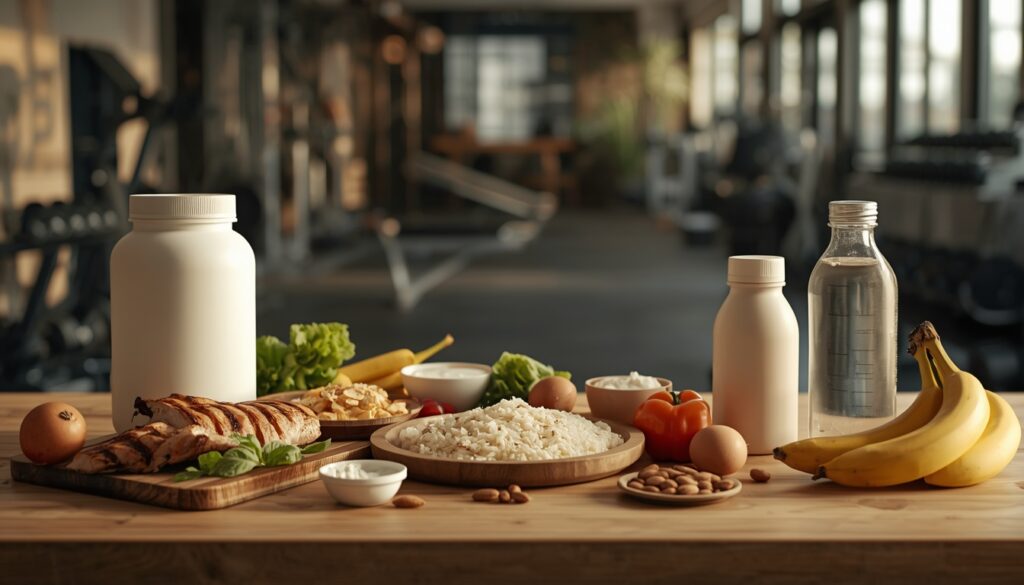
Pakistani Foods That Can Support Muscle Growth
You don’t need an expensive Western-style bodybuilding diet to build muscle in Pakistan.
There are plenty of affordable local foods that can provide protein, carbohydrates, fats, vitamins, and minerals.
High-Protein Options
- Eggs
- Chicken
- Fish
- Lean beef
- Milk
- Yogurt
- Daal
- Chickpeas
- Kidney beans
- Black beans
- Paneer
- Soy products
Carbohydrate Sources
- Rice
- Roti
- Oats
- Potatoes
- Sweet potatoes
- Bananas
- Other fruits
Healthy Fat Sources
- Peanuts
- Almonds
- Walnuts
- Seeds
- Eggs
- Olive oil
- Some fish
A muscle-building diet can be simple, affordable, and culturally familiar

Sample Pakistani Muscle-Gain Meal Plan
Here’s an example of how a beginner might structure a day.
| Meal | Example |
|---|---|
| Breakfast | 3 eggs, roti, yogurt, banana |
| Mid-Morning | Milk + handful of peanuts |
| Lunch | Chicken, rice, vegetables |
| Pre-Workout | Banana + yogurt |
| Post-Workout | Milk + meal containing protein and carbohydrates |
| Dinner | Fish/chicken, roti, vegetables |
| Before Bed | Milk or yogurt if desired |
This is an example rather than a personalized prescription.
Your calorie and protein needs depend on your body size, activity level, goals, and individual circumstances.
Should You Eat Before Your Workout?
You don’t necessarily need a special pre-workout meal.
What matters most is your overall daily nutrition.
However, eating before training can help you feel energized.
A pre-workout meal or snack can contain:
- Carbohydrates for energy
- Some protein
- Enough time to digest before exercising
Examples include:
- Banana + yogurt
- Oats + milk
- Eggs + toast
- Rice + chicken if you have more time before training
Avoid eating a very large, heavy meal immediately before an intense workout if it makes you uncomfortable.
What Should You Eat After a Workout?
You don’t need to rush home and consume protein within a tiny “anabolic window.”
Instead, focus on getting adequate protein throughout the day.
A normal post-workout meal could include:
- Chicken + rice
- Eggs + roti
- Fish + potatoes
- Daal + rice + yogurt
- Milk + a balanced meal
The most important thing is your overall daily protein and calorie intake.
How Much Water Should You Drink?
Hydration matters for general health and exercise performance.
Your needs vary based on:
- Temperature
- Sweat rate
- Exercise duration
- Body size
- Activity level
This is particularly important in Pakistan during hot weather.
Instead of obsessing over one universal number, drink regularly throughout the day and pay attention to thirst and your activity level.
During longer or particularly sweaty workouts, replacing fluids and electrolytes may become more important.
Beginner Tip: Don’t Confuse Sweating With Fat Loss
Sweating more doesn’t automatically mean you’re burning more body fat.
A hot gym, sauna, or excessive clothing can make you lose water through sweat.
Once you rehydrate, that water weight comes back.
Fat loss and water loss are not the same thing.
Should You Do Cardio While Building Muscle?
Yes.
Cardio doesn’t automatically destroy muscle gains.
In fact, cardiovascular exercise supports heart health, fitness, and overall health.
For someone primarily focused on muscle growth, you can include a sensible amount of cardio without allowing it to interfere significantly with your resistance training and recovery.
Good options include:
- Brisk walking
- Cycling
- Swimming
- Jogging
- Light treadmill sessions
If muscle gain is your priority, avoid turning every day into an exhausting endurance session.
A balanced approach works better.
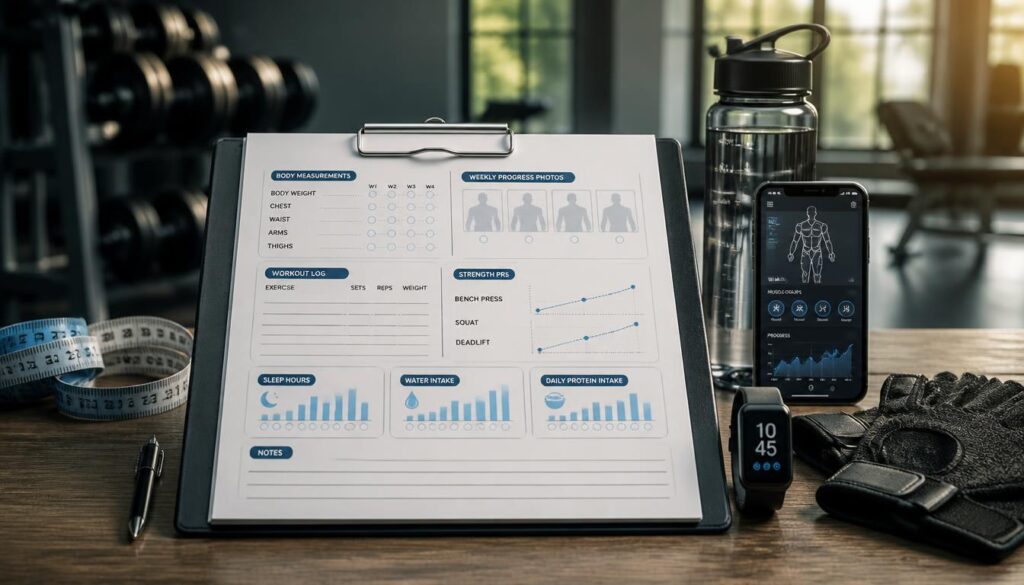
How to Track Your Muscle-Building Progress
The scale alone doesn’t tell the whole story.
Track several indicators.
1. Body Weight
Weigh yourself under similar conditions and look at trends rather than reacting to a single day’s number.
2. Measurements
Every few weeks, you can measure:
- Waist
- Chest
- Arms
- Thighs
3. Progress Photos
Take photos under similar lighting, distance, and poses.
4. Strength
Record your performance on key exercises.
5. Workout Consistency
Ask yourself:
“How many planned workouts did I actually complete?”
Consistency is a result worth tracking.
What If Your Weight Isn’t Increasing?
If you’re intentionally trying to gain weight and your body weight hasn’t changed for several weeks, your current food intake may not be enough to produce a calorie surplus.
Before dramatically increasing calories, check:
- Are you actually eating consistently?
- Are you tracking your food accurately?
- Are you skipping meals?
- Has your activity increased?
- Are you sleeping enough?
- Are your workouts progressing?
If everything is consistent and your weight remains stable, a modest increase in food intake may be appropriate.
Don’t immediately jump to an enormous calorie surplus.
What If You’re Gaining Weight Too Quickly?
Fast weight gain isn’t automatically fast muscle gain.
If your body weight is increasing rapidly and you’re also gaining more body fat than you’d like, your calorie surplus may be larger than necessary.
A slower, controlled approach can make it easier to manage body composition.
Remember:
The goal is not simply to gain weight. The goal is to improve your physique and performance.
Beginner Muscle Building Supplements
Supplements can be useful, but they’re not the foundation of muscle growth.
Before purchasing anything, get your:
- Training
- Protein intake
- Overall diet
- Sleep
- Recovery
under control.
Protein Powder
Protein powder can be useful when you’re struggling to consume enough protein from normal foods.
It’s convenience—not magic.
You can build muscle without it.
Creatine Monohydrate
Creatine monohydrate is one of the most extensively researched sports supplements and can improve performance in repeated high-intensity activities and support strength and muscle gains when combined with resistance training.
A commonly studied maintenance intake is around 3–5 grams per day for healthy adults.
If you’re under 18, pregnant, have a medical condition, take medications, or have concerns about supplementation, speak with a qualified healthcare professional before using it.
Caffeine
Caffeine can improve alertness and exercise performance for some people.
However, more isn’t better.
Too much caffeine can interfere with sleep, and poor sleep can undermine your recovery.
Be particularly careful with high-caffeine energy drinks and pre-workout products.
Supplement Rule: If your diet, training, and sleep aren’t consistent, buying more supplements probably isn’t the solution.
Muscle Building Myths Beginners Should Ignore
The internet is full of fitness claims.
Let’s separate some common myths from reality.
Myth 1: “You Need to Train Every Day”
Reality:
Muscle growth requires training and recovery. More sessions aren’t automatically better.
Myth 2: “You Must Eat Huge Amounts of Protein”
Reality:
Protein matters, but extremely high intake isn’t necessary for most people.
Myth 3: “You Need Supplements to Build Muscle”
Reality:
A good training program and balanced diet are much more important.
Myth 4: “You Have to Train Until Failure Every Set”
Reality:
You can build muscle without taking every set to complete failure.
Myth 5: “You Need a Perfect Diet”
Reality:
Consistency over time matters more than eating perfectly every day.
Myth 6: “You Can Build Huge Muscles in 30 Days”
Reality:
Meaningful muscle development takes time.
Myth 7: “Only Men Should Lift Heavy Weights”
Reality:
Resistance training can be beneficial for people of different sexes and fitness levels when appropriately programmed.
Common Muscle-Building Mistakes to Avoid
Even a good program can fail if your habits work against it.
1. Changing Exercises Constantly
If you change your entire workout every week, it becomes difficult to know whether you’re actually progressing.
2. Copying Advanced Bodybuilders
An experienced lifter may have years of training behind their routine.
A beginner needs a different starting point.
3. Neglecting Legs
A muscular upper body with poorly developed legs creates an unbalanced physique.
4. Doing Too Much Cardio
Cardio is healthy, but excessive endurance work can make recovery and calorie management more challenging for someone prioritizing muscle gain.
5. Not Eating Enough
You can’t expect significant weight gain while consistently undereating.
6. Eating Anything and Everything
A calorie surplus doesn’t mean you should live on fast food.
Nutrient quality still matters.
7. Ignoring Technique
More weight isn’t useful if you can’t perform the movement properly.
8. Sleeping Too Little
Recovery is not optional.
9. Giving Up Too Early
Your body won’t transform overnight.
Give your program enough time to work.
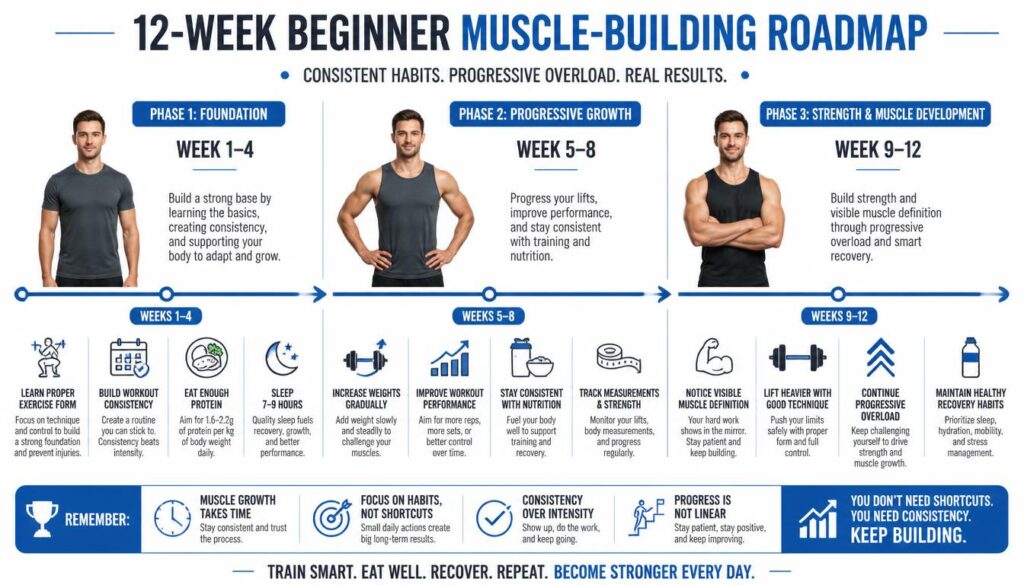
A Simple 12-Week Muscle-Building Roadmap
Instead of trying to change everything at once, approach your first three months in stages.
Weeks 1–4: Learn
Focus on:
- Exercise technique
- Gym confidence
- Consistent attendance
- Finding appropriate weights
- Establishing meal routines
- Improving sleep
Don’t worry about lifting huge weights.
Weeks 5–8: Progress
Now focus more closely on:
- Increasing repetitions
- Gradually increasing resistance
- Tracking workouts
- Improving protein intake
- Maintaining consistency
Weeks 9–12: Refine
Evaluate:
- Strength improvements
- Body measurements
- Weight trends
- Workout consistency
- Recovery
- Nutrition
Then make small adjustments rather than completely changing your routine.
Beginner Muscle-Building Checklist
Save this checklist and use it as a simple reference.
Training
- ☐ Train consistently
- ☐ Learn proper exercise form
- ☐ Train all major muscle groups
- ☐ Use progressive overload
- ☐ Track sets, reps, and weight
- ☐ Avoid unnecessary training volume
Nutrition
- ☐ Eat enough protein
- ☐ Consume sufficient calories for your goal
- ☐ Include carbohydrates
- ☐ Include healthy fats
- ☐ Eat fruits and vegetables
- ☐ Stay hydrated
Recovery
- ☐ Aim for 7–9 hours of sleep
- ☐ Take appropriate rest days
- ☐ Manage stress
- ☐ Avoid training through significant pain
Progress
- ☐ Track strength
- ☐ Track body weight if relevant
- ☐ Take occasional progress photos
- ☐ Measure your body periodically
- ☐ Review your routine every few weeks
When Should You Get Professional Help?
A qualified trainer can be particularly useful if you’re completely new to the gym, unsure about exercise technique, or struggling to create a suitable routine.
You should also speak with an appropriately qualified healthcare professional before beginning a demanding exercise or nutrition program if you have a medical condition, significant injury, symptoms during exercise, or other health concerns.
Stop exercising and seek appropriate medical evaluation if you experience concerning symptoms such as chest pain, fainting, severe shortness of breath, or sudden severe pain.
Fitness should improve your health—not put it at unnecessary risk.
Quick Summary: The Beginner Muscle-Building Blueprint
Here’s the complete process in simple terms:
Step 1: Choose a realistic muscle-building goal.
Step 2: Train consistently 3–4 days per week.
Step 3: Focus on compound movements and complementary isolation exercises.
Step 4: Learn proper form.
Step 5: Use manageable sets and repetitions.
Step 6: Progress gradually.
Step 7: Consume enough protein.
Step 8: Eat enough total calories to support your goal.
Step 9: Sleep and recover.
Step 10: Track your progress.
Step 11: Stay patient.
Step 12: Adjust your plan based on results.
That’s the foundation.
You don’t need a secret program.
You need to execute the fundamentals consistently.
Frequently Asked Questions About Building Muscle
1. How can a beginner start building muscle?
Start with resistance training 3–4 times per week, learn proper exercise technique, consume enough protein and overall calories, and prioritize recovery. Beginners should focus on consistency and gradual progression rather than immediately using advanced training methods.
2. How many days a week should a beginner train for muscle gain?
Three to four resistance-training sessions per week can be an effective starting point. The ideal frequency depends on your schedule, training experience, workout structure, and recovery ability.
3. How much protein does a beginner need to build muscle?
A commonly used range for exercising individuals is approximately 1.4–2.0 grams of protein per kilogram of body weight per day. Your individual needs can vary depending on your goals and circumstances.
4. Can you build muscle without protein powder?
Yes. Protein powder isn’t necessary for muscle growth. Foods such as eggs, chicken, fish, milk, yogurt, lentils, chickpeas, beans, and meat can provide plenty of protein.
5. What are the best foods for muscle gain in Pakistan?
Affordable options include eggs, milk, yogurt, chicken, fish, lean beef, daal, chickpeas, beans, rice, roti, oats, potatoes, peanuts, and other nuts and seeds. A balanced combination can support muscle growth without requiring expensive foods.
6. How long does it take to see muscle growth?
The timeline varies significantly. Beginners may notice improvements in strength relatively quickly, while visible changes in muscle size generally require consistent training and nutrition over a longer period.
7. Do beginners need to bulk to build muscle?
Not necessarily. A calorie surplus can help support muscle and body-weight gain, but the ideal strategy depends on your current body composition and goals. Some beginners can make significant improvements without deliberately eating a large surplus.
8. Is it better to lift heavy or do more repetitions?
Both heavier and lighter loads can contribute to muscle growth when used appropriately. Beginners should prioritize controlled technique, sufficient effort, and progressive improvement rather than obsessing over one particular rep range.
9. Should I train every muscle every day?
No. Muscles need recovery after challenging resistance training. A structured routine allows you to train consistently while giving your body appropriate time to recover.
10. Can I build muscle and lose fat at the same time?
It can happen, particularly among beginners, people returning to training, and individuals with higher levels of body fat. Results depend on training status, nutrition, body composition, and other individual factors.
11. Is creatine safe for beginners?
Creatine monohydrate is well researched and can be useful for healthy adults when used appropriately. However, people with medical conditions, those taking medications, and younger individuals should consult an appropriate healthcare professional before supplementation.
12. Do I need to train until failure to build muscle?
No. Training close enough to failure can provide a strong stimulus, but you don’t need to take every set to complete failure. Beginners should especially prioritize good technique and manageable fatigue.
13. What should I eat after a workout to build muscle?
A normal balanced meal containing protein and carbohydrates is a good choice. Examples include chicken with rice, eggs with roti, fish with potatoes, or daal with rice and yogurt.
14. Why am I not gaining muscle even though I work out?
Possible reasons include insufficient training progression, inadequate protein or calorie intake, poor sleep, inconsistent workouts, poor technique, excessive fatigue, or simply not allowing enough time for results to develop.
15. What’s the biggest mistake beginners make when trying to build muscle?
One of the biggest mistakes is trying to progress too quickly. Beginners often lift heavier than they can safely control, change routines constantly, train excessively, or expect rapid transformations. Consistent, gradual progress is a much better strategy.
Final Thoughts
Building your first serious amount of muscle doesn’t require you to become a professional bodybuilder.
You don’t need a kitchen full of supplements.
You don’t need to spend three hours in the gym every day.
And you certainly don’t need to follow every fitness trend you see on social media.
Start with the fundamentals.
Train consistently. Eat well. Consume enough protein. Progress gradually. Sleep properly. Recover. Repeat.
Some weeks you’ll feel stronger. Other weeks your progress may seem almost invisible. That’s normal.
What matters is what happens over months.
The person who consistently completes sensible workouts for a year will usually make far more progress than the person who follows a “perfect” program for three weeks and quits.
Your goal isn’t to transform overnight.
Your goal is to become a little stronger, a little more knowledgeable, and a little more consistent over time.
Muscle is built through patience. Strength is built through practice. Results are built through consistency.
Keep Learning With FitnessAdda
If you want to take the next step, explore these related FitnessAdda guides:
- Learn the fundamentals of gaining muscle without relying on unnecessary shortcuts. How to Build Muscle Naturally
- Discover effective exercises to include in your muscle-building routine. Best Exercises for Muscle Gain
- Ready to move beyond full-body training? Learn how an upper/lower split can structure your workouts. Upper-Lower Split Workout
- Explore one of the most popular workout splits for organizing your weekly training. Push Pull Legs Workout: Complete 2026 Guide
- If you’re still getting comfortable in the gym, this beginner-friendly guide can help you get started with confidence. Complete Beginner Gym Guide
- If your goal includes reducing body fat alongside improving your fitness, explore this complete guide. Complete Weight Loss Guide
- Learn how familiar Pakistani foods can fit into a practical weight-loss approach. Best Pakistani Diet for Weight Loss
- Looking for a suitable gym environment? Explore this guide for women searching for gyms nearby. Ladies Gym Near Me
If you’re ready to begin your fitness journey in Pakistan, FitnessAdda.pk can help you discover gyms, personal trainers, fighting clubs, fitness events, and educational resources to keep moving forward.
Start where you are.
Learn the basics.
Train smart.
And give yourself enough time to grow.
Leave a Reply