
What is the best full body workout for beginners?
A good beginner full body workout trains all major muscle groups in one session — legs, back, chest, shoulders, arms, and core — using simple, safe exercises like squats, push-ups, rows, and planks. Done 3 times a week with a day of rest in between, it builds strength, improves form, and creates a foundation before moving to more advanced training.
Introduction
Walking into a gym for the first time can feel intimidating. Rows of machines, people who clearly know what they’re doing, and no idea where to even start — it’s one of the biggest reasons beginners quit before they see real results.
Here’s the good news: you don’t need a complicated split routine, fancy equipment, or hours in the gym to get stronger and build a solid foundation. A well-structured full body workout, done consistently, is one of the most effective ways for beginners to build muscle, lose fat, and develop the confidence and habit of training.
In this guide, you’ll learn:
- Why full body workouts are ideal for beginners
- The basics of sets, reps, rest, and progressive overload
- A complete beginner-friendly full body workout plan
- Proper form cues for each exercise
- A warm-up and cool-down routine
- Common mistakes beginners make
- Answers to the most common beginner training questions

Why Full Body Workouts Are Ideal for Beginners
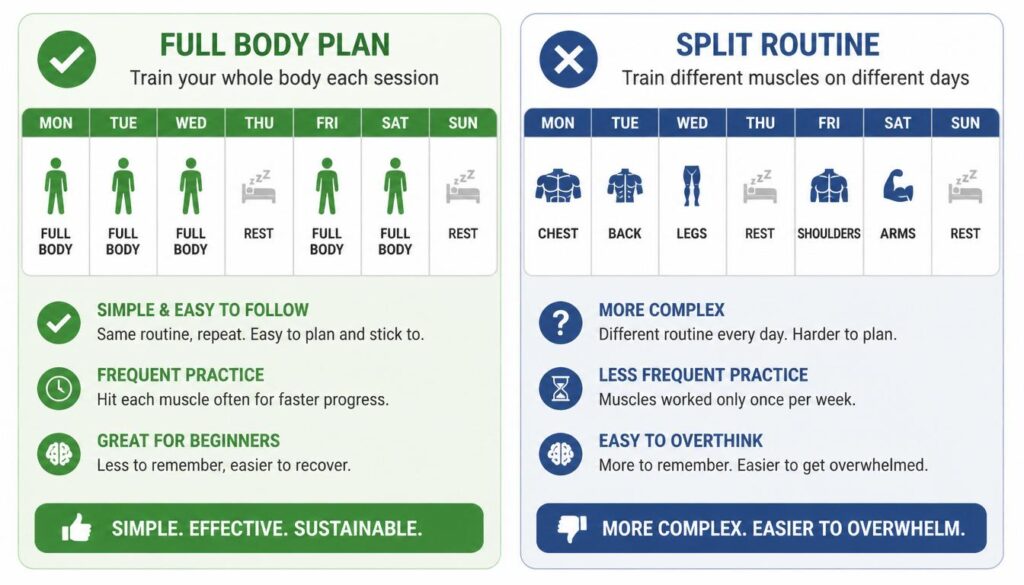
Many beginners jump straight into “bro splits” (chest day, back day, leg day) because that’s what they see online. But for someone new to training, full body workouts offer real advantages:
- More frequent practice of key movements. Training squats, push-ups, and rows multiple times a week helps beginners learn proper form faster than doing them once a week.
- Better time efficiency. Three sessions a week covering the entire body is easier to stick to than five or six days of split training.
- Balanced development from day one. No muscle group gets neglected while you’re still learning the basics.
- Faster strength gains early on. Beginners respond well to frequency — hitting a muscle group 3x a week accelerates the learning curve of lifting.
- Flexibility for missed days. If you miss one full body session, you haven’t skipped an entire muscle group for the week, unlike with split routines.
The Real Benefits of a Full Body Workout for Beginners
Beyond “getting fit,” a full body workout delivers specific, measurable benefits that matter most in your first few months of training:
- Faster skill acquisition. Practicing a squat or push-up three times a week instead of once means your nervous system learns the movement pattern much faster, which translates to safer, more effective training.
- Improved metabolic rate. Full body strength training builds lean muscle, which increases your resting metabolism over time — useful whether your goal is fat loss, muscle gain, or general health.
- Better joint stability and posture. Compound movements like squats and rows strengthen the muscles that support your knees, hips, shoulders, and spine, which is especially valuable for people coming from a sedentary desk job.
- Higher workout adherence. Because sessions are only 3 days a week and cover everything, it’s easier to actually show up consistently compared to a 5–6 day split that quickly feels overwhelming for a beginner.
- A foundation for every future goal. Whether you eventually want to build muscle, run faster, or simply feel stronger in daily life, the strength and movement quality built through full body training carries over to all of it.
Understanding the Basics: Sets, Reps, Rest, and Progressive Overload
Before jumping into the plan, it helps to understand a few core training concepts.
Reps (repetitions) are how many times you perform a single exercise in a row. Sets are groups of reps with rest in between. For example, “3 sets of 10 reps” means you do 10 repetitions, rest, then repeat that two more times.
Rest between sets for beginners is usually 60–90 seconds for most exercises, giving your muscles enough recovery to perform the next set with good form.
Progressive overload simply means gradually making workouts more challenging over time — more weight, more reps, or better form — so your body keeps adapting and getting stronger. Without this, progress stalls.
Form before weight. As a beginner, your priority should always be learning correct movement patterns before adding heavier weight. Lifting too heavy too soon is one of the most common causes of injury and stalled progress.
Rest days matter. Muscles grow and repair during rest, not during the workout itself. Beginners should have at least one rest day between full body sessions.
Key Training Terms at a Glance
| Term | Meaning | Why It Matters |
|---|---|---|
| Rep | One complete movement of an exercise | Basic unit of training volume |
| Set | A group of reps done consecutively | Determines total workload |
| Rest | Time between sets | Allows recovery for the next set |
| Progressive overload | Gradually increasing difficulty | Drives long-term strength gains |
| Form | Correct movement technique | Prevents injury, improves results |
The Complete Beginner Full Body Workout Plan
This plan is designed to be done 3 times a week (for example, Monday, Wednesday, Friday), with rest or light activity on the other days. Each session trains your whole body using simple, effective, beginner-friendly exercises.
Warm-Up (5–8 minutes, every session)
- Light cardio: brisk walk, jog in place, or jumping jacks — 2–3 minutes
- Arm circles and leg swings — 1 minute
- Bodyweight squats — 10 reps
- Bodyweight push-ups (or knee push-ups) — 5–8 reps
Main Workout
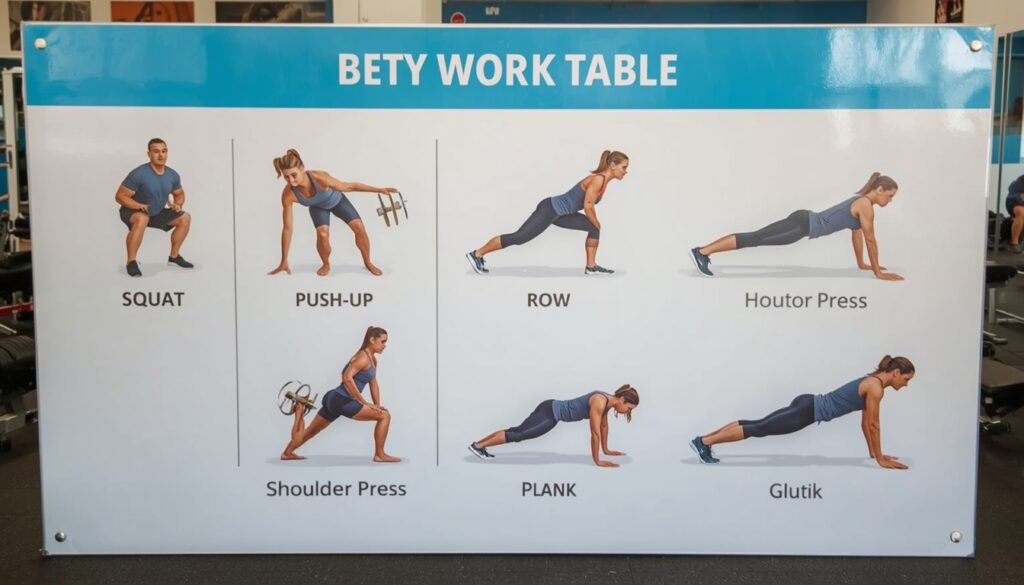
| Exercise | Muscles Worked | Sets x Reps | Rest Between Sets |
|---|---|---|---|
| Bodyweight or Goblet Squat | Legs, glutes, core | 3 x 10–12 | 60–90 sec |
| Push-Ups (or knee push-ups) | Chest, shoulders, triceps | 3 x 8–12 | 60–90 sec |
| Dumbbell or Band Row | Back, biceps | 3 x 10–12 | 60–90 sec |
| Standing Shoulder Press (light dumbbells) | Shoulders, triceps | 3 x 10–12 | 60–90 sec |
| Glute Bridge | Glutes, hamstrings, core | 3 x 12–15 | 60 sec |
| Plank | Core | 3 x 20–30 sec hold | 45–60 sec |
Cool-Down (5 minutes, every session)
- Slow walking to bring heart rate down — 1–2 minutes
- Hamstring stretch — 30 seconds each leg
- Quad stretch — 30 seconds each leg
- Chest and shoulder stretch — 30 seconds each side
- Deep breathing — 1 minute
Proper Form Cues for Each Exercise
Squat: Feet shoulder-width apart, chest up, push your hips back like sitting into a chair, keep knees tracking over your toes, and go as low as comfortable while keeping your heels on the ground.
Push-Up: Hands slightly wider than shoulders, body in a straight line from head to heels (or knees, if doing a modified version), lower your chest toward the floor with control, and push back up.
Row: Hinge slightly at the hips, keep your back flat, and pull the weight or band toward your waist by squeezing your shoulder blades together.
Shoulder Press: Start with dumbbells at shoulder height, press straight overhead without arching your lower back, and lower with control.
Glute Bridge: Lie on your back, feet flat, knees bent, and lift your hips by squeezing your glutes until your body forms a straight line from shoulders to knees.
Plank: Forearms on the ground, body in a straight line, core tight, and avoid letting your hips sag or rise too high.
Sample Weekly Schedule
| Day | Activity |
|---|---|
| Monday | Full Body Workout (as above) |
| Tuesday | Rest or light walk |
| Wednesday | Full Body Workout (as above) |
| Thursday | Rest or light walk |
| Friday | Full Body Workout (as above) |
| Saturday | Optional light activity (walk, stretching, sport) |
| Sunday | Rest |
This structure gives your muscles 48 hours of recovery between sessions while still training frequently enough to build real strength and consistency.
Common Mistakes Beginners Make
- Skipping the warm-up and going straight into heavy lifts, increasing injury risk.
- Lifting too heavy too soon, sacrificing form for weight on the bar.
- Not resting enough between sessions, leading to fatigue and poor recovery.
- Copying advanced routines seen on social media instead of building a foundation first.
- Holding their breath during lifts instead of breathing steadily throughout each rep.
- Rushing through reps instead of controlling the movement, especially on the way down.
- Ignoring core exercises, which support almost every other movement in the gym.
- Comparing progress to others instead of tracking their own improvement over time.
- Being inconsistent, training hard for a week then stopping for two.
- Not eating enough protein to support muscle repair and recovery.
Frequently Asked Questions
How many days a week should beginners do a full body workout? Three days a week, with rest days in between, is ideal for most beginners to allow proper recovery while building consistency.
How long should a beginner full body workout take? Including warm-up and cool-down, most sessions take 45–60 minutes.
Can I do a full body workout at home without a gym? Yes. Bodyweight versions of squats, push-ups, glute bridges, and planks can be done at home with little to no equipment, and resistance bands can replace dumbbells for rows and presses.
Do I need weights to start a full body workout? No. Beginners can start with bodyweight exercises and gradually add light dumbbells, resistance bands, or household items as they get stronger.
How soon will I see results from a full body workout? Most beginners notice strength improvements within 2–4 weeks, with visible physical changes typically appearing after 6–8 weeks of consistent training combined with good nutrition.
Should beginners do cardio along with a full body workout? Yes, light cardio like walking is a great addition and supports overall fitness, but it shouldn’t replace strength training for beginners wanting to build muscle and strength.
Is it normal to feel sore after a beginner workout? Yes, mild muscle soreness (DOMS) in the first few weeks is normal as your body adapts. It should improve within a day or two and should not be sharp or joint-related pain.
Can I do a full body workout every day? It’s not recommended for beginners. Muscles need at least 48 hours to recover between full body sessions, so 3 sessions a week with rest days is more effective and safer.
What should I eat before and after a full body workout? A light meal with protein and carbs (like eggs and toast, or a banana with peanut butter) an hour or two before training works well, and a protein-rich meal afterward supports recovery.
Do I need a personal trainer to start a full body workout? Not necessarily, but a certified trainer can correct your form early on, which helps prevent bad habits and injuries — especially valuable in your first few weeks.
When should a beginner move on from full body training to a split routine? Most beginners benefit from 3–6 months of full body training before considering a split routine, once basic strength and form are well established.
Is it okay to feel tired during my first few full body workouts? Yes, this is completely normal as your body adjusts to a new routine. Focus on completing the sessions with good form rather than pushing to exhaustion in the early weeks.
How to Progress as a Beginner
The workout plan above is your starting point, not something to repeat identically forever. Here’s how to keep progressing safely:
- Weeks 1–2: Focus entirely on learning correct form with light weight or bodyweight only. Don’t worry about how challenging the sets feel.
- Weeks 3–4: Once form feels solid, start adding small amounts of weight or a few extra reps each week — this is progressive overload in action.
- Weeks 5–8: You can increase to 3–4 sets per exercise, or slightly reduce rest time between sets as your conditioning improves.
- After 3–6 months: Many beginners are ready to explore a split routine (like upper/lower or push/pull/legs) if they want more targeted volume per muscle group, though continuing full body training is also completely fine long-term.
Track your workouts — even a simple note on your phone with the weight and reps used each session — so you can see clear evidence of progress and know exactly when to push a little harder.
Nutrition Basics to Support Your Training
Training alone isn’t the full picture — what you eat directly affects your recovery and results:
- Protein supports muscle repair after each session. Eggs, chicken, daal, and yogurt are accessible, affordable sources.
- Carbohydrates refuel your muscles and energy levels — whole wheat roti, rice, and oats work well around training days.
- Hydration matters more than most beginners realize; even mild dehydration can reduce strength and increase perceived fatigue during workouts.
- Sleep is when most muscle recovery actually happens, so 7–8 hours a night supports your training far more than any supplement.
Conclusion
You don’t need years of gym experience or a complicated program to start building real strength. A simple, consistent full body workout — done three times a week with proper form and enough rest — is one of the most effective ways for beginners to get stronger, build confidence, and create a habit that lasts.
Start where you are, focus on form over weight, and let consistency do the rest.
Looking for a gym or certified personal trainer to guide you through your first few months of training? Discover verified gyms and trainers across Pakistan on FitnessAdda.pk.
Leave a Reply