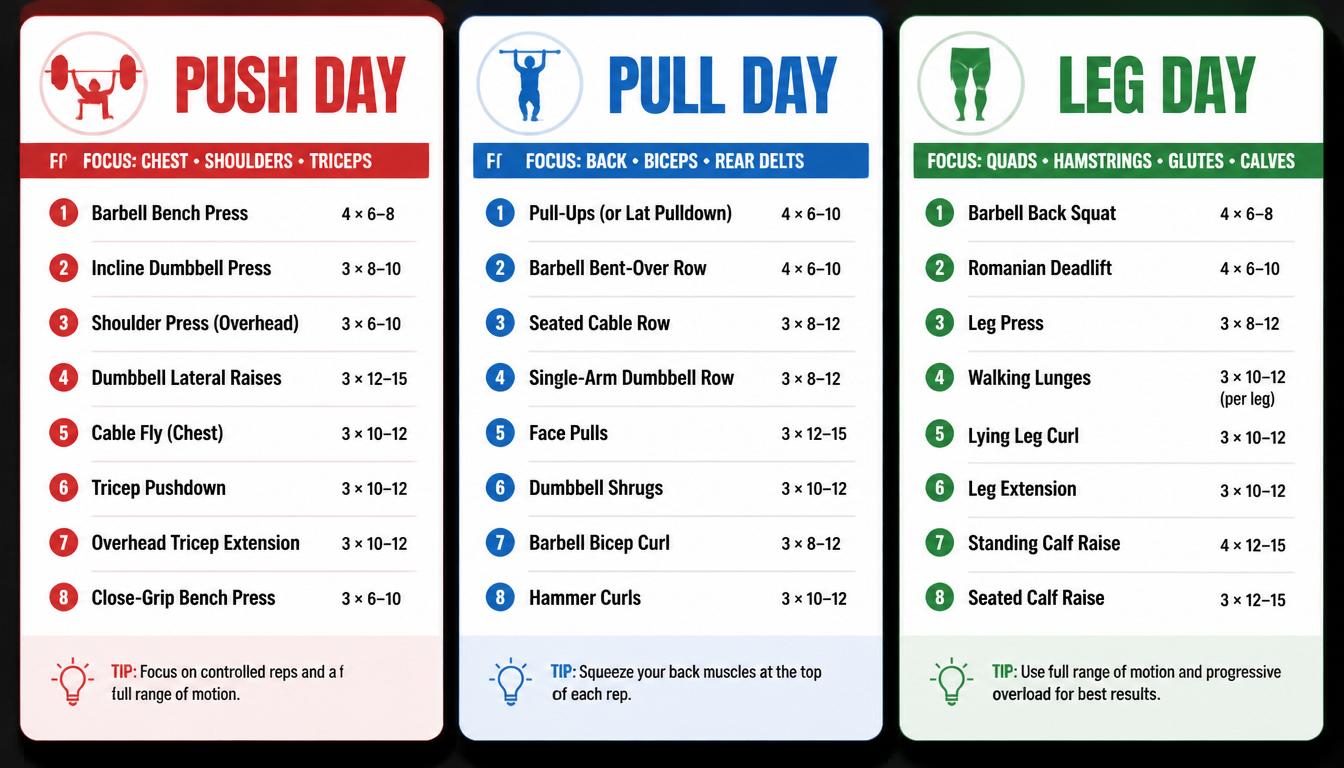
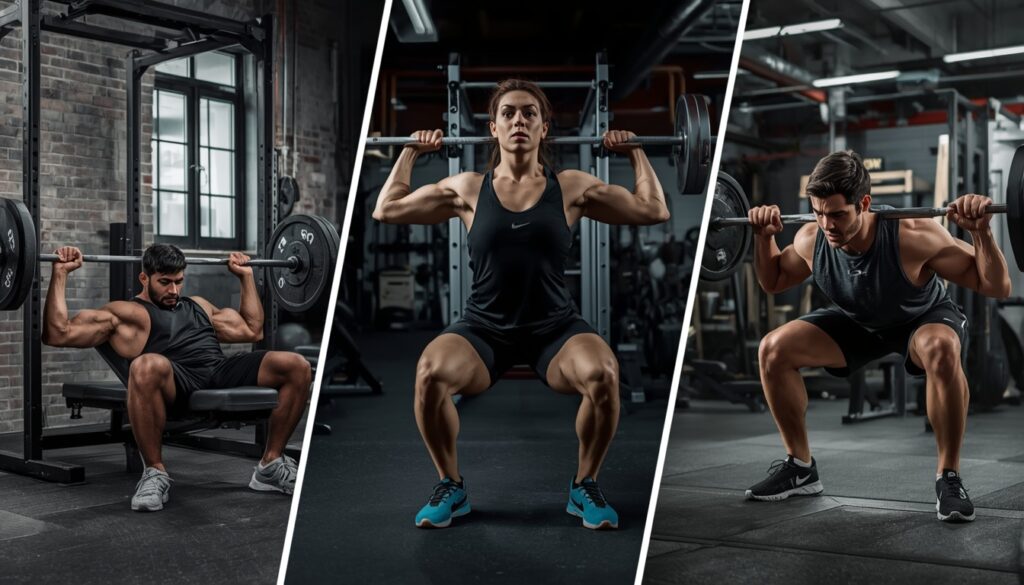
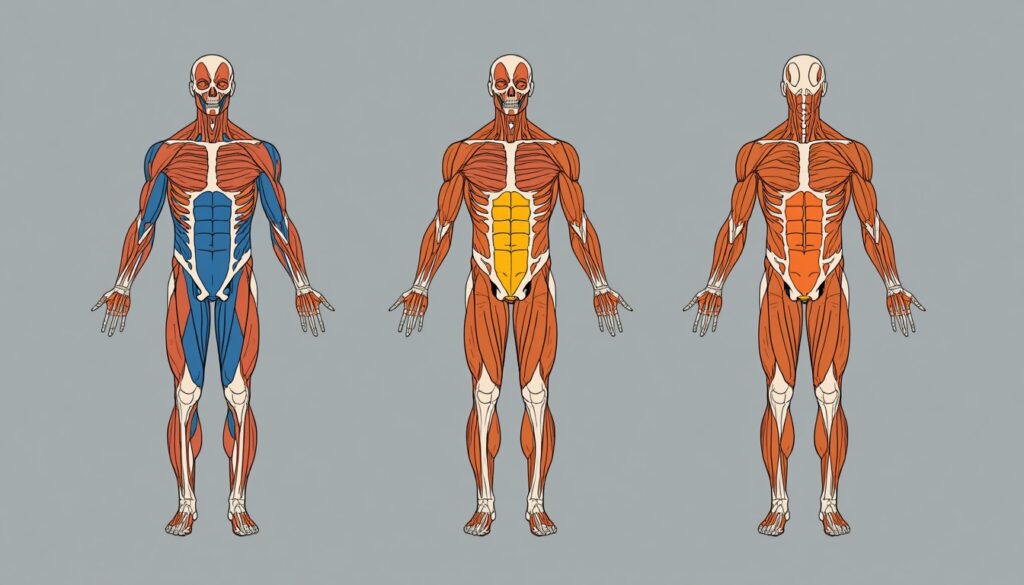
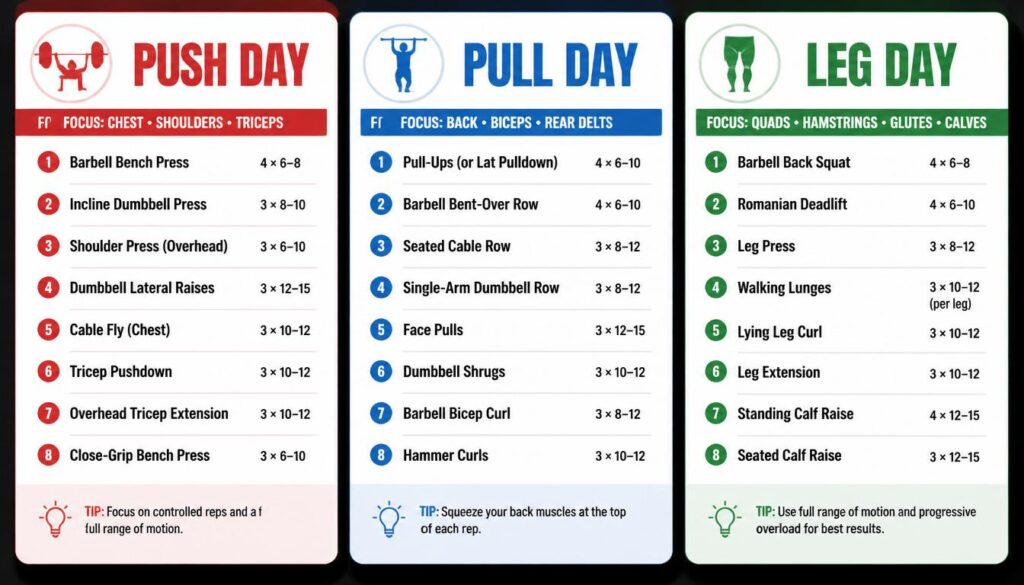
A Push Pull Legs (PPL) workout is a training split that organizes exercises by movement pattern: Push day trains chest, shoulders, and triceps; Pull day trains back and biceps; Leg day trains quads, hamstrings, glutes, and calves. It can be run 3 or 6 days a week and is one of the most effective, sustainable ways to build muscle and strength once you’ve mastered the basics.
Introduction
If you’ve spent a few months in the gym doing full body workouts and you’re ready for more volume, more focus, and faster muscle growth, the Push Pull Legs split is probably the next logical step. It’s one of the most popular and time-tested training splits used by lifters worldwide — and for good reason.
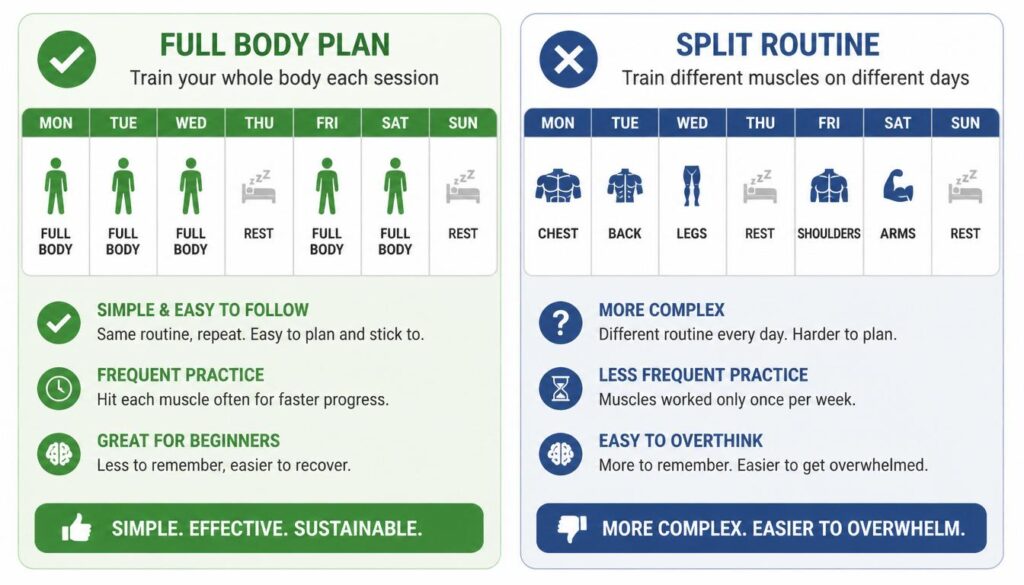
Unlike a full body routine where every muscle group gets a small amount of work each session, PPL lets you dedicate an entire day to pushing muscles, another to pulling muscles, and another to legs. This means more total sets per muscle group per week, better recovery between sessions for the same muscles, and a structure that’s easy to scale as you progress.
In this guide, you’ll learn:
What Push Pull Legs actually means and why it works
Who should (and shouldn’t) use this split
A complete Push day, Pull day, and Leg day workout
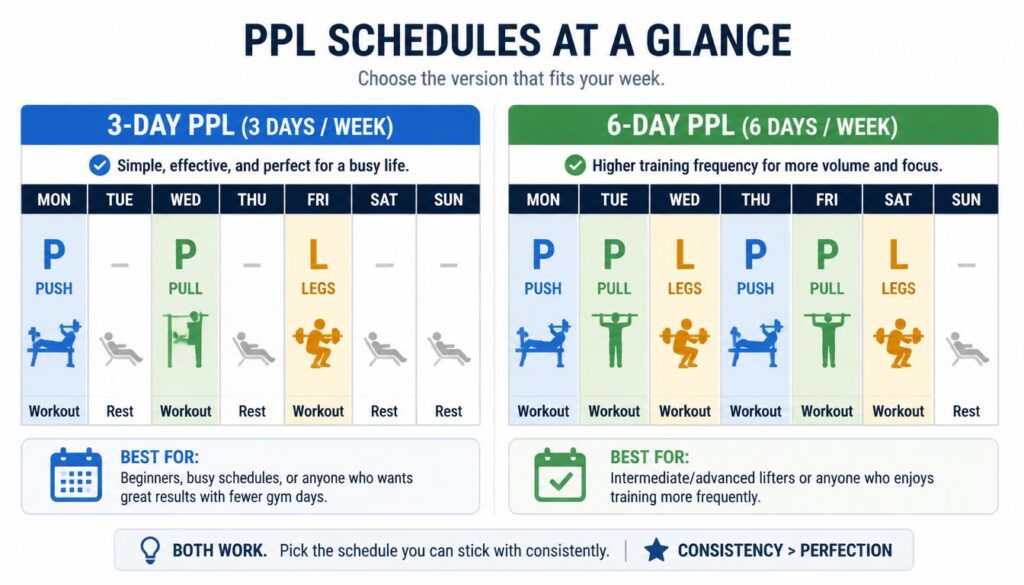
3-day and 6-day weekly schedule options
Proper form cues for key exercises
Common mistakes lifters make on PPL
Answers to the most common PPL questions
What Does “Push Pull Legs” Actually Mean?
The split is organized around how your muscles function during movement, not just which body part they belong to:
Push muscles (chest, shoulders, triceps) work together whenever you push something away from your body — a bench press, an overhead press, a push-up.
Pull muscles (back, biceps, rear shoulders) work together whenever you pull something toward your body — a row, a pull-up, a deadlift’s initial pull.
Leg muscles (quads, hamstrings, glutes, calves) handle everything lower body — squats, lunges, leg presses, calf raises.
Grouping exercises this way means muscles that assist each other get trained together and then get proper recovery time before being worked again — instead of, say, training triceps on chest day and then again on shoulder day with no rest in between.
Who Should Use a Push Pull Legs Split?
PPL works best for people who already have some training experience and want to increase training volume and focus. It’s a great fit if:
You’ve built a foundation with full body training for at least a few months
You want to train 3–6 days a week
You’re aiming for muscle growth (hypertrophy) or strength, not just general fitness
You enjoy having a clear, focused plan for each gym session
It may not be ideal if you’re brand new to the gym (a full body routine is usually better for the first few months) or if you can only commit to 1–2 days a week, since PPL benefits from higher training frequency.
The Complete Push Pull Legs Workout
Below is a full PPL routine covering all three days. Each session should include a short warm-up (5 minutes of light cardio plus a couple of warm-up sets on your first exercise) before working sets begin.
Push Day (Chest, Shoulders, Triceps)
Exercise
Sets x Reps
Rest Between Sets
Barbell or Dumbbell Bench Press
4 x 6–10
90–120 sec
Standing Overhead Shoulder Press
3 x 8–10
90 sec
Incline Dumbbell Press
3 x 8–12
75–90 sec
Lateral Raises
3 x 12–15
60 sec
Triceps Pushdown or Dips
3 x 10–12
60 sec
Overhead Triceps Extension
2 x 12–15
60 sec
Pull Day (Back, Biceps)
Exercise
Sets x Reps
Rest Between Sets
Deadlift or Barbell Row
4 x 6–8
120 sec
Pull-Ups or Lat Pulldown
3 x 8–12
90 sec
Seated Cable Row
3 x 10–12
90 sec
Face Pulls
3 x 12–15
60 sec
Barbell or Dumbbell Bicep Curl
3 x 10–12
60 sec
Hammer Curl
2 x 12–15
60 sec
Leg Day (Quads, Hamstrings, Glutes, Calves)
Exercise
Sets x Reps
Rest Between Sets
Barbell Back Squat
4 x 6–10
120 sec
Romanian Deadlift
3 x 8–10
90–120 sec
Leg Press
3 x 10–12
90 sec
Walking Lunges
3 x 10–12 per leg
75 sec
Leg Curl
3 x 12–15
60 sec
Standing Calf Raise
4 x 12–15
45–60 sec
Weekly Schedule Options
PPL is flexible and can be run at different frequencies depending on your experience level and available time.
3-Day Push Pull Legs (Beginner to Early Intermediate)
Day
Workout
Monday
Push
Tuesday
Rest
Wednesday
Pull
Thursday
Rest
Friday
Legs
Saturday
Rest or light activity
Sunday
Rest
6-Day Push Pull Legs (Intermediate to Advanced)
Day
Workout
Monday
Push
Tuesday
Pull
Wednesday
Legs
Thursday
Push
Friday
Pull
Saturday
Legs
Sunday
Rest
The 6-day version doubles your weekly training volume per muscle group, which can accelerate results but also demands more recovery, sleep, and nutrition to support it. Beginners to this split should start with the 3-day version and only move to 6 days once recovery, sleep, and consistency are solid.
Proper Form Cues for Key PPL Exercises
Bench Press: Keep your shoulder blades pulled back and down, feet flat on the floor, and lower the bar with control to your mid-chest before pressing up in a straight line.
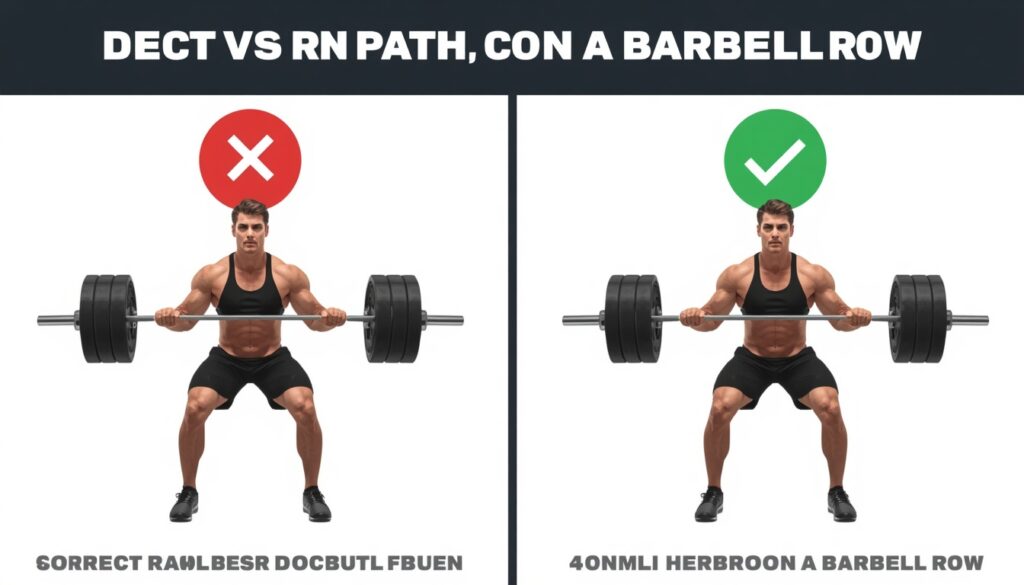
Barbell Row: Hinge at the hips with a flat back, pull the bar toward your lower ribcage, and avoid using momentum to swing the weight up.
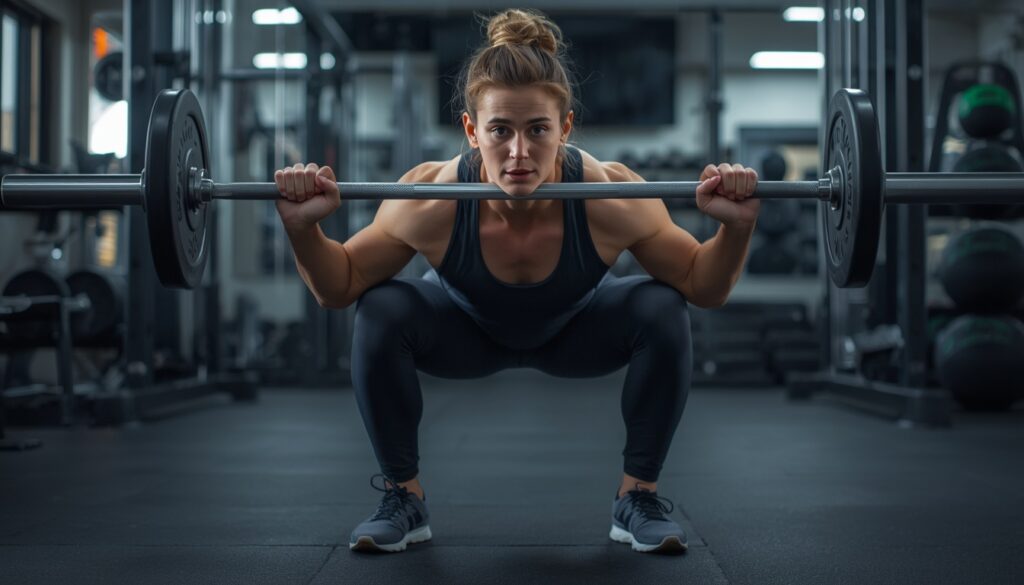
Squat: Brace your core, push your hips back and down, keep your knees tracking over your toes, and drive through your heels to stand back up.
Deadlift: Keep the bar close to your shins and body throughout the lift, maintain a neutral spine, and drive through your legs before your back finishes the movement.
Overhead Press: Keep your core tight to avoid arching your lower back, and press the bar in a straight path directly overhead.
Common Mistakes People Make on Push Pull Legs
Jumping straight to 6 days without the recovery capacity (sleep, nutrition, experience) to support it.
Copying someone else’s exact weights instead of progressing at their own pace.
Neglecting rear delts and hamstrings, which are easy to underwork on a pure push/pull/legs split if exercise selection isn’t balanced.
Skipping warm-up sets before heavy compound lifts like squats and deadlifts.
Not tracking weights and reps, making it hard to know if they’re actually progressing week to week.
Training to complete failure on every set, which increases injury risk and slows recovery unnecessarily.
Ignoring sleep and protein intake, which are essential for recovering from the higher volume PPL involves.
Doing too much accessory work and running out of energy for the main compound lifts.
Staying on the same weights for months instead of applying progressive overload.
Switching programs too often instead of giving PPL at least 8–12 weeks to show results.
Frequently Asked Questions
Is Push Pull Legs good for beginners? It can work for beginners, but most people get better results starting with a full body routine for the first few months before moving to PPL, since it allows more frequent practice of key lifts early on.
How many days a week should I do Push Pull Legs? Either 3 days (one full PPL cycle per week) or 6 days (two full cycles per week) — 3 days suits people newer to the split or with limited gym time, while 6 days suits more experienced lifters who can recover from higher frequency.
Can I build muscle on a 3-day Push Pull Legs split? Yes. A well-executed 3-day PPL routine provides sufficient volume for most people to build muscle, especially when combined with progressive overload and adequate protein intake.
Do I need a gym to do Push Pull Legs, or can I do it at home? A full gym with barbells, dumbbells, and cable machines makes PPL easier to execute as written, though a home setup with dumbbells and resistance bands can be adapted with modified exercises.
How long should each PPL session take? Most Push, Pull, or Leg sessions take 60–75 minutes including warm-up, depending on how many exercises and sets you include.
Should I do cardio on a Push Pull Legs program? Yes, light to moderate cardio can be added on rest days or after weight sessions without interfering with muscle growth, as long as it doesn’t compromise recovery for your next lifting day.
How long before I see results from Push Pull Legs? Most people notice strength improvements within 3–4 weeks, with visible muscle growth typically becoming noticeable after 8–12 weeks of consistent training and proper nutrition.
Is Push Pull Legs better than a full body routine? Neither is universally “better” — full body suits beginners and people with limited training days, while PPL suits those with more experience and more days available who want higher training volume per muscle group.
Can women do a Push Pull Legs split? Yes, PPL works equally well for men and women, since it’s based on movement patterns and training volume rather than gender-specific programming.
What should I eat to support a Push Pull Legs program? A diet with adequate protein (to support muscle repair), sufficient carbohydrates (to fuel training), and enough total calories to support your goal (muscle gain, maintenance, or fat loss) works best alongside this split.
Can I switch the order of Push, Pull, and Legs days? Yes, the order can be adjusted around your schedule as long as you’re not training the same muscle group on back-to-back days without adequate rest.
Do I need supplements to succeed on Push Pull Legs? No, supplements are optional. Whole food protein sources, consistent training, and proper rest matter far more than any supplement for progress on this program.
Conclusion
The Push Pull Legs split is one of the most effective, proven ways to build strength and muscle once you’ve moved past the beginner stage. By grouping exercises around how your muscles actually work together, it allows for higher training volume, better recovery, and a clear, repeatable structure you can stick to for months or even years.
Choose the 3-day or 6-day version based on your experience and schedule, focus on progressive overload, and give the program enough time to show results.
Looking for a gym or certified personal trainer to guide your Push Pull Legs program? Discover verified gyms and trainers across Pakistan on FitnessAdda.pk.
A good beginner full body workout trains all major muscle groups in one session — legs, back, chest, shoulders, arms, and core — using simple, safe exercises like squats, push-ups, rows, and planks. Done 3 times a week with a day of rest in between, it builds strength, improves form, and creates a foundation before moving to more advanced training.
Introduction
Walking into a gym for the first time can feel intimidating. Rows of machines, people who clearly know what they’re doing, and no idea where to even start — it’s one of the biggest reasons beginners quit before they see real results.
Here’s the good news: you don’t need a complicated split routine, fancy equipment, or hours in the gym to get stronger and build a solid foundation. A well-structured full body workout, done consistently, is one of the most effective ways for beginners to build muscle, lose fat, and develop the confidence and habit of training.
In this guide, you’ll learn:
Why full body workouts are ideal for beginners
The basics of sets, reps, rest, and progressive overload
A complete beginner-friendly full body workout plan
Proper form cues for each exercise
A warm-up and cool-down routine
Common mistakes beginners make
Answers to the most common beginner training questions
Why Full Body Workouts Are Ideal for Beginners
Many beginners jump straight into “bro splits” (chest day, back day, leg day) because that’s what they see online. But for someone new to training, full body workouts offer real advantages:
More frequent practice of key movements. Training squats, push-ups, and rows multiple times a week helps beginners learn proper form faster than doing them once a week.
Better time efficiency. Three sessions a week covering the entire body is easier to stick to than five or six days of split training.
Balanced development from day one. No muscle group gets neglected while you’re still learning the basics.
Faster strength gains early on. Beginners respond well to frequency — hitting a muscle group 3x a week accelerates the learning curve of lifting.
Flexibility for missed days. If you miss one full body session, you haven’t skipped an entire muscle group for the week, unlike with split routines.
The Real Benefits of a Full Body Workout for Beginners
Beyond “getting fit,” a full body workout delivers specific, measurable benefits that matter most in your first few months of training:
Faster skill acquisition. Practicing a squat or push-up three times a week instead of once means your nervous system learns the movement pattern much faster, which translates to safer, more effective training.
Improved metabolic rate. Full body strength training builds lean muscle, which increases your resting metabolism over time — useful whether your goal is fat loss, muscle gain, or general health.
Better joint stability and posture. Compound movements like squats and rows strengthen the muscles that support your knees, hips, shoulders, and spine, which is especially valuable for people coming from a sedentary desk job.
Higher workout adherence. Because sessions are only 3 days a week and cover everything, it’s easier to actually show up consistently compared to a 5–6 day split that quickly feels overwhelming for a beginner.
A foundation for every future goal. Whether you eventually want to build muscle, run faster, or simply feel stronger in daily life, the strength and movement quality built through full body training carries over to all of it.
Understanding the Basics: Sets, Reps, Rest, and Progressive Overload
Before jumping into the plan, it helps to understand a few core training concepts.
Reps (repetitions) are how many times you perform a single exercise in a row. Sets are groups of reps with rest in between. For example, “3 sets of 10 reps” means you do 10 repetitions, rest, then repeat that two more times.
Rest between sets for beginners is usually 60–90 seconds for most exercises, giving your muscles enough recovery to perform the next set with good form.
Progressive overload simply means gradually making workouts more challenging over time — more weight, more reps, or better form — so your body keeps adapting and getting stronger. Without this, progress stalls.
Form before weight. As a beginner, your priority should always be learning correct movement patterns before adding heavier weight. Lifting too heavy too soon is one of the most common causes of injury and stalled progress.
Rest days matter. Muscles grow and repair during rest, not during the workout itself. Beginners should have at least one rest day between full body sessions.
Key Training Terms at a Glance
Term
Meaning
Why It Matters
Rep
One complete movement of an exercise
Basic unit of training volume
Set
A group of reps done consecutively
Determines total workload
Rest
Time between sets
Allows recovery for the next set
Progressive overload
Gradually increasing difficulty
Drives long-term strength gains
Form
Correct movement technique
Prevents injury, improves results
The Complete Beginner Full Body Workout Plan
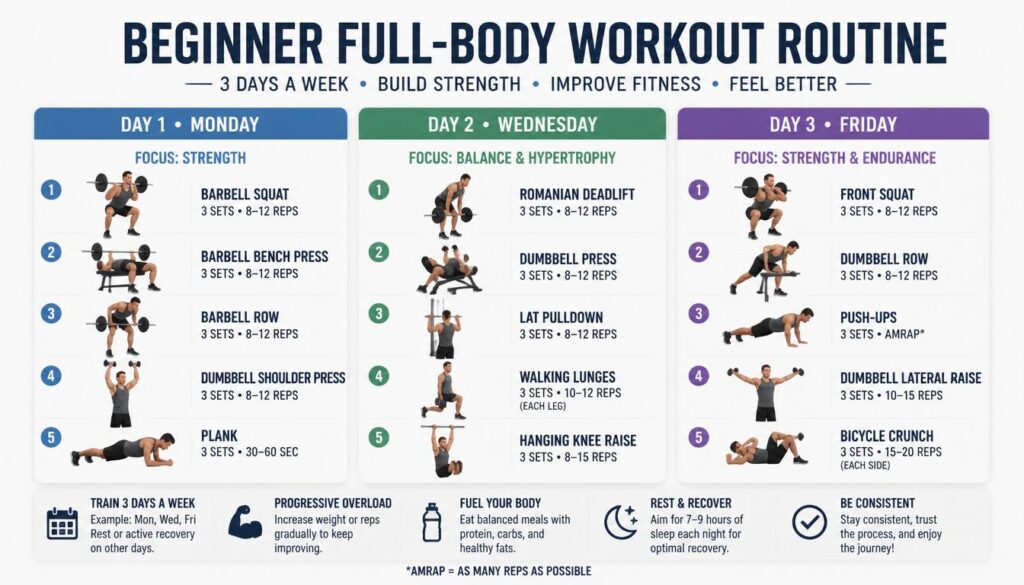
This plan is designed to be done 3 times a week (for example, Monday, Wednesday, Friday), with rest or light activity on the other days. Each session trains your whole body using simple, effective, beginner-friendly exercises.
Warm-Up (5–8 minutes, every session)
Light cardio: brisk walk, jog in place, or jumping jacks — 2–3 minutes
Arm circles and leg swings — 1 minute
Bodyweight squats — 10 reps
Bodyweight push-ups (or knee push-ups) — 5–8 reps
Main Workout
Exercise
Muscles Worked
Sets x Reps
Rest Between Sets
Bodyweight or Goblet Squat
Legs, glutes, core
3 x 10–12
60–90 sec
Push-Ups (or knee push-ups)
Chest, shoulders, triceps
3 x 8–12
60–90 sec
Dumbbell or Band Row
Back, biceps
3 x 10–12
60–90 sec
Standing Shoulder Press (light dumbbells)
Shoulders, triceps
3 x 10–12
60–90 sec
Glute Bridge
Glutes, hamstrings, core
3 x 12–15
60 sec
Plank
Core
3 x 20–30 sec hold
45–60 sec
Cool-Down (5 minutes, every session)
Slow walking to bring heart rate down — 1–2 minutes
Hamstring stretch — 30 seconds each leg
Quad stretch — 30 seconds each leg
Chest and shoulder stretch — 30 seconds each side
Deep breathing — 1 minute
Proper Form Cues for Each Exercise
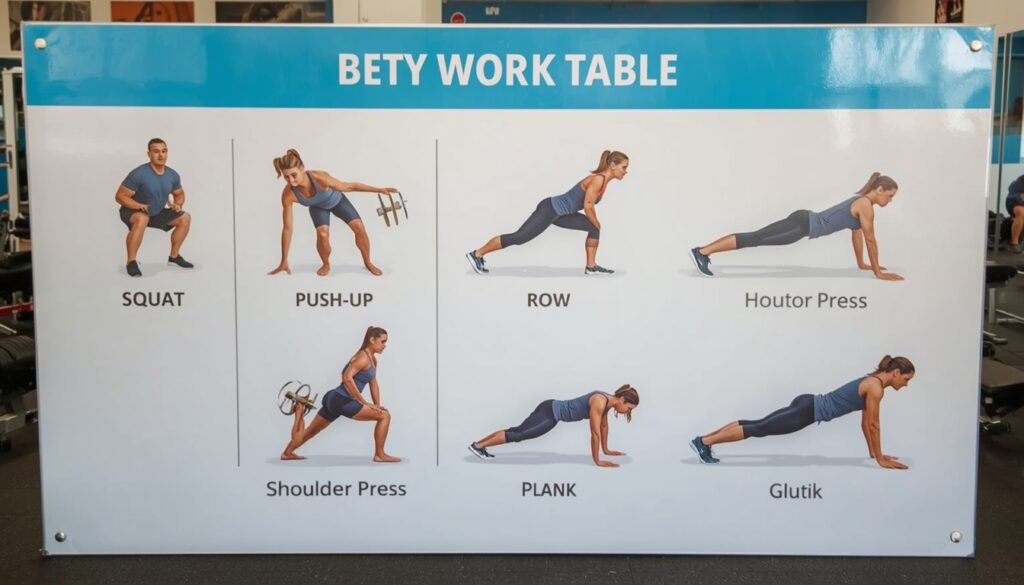
Squat: Feet shoulder-width apart, chest up, push your hips back like sitting into a chair, keep knees tracking over your toes, and go as low as comfortable while keeping your heels on the ground.
Push-Up: Hands slightly wider than shoulders, body in a straight line from head to heels (or knees, if doing a modified version), lower your chest toward the floor with control, and push back up.
Row: Hinge slightly at the hips, keep your back flat, and pull the weight or band toward your waist by squeezing your shoulder blades together.
Shoulder Press: Start with dumbbells at shoulder height, press straight overhead without arching your lower back, and lower with control.
Glute Bridge: Lie on your back, feet flat, knees bent, and lift your hips by squeezing your glutes until your body forms a straight line from shoulders to knees.
Plank: Forearms on the ground, body in a straight line, core tight, and avoid letting your hips sag or rise too high.
Sample Weekly Schedule
Day
Activity
Monday
Full Body Workout (as above)
Tuesday
Rest or light walk
Wednesday
Full Body Workout (as above)
Thursday
Rest or light walk
Friday
Full Body Workout (as above)
Saturday
Optional light activity (walk, stretching, sport)
Sunday
Rest
This structure gives your muscles 48 hours of recovery between sessions while still training frequently enough to build real strength and consistency.
Common Mistakes Beginners Make
Skipping the warm-up and going straight into heavy lifts, increasing injury risk.
Lifting too heavy too soon, sacrificing form for weight on the bar.
Not resting enough between sessions, leading to fatigue and poor recovery.
Copying advanced routines seen on social media instead of building a foundation first.
Holding their breath during lifts instead of breathing steadily throughout each rep.
Rushing through reps instead of controlling the movement, especially on the way down.
Ignoring core exercises, which support almost every other movement in the gym.
Comparing progress to others instead of tracking their own improvement over time.
Being inconsistent, training hard for a week then stopping for two.
Not eating enough protein to support muscle repair and recovery.
Frequently Asked Questions
How many days a week should beginners do a full body workout? Three days a week, with rest days in between, is ideal for most beginners to allow proper recovery while building consistency.
How long should a beginner full body workout take? Including warm-up and cool-down, most sessions take 45–60 minutes.
Can I do a full body workout at home without a gym? Yes. Bodyweight versions of squats, push-ups, glute bridges, and planks can be done at home with little to no equipment, and resistance bands can replace dumbbells for rows and presses.
Do I need weights to start a full body workout? No. Beginners can start with bodyweight exercises and gradually add light dumbbells, resistance bands, or household items as they get stronger.
How soon will I see results from a full body workout? Most beginners notice strength improvements within 2–4 weeks, with visible physical changes typically appearing after 6–8 weeks of consistent training combined with good nutrition.
Should beginners do cardio along with a full body workout? Yes, light cardio like walking is a great addition and supports overall fitness, but it shouldn’t replace strength training for beginners wanting to build muscle and strength.
Is it normal to feel sore after a beginner workout? Yes, mild muscle soreness (DOMS) in the first few weeks is normal as your body adapts. It should improve within a day or two and should not be sharp or joint-related pain.
Can I do a full body workout every day? It’s not recommended for beginners. Muscles need at least 48 hours to recover between full body sessions, so 3 sessions a week with rest days is more effective and safer.
What should I eat before and after a full body workout? A light meal with protein and carbs (like eggs and toast, or a banana with peanut butter) an hour or two before training works well, and a protein-rich meal afterward supports recovery.
Do I need a personal trainer to start a full body workout? Not necessarily, but a certified trainer can correct your form early on, which helps prevent bad habits and injuries — especially valuable in your first few weeks.
When should a beginner move on from full body training to a split routine? Most beginners benefit from 3–6 months of full body training before considering a split routine, once basic strength and form are well established.
Is it okay to feel tired during my first few full body workouts? Yes, this is completely normal as your body adjusts to a new routine. Focus on completing the sessions with good form rather than pushing to exhaustion in the early weeks.
How to Progress as a Beginner
The workout plan above is your starting point, not something to repeat identically forever. Here’s how to keep progressing safely:
Weeks 1–2: Focus entirely on learning correct form with light weight or bodyweight only. Don’t worry about how challenging the sets feel.
Weeks 3–4: Once form feels solid, start adding small amounts of weight or a few extra reps each week — this is progressive overload in action.
Weeks 5–8: You can increase to 3–4 sets per exercise, or slightly reduce rest time between sets as your conditioning improves.
After 3–6 months: Many beginners are ready to explore a split routine (like upper/lower or push/pull/legs) if they want more targeted volume per muscle group, though continuing full body training is also completely fine long-term.
Track your workouts — even a simple note on your phone with the weight and reps used each session — so you can see clear evidence of progress and know exactly when to push a little harder.
Nutrition Basics to Support Your Training
Training alone isn’t the full picture — what you eat directly affects your recovery and results:
Protein supports muscle repair after each session. Eggs, chicken, daal, and yogurt are accessible, affordable sources.
Carbohydrates refuel your muscles and energy levels — whole wheat roti, rice, and oats work well around training days.
Hydration matters more than most beginners realize; even mild dehydration can reduce strength and increase perceived fatigue during workouts.
Sleep is when most muscle recovery actually happens, so 7–8 hours a night supports your training far more than any supplement.
Conclusion
You don’t need years of gym experience or a complicated program to start building real strength. A simple, consistent full body workout — done three times a week with proper form and enough rest — is one of the most effective ways for beginners to get stronger, build confidence, and create a habit that lasts.
Start where you are, focus on form over weight, and let consistency do the rest.
Looking for a gym or certified personal trainer to guide you through your first few months of training? Discover verified gyms and trainers across Pakistan on FitnessAdda.pk.
The best Pakistani diet for weight loss combines a moderate calorie deficit with familiar foods: roti made from whole wheat, daal, grilled chicken or fish, yogurt, vegetables, and fruit — while cutting back on fried snacks, sugary tea, and excess oil. It works because it uses foods you already eat, just in smarter portions and preparations.
Introduction
Walk into almost any Pakistani home and you’ll find a table full of daal, sabzi, roti, and maybe a bit of chicken karahi on a good day. So why do so many people here still struggle to lose weight, even when they’re eating “home-cooked” food?
The truth is, home-cooked doesn’t automatically mean healthy. A lot of us grew up on parathas fried in generous ghee, sugary doodh-patti tea five times a day, and portions sized for a joint family feast rather than one plate. Add a desk job, long commutes in traffic instead of walks, and late-night biryani orders, and the weight creeps up quietly.
The good news? You don’t need to give up Pakistani food to lose weight. You don’t need imported quinoa, avocado toast, or a diet plan built for someone living in London or Toronto. You need a plan that works with your kitchen, your budget, and your lifestyle — not against it.
In this guide, you’ll learn:
Why most diets fail for Pakistani dieters specifically
The basics of weight loss explained simply
The best Pakistani foods for fat loss (with calories and protein)
Foods that are quietly sabotaging your progress
A full 7-day Pakistani meal plan
A weekly grocery list with realistic PKR prices
Practical tips and the most common mistakes to avoid
Answers to the questions Pakistanis ask most about dieting
Let’s get into it.
Why Most Diets Fail in Pakistan
Most weight loss advice online is written for a Western diet and lifestyle. It doesn’t account for how we actually eat. Here’s what typically derails weight loss for Pakistani dieters:
Too much oil. Many home kitchens still use generous amounts of oil or ghee for daily cooking — far more than needed for flavor.
Portions built for sharing. A “normal” plate of rice or a stack of two to three rotis is often double what an individual actually needs.
Sugary drinks everywhere. Cold drinks at every gathering, sugarcane juice in summer, and doodh-patti tea multiple times a day add up to hundreds of hidden calories.
White flour dominance. Maida-based naan, bakery biscuits, and bread are cheap, tasty, and low in fiber — meaning you get hungry again quickly.
Fried snacks as a daily habit. Samosas and pakoras aren’t just an occasional treat in many households; they’re a near-daily evening ritual.
Not enough protein. Meals are often carb-heavy (rice, roti, naan) with protein as an afterthought rather than the main event.
Sedentary routines. Rickshaws, cars, and desk jobs mean many people walk far less than their bodies are designed for.
None of this means Pakistani food is “bad.” It means the default preparation and portioning need small, sustainable adjustments — not a complete overhaul.
Understanding Weight Loss: The Basics
Before jumping into food lists, it helps to understand what actually causes weight loss. It isn’t magic, and it isn’t about any single “superfood.”
Calories are simply units of energy. Your body needs a certain number each day to function — this is called your maintenance level.
Calorie deficit means consistently eating somewhat fewer calories than your body burns. This is the single most important factor in weight loss. Everything else — food choice, timing, exercise — supports this deficit or makes it easier to sustain.
Protein helps preserve muscle while you lose fat, keeps you fuller for longer, and has a higher “thermic effect” (your body burns more calories digesting it) than carbs or fat.
Carbohydrates are your body’s preferred energy source. The type matters more than the total avoidance — whole grains and legumes digest slowly and keep blood sugar stable, while refined carbs (maida, sugar) spike it.
Healthy fats (from nuts, seeds, olive oil, fish) support hormone health and satiety, but are calorie-dense, so portion matters.
Fiber (from vegetables, fruits, whole grains, lentils) slows digestion, supports gut health, and helps control appetite.
Water often gets confused with hunger. Drinking enough water throughout the day, and especially before meals, can meaningfully reduce overeating.
Nutrient Roles at a Glance
Nutrient
Main Role
Best Pakistani Sources
Protein
Preserves muscle, controls hunger
Chicken, eggs, fish, daal, chana, yogurt
Complex Carbs
Steady energy, fiber
Brown rice, whole wheat roti, oats
Healthy Fats
Hormones, satiety
Olive oil, almonds, walnuts, fish
Fiber
Digestion, fullness
Vegetables, fruits, lentils, whole grains
Water
Hydration, appetite control
Plain water, lemon water, herbal tea
Best Pakistani Foods for Weight Loss
Here are the most effective, affordable, and widely available foods for fat loss in Pakistan, organized by category.
Proteins
Food
Calories (100g, cooked)
Protein
Benefits
Best Serving Size
Chicken breast (grilled/boiled)
~165 kcal
31g
Lean, versatile, cheap
100–150g per meal
Eggs
~78 kcal each
6g each
Affordable, complete protein
2–3 eggs
Fish (rohu/tilapia)
~120–150 kcal
20–24g
Omega-3s, easy to digest
100–150g
Daal (lentils)
~115 kcal
9g
Cheap, high fiber, plant protein
1 cup cooked
Lobia (beans)
~130 kcal
8g
Fiber + protein combo
1 cup cooked
Chana (chickpeas)
~164 kcal
9g
Filling, versatile
1 cup cooked
Plain yogurt (dahi)
~60 kcal
3.5g
Probiotics, calcium
1 cup
Carbohydrates
Food
Calories (100g cooked)
Notes
Brown rice
~110 kcal
More fiber than white rice, slower digestion
Whole wheat roti
~85 kcal (1 medium)
Better than naan/paratha for daily eating
Oats
~68 kcal (cooked)
Great breakfast base, very filling
Sweet potato
~86 kcal
Naturally sweet, nutrient-dense
Vegetables
Bhindi, karela, palak, tinda, lauki, gobi, and mixed salad (cucumber, tomato, onion) are all low-calorie, high-fiber, and inexpensive. Aim to fill half your plate with vegetables at lunch and dinner.
Fruits
Apples, guava, papaya, oranges, and berries in season are excellent choices — high fiber, naturally sweet, and satisfying. Mangoes and bananas are healthy too, just slightly higher in natural sugar, so keep portions moderate (half a mango, one banana) if you’re in an active weight loss phase.
Healthy Fats
Small amounts of olive oil, almonds, walnuts, and flaxseed support hormone health without wrecking your calorie budget. A handful (not a bowlful) is the right serving size.
Deep-fried, high in refined carbs and oil, easy to overeat
Jalebi / Mithai
Very high sugar and fat combination, minimal fullness
Soft drinks
Pure sugar calories with no nutrition or satiety
Bakery items (biscuits, cakes, rusk)
Refined flour and sugar, low fiber
Fried paratha
High oil content even in a “healthy” roti format
Sugary tea (multiple cups/day)
Hidden sugar calories add up fast across the day
Excess sugar (in general)
Spikes blood sugar, increases cravings, low satiety per calorie
This doesn’t mean total, permanent elimination — occasional treats are part of a sustainable lifestyle. The goal is making these “sometimes” foods instead of daily habits.
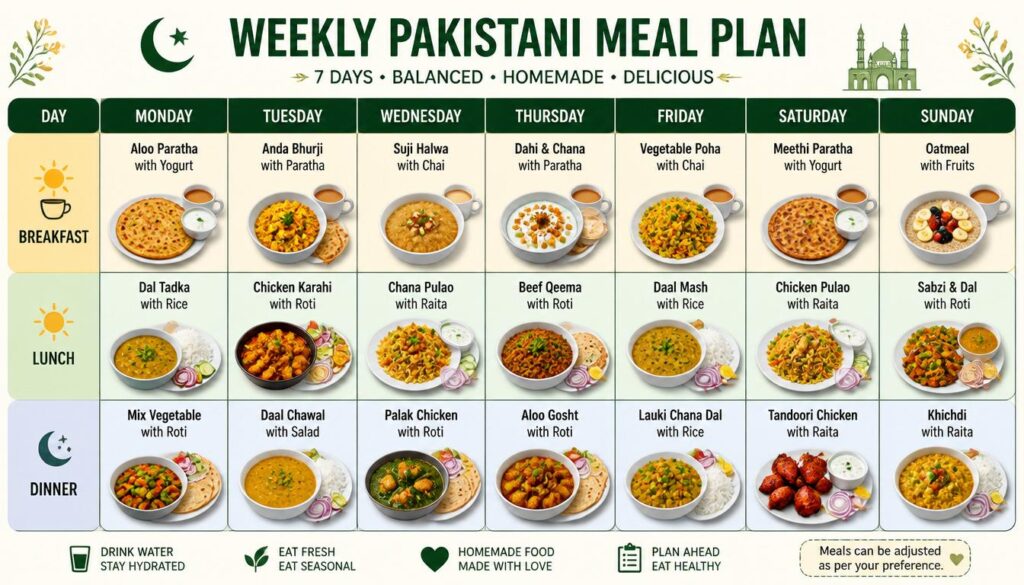
Sample 7-Day Pakistani Weight Loss Meal Plan
This plan is built around a moderate calorie deficit (roughly 1,400–1,600 kcal/day for most adults — adjust based on your size, activity level, and goals) using affordable, widely available foods.
Prices below are approximate averages and will vary by city, season, and market — always check local rates, as prices fluctuate.
Food
Weekly Quantity
Approx. Cost (PKR)
Benefits
Chicken (boneless/breast)
1 kg
700–900
Lean protein staple
Eggs
1 dozen
300–400
Cheap complete protein
Daal (mixed lentils)
1 kg
300–400
Fiber + plant protein
Chana / Lobia
1 kg combined
250–350
Filling, budget-friendly
Plain yogurt (dahi)
1 kg
150–200
Protein + probiotics
Whole wheat atta
5 kg
700–900
Roti staple
Seasonal vegetables
3–4 kg mixed
400–600
Fiber, micronutrients
Seasonal fruit
2–3 kg
300–500
Natural sugar with fiber
Oats
500g pack
250–350
Filling breakfast base
Cooking oil
Reduce to ~500ml/week
250–300
Use sparingly, prefer measured pouring
A full week of weight-loss-friendly groceries for one person typically runs somewhere around PKR 3,500–4,500, which is often comparable to or cheaper than regular grocery habits once fried snacks and soft drinks are removed.
Weight Loss Tips That Actually Work
Practice portion control rather than total elimination — smaller plates, one roti instead of three.
Drink water consistently, including a glass before meals to help manage appetite.
Walk daily. Even 30–40 minutes of brisk walking makes a real difference over weeks.
Add strength training. Building or preserving muscle keeps your metabolism higher as you lose fat.
Prioritize sleep. Poor sleep is strongly linked to increased hunger and cravings.
Aim for consistency over perfection. A sustainable 80%-on-track plan beats a “perfect” plan you quit after two weeks.
Common Mistakes Pakistanis Make While Dieting
Skipping meals to “save calories” — this often backfires into overeating later.
Cutting out roti entirely instead of just moderating portions.
Drinking sugary tea multiple times a day without counting it as a real calorie source.
Believing “desi ghee” in any amount is automatically healthy — it’s still calorie-dense.
Doing crash diets that aren’t sustainable beyond a week or two.
Ignoring protein and filling up mostly on rice or naan.
Underestimating oil used in cooking — a heavy hand with oil adds up fast.
Treating fruit as “unlimited” because it’s natural — portion still matters.
Not tracking progress, so it’s hard to know what’s actually working.
Expecting overnight results and giving up when the scale moves slowly.
Copying international diet plans that ignore local food availability and culture.
Frequently Asked Questions
Can I eat roti while losing weight? Yes. Whole wheat roti in moderate portions (1–2 per meal) fits well into a weight loss diet. The issue is usually quantity and pairing it with oily curries, not roti itself.
Is rice bad for weight loss? No, rice isn’t inherently bad — portion size matters most. Brown rice offers more fiber, but white rice in a controlled portion can still fit into a calorie deficit.
Can I eat mangoes while trying to lose weight? Yes, in moderation. Mangoes are nutritious but higher in natural sugar than some fruits, so half a mango rather than a whole one is a reasonable portion during an active weight loss phase.
Is desi ghee healthy? Desi ghee has some nutritional benefits, but it’s very calorie-dense. Small amounts occasionally are fine; using it as your everyday cooking fat in large quantities works against a calorie deficit.
Can I lose weight without a gym? Yes. Walking, home bodyweight exercises, and diet changes can produce meaningful weight loss without gym equipment, though strength training can speed up results and improve body composition.
How much weight can I realistically lose per week? A safe, sustainable rate is generally around 0.5–1 kg per week for most people, achieved through a moderate calorie deficit.
Do I need to completely stop eating fried food? No. Making fried snacks an occasional treat rather than a daily habit is a realistic, sustainable approach.
Is intermittent fasting good for Pakistani dieters? It can work for some people as a tool to manage total calorie intake, but it isn’t magic — the calorie deficit still matters most. It should fit your lifestyle and health situation.
Can I lose belly fat specifically? Spot reduction isn’t possible — fat loss happens across the whole body based on genetics and overall calorie deficit, with the abdomen often being one of the last areas to show visible change.
Is it necessary to hire a personal trainer? Not necessary, but a certified trainer can personalize your plan, correct your form, and keep you accountable — which often speeds up results.
How many rotis should I eat per day to lose weight? This depends on your total calorie needs, but many people find 2–4 rotis per day (spread across meals) works well within a moderate deficit, paired with adequate protein and vegetables.
Is milk tea okay in moderation? Yes, 1–2 cups a day with reduced sugar is generally fine. The concern is drinking it 5+ times daily with heaped sugar each time.
What is the best time to eat dinner for weight loss? There’s no single “magic” time — total daily calories matter more than timing. That said, avoiding very heavy meals right before sleep can help with digestion and sleep quality.
Can students and office workers follow this diet on a tight schedule? Yes. Many of the meals in this plan (boiled eggs, yogurt, daal, roti) are quick to prepare or can be batch-cooked in advance for busy weekdays.
Do I need supplements to lose weight? No supplement replaces a calorie deficit and good food choices. Some people use protein powder or multivitamins for convenience, but they’re optional, not essential.
How to Adjust This Plan for Your Own Body
Every “sample” meal plan is a starting template, not a rigid rulebook. Here’s how to make it work for you specifically:
If you’re a student or office worker with limited cooking time, batch-cook daal, boiled eggs, and grilled chicken on weekends so weekday meals take minutes, not hours.
If you’re a housewife cooking for the whole family, cook one base curry with less oil for everyone, then simply portion your own plate smaller and add extra salad or vegetables to fill up.
If you’re a gym beginner, keep the protein targets in this plan but don’t stress about hitting an exact number — consistency matters more than precision in the first few months.
If you’re on a tighter budget, lean more heavily on eggs, daal, chana, and seasonal vegetables, which offer some of the best protein and fiber per rupee spent.
If weight loss has stalled, reassess portion sizes first (it’s usually oil or rice/roti quantity creeping up) before assuming you need a completely different plan.
Everybody’s calorie needs differ based on age, height, current weight, gender, and activity level. The meal plan above is a reasonable starting point for many adults, but if you want a plan calculated specifically for your body and goals, working with a certified nutritionist or trainer — easy to find through FitnessAdda.pk — can save you months of guesswork.
Conclusion
Losing weight in Pakistan doesn’t mean giving up daal-chawal, roti, or your Sunday chicken karahi. It means understanding portions, prioritizing protein, cutting back on fried snacks and sugary drinks, and staying consistent over time. Small, sustainable changes — not extreme diets — are what actually work long term.
Start with one change this week: maybe it’s swapping one paratha for a whole wheat roti, or walking 30 minutes daily. Build from there.
Looking for a gym or certified personal trainer to support your weight loss journey? Discover verified gyms and trainers across Pakistan on FitnessAdda.pk.
Walking into a gym for the first time can feel exciting—but it can also be overwhelming.
You see rows of machines you’ve never used, people lifting heavy weights with confidence, trainers giving instructions, and members who seem to know exactly what they’re doing. It’s natural to wonder if you belong there or whether you’ll make mistakes.
Here’s the good news: every experienced gym-goer was once a beginner too.
No one starts their fitness journey knowing every exercise, machine, or workout routine. The difference between those who succeed and those who quit isn’t talent—it’s consistency, patience, and a willingness to learn.
This Complete Beginner Gym Guide is designed to remove the confusion and help you build confidence before you even step inside a gym. Whether your goal is to lose weight, build muscle, improve your health, or simply become more active, this guide will walk you through everything you need to know.
By the end of this article, you’ll understand:
How to choose the right gym
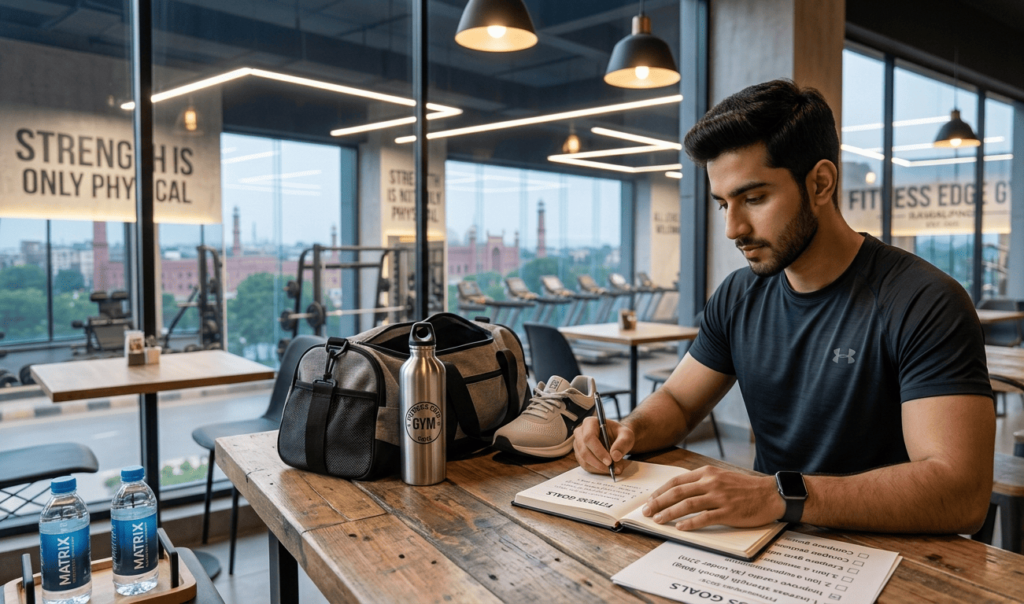
What to bring on your first day
How to set realistic fitness goals
Basic gym etiquette
Essential equipment you’ll use
Beginner-friendly workout strategies
Common mistakes to avoid
Most importantly, you’ll realize that you don’t need to be fit before joining a gym—you join a gym to become fitter.
Remember: Progress isn’t about being perfect. It’s about showing up, learning, and improving one workout at a time.
Why Starting the Gym Can Feel Intimidating
If you’re nervous about joining a gym, you’re not alone.
Many beginners delay their fitness journey because they feel unsure about what to expect. These worries are completely normal and are experienced by people of all ages and fitness levels.
Let’s address some of the most common concerns.
“Everyone Will Judge Me”
This is one of the biggest fears beginners have.
In reality, most people at the gym are focused on their own workouts. They’re thinking about their next set, their progress, or getting through a challenging session—not watching someone else.
Experienced gym members often respect beginners because they know how difficult it is to take that first step.
“I Don’t Know How to Use the Machines”
Modern gyms can have dozens of different machines, and it’s impossible to know how each one works on your first visit.
Many exercises can be performed using simple equipment like dumbbells or resistance machines.
Start with the basics. You don’t need to master every machine on day one.
“I’m Not Fit Enough Yet”
Many people believe they should get fit before joining a gym.
This is a myth.
The gym is where you build fitness—not where you’re expected to already have it.
Whether you’re overweight, underweight, or haven’t exercised in years, every workout is a step toward becoming healthier.
“What If I Do Something Wrong?”
Making mistakes is part of learning.
Everyone has used a machine incorrectly, forgotten an exercise, or needed guidance at some point.
What’s important is being open to learning and asking for help when needed.
Why Joining a Gym Is One of the Best Decisions You Can Make
A gym isn’t just a place to lift weights.
It’s an environment designed to help you improve both your physical and mental well-being.
Here are some of the biggest benefits of regular gym training.
Better Physical Health
Regular exercise can help you:
Improve cardiovascular fitness
Increase strength
Enhance flexibility
Build endurance
Improve posture
Maintain healthy body weight
Even a few workouts each week can make a noticeable difference over time.
Increased Confidence
As you become stronger and healthier, you’ll likely notice improvements beyond your physical appearance.
Many beginners report feeling:
More energetic
More confident
More productive
Better able to handle daily tasks
Fitness is about feeling better, not just looking different.
Improved Mental Well-Being
Exercise has been shown to support mental health by reducing stress and improving mood.
Regular physical activity can also:
Boost energy levels
Improve sleep quality
Enhance focus
Promote overall well-being
If you’re feeling overwhelmed by work or studies, a consistent workout routine can become a valuable part of your self-care.
Building Healthy Habits
One of the greatest benefits of joining a gym is developing discipline.
When you commit to regular workouts, you’re also building habits that can positively influence other areas of your life, such as nutrition, sleep, and time management.
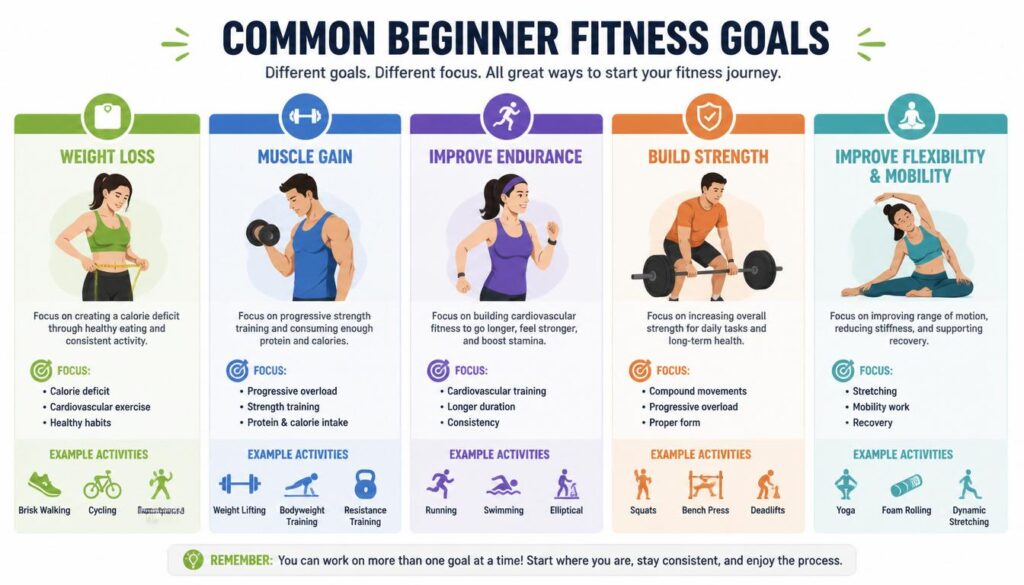
Set Clear Fitness Goals Before You Begin
Walking into the gym without a plan is like starting a road trip without a destination.
Before your first workout, ask yourself:
“What do I want to achieve?”
Your answer will help you choose the right exercises, workout routine, and even the right gym.
Goal 1: Lose Weight
If your primary goal is weight loss, focus on:
Strength training
Cardio exercises
Healthy eating habits
Staying consistent
Remember, strength training helps preserve muscle while losing body fat.
Goal 2: Build Muscle
If you want to gain muscle, prioritize:
Progressive strength training
Adequate protein intake
Quality sleep
Proper recovery
Building muscle takes time, so be patient and focus on gradual progress.
Goal 3: Improve Overall Fitness
Not everyone trains for a specific body transformation.
You may simply want to:
Feel healthier
Increase energy
Improve stamina
Reduce stress
Stay active
A balanced workout routine that includes strength, cardio, and flexibility exercises is ideal for general fitness.
Goal 4: Increase Strength
If your focus is becoming stronger, your workouts should emphasize compound exercises such as:
Squats
Deadlifts
Bench Press
Overhead Press
Rows
Learning proper technique should always come before lifting heavier weights.
Fitness Goals Comparison
Goal
Primary Focus
Recommended Training
Weight Loss
Fat reduction
Strength + Cardio
Muscle Gain
Build muscle
Progressive resistance training
General Fitness
Health
Balanced workouts
Strength
Increase power
Compound lifts
Choosing the Right Gym
Not every gym is the right fit for every beginner.
Before purchasing a membership, consider:
Distance from home or work
Membership cost
Equipment quality
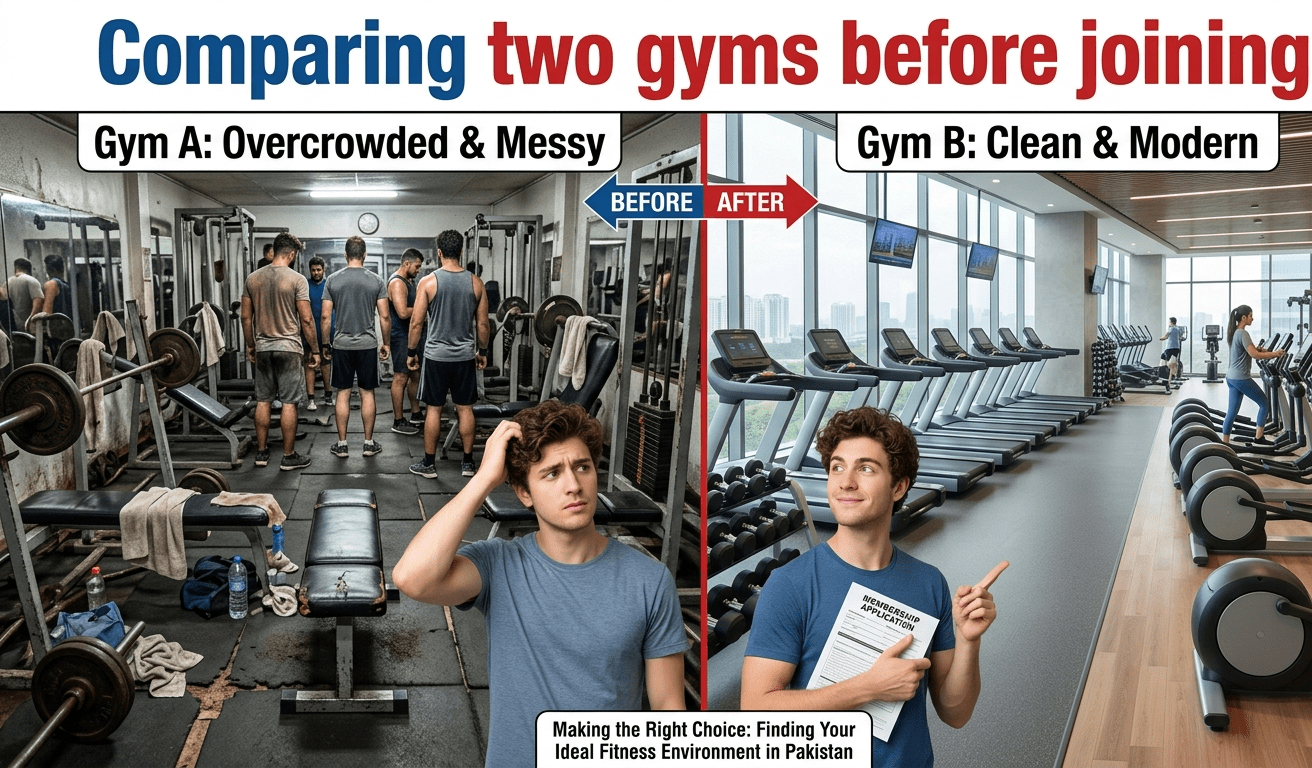
Cleanliness
Trainer availability
Operating hours
Overall atmosphere
A gym that fits your lifestyle is one you’re far more likely to visit consistently.
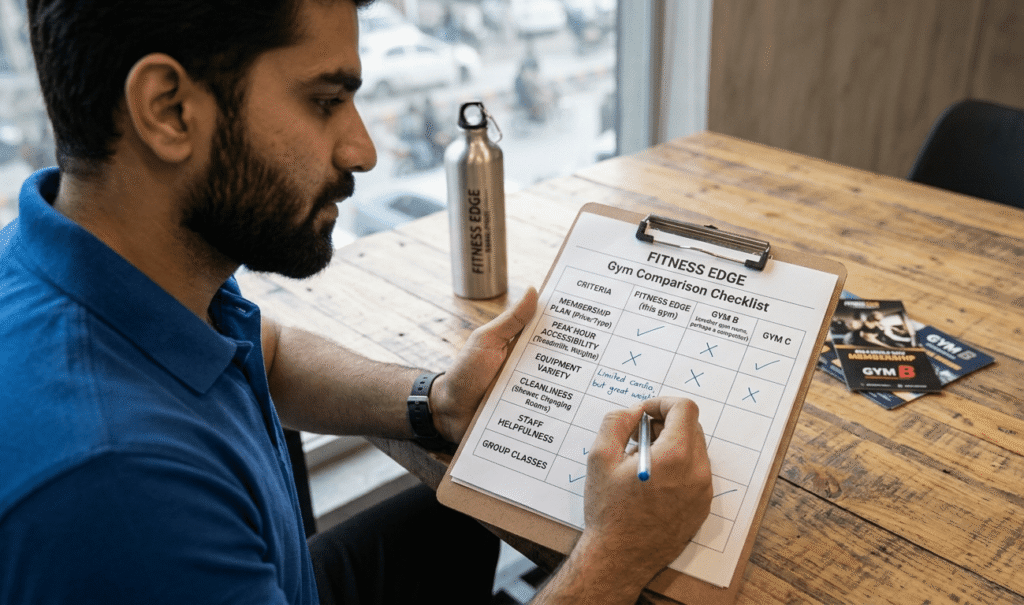
Related Guide:How to Choose the Right Gym for Your Fitness Goals
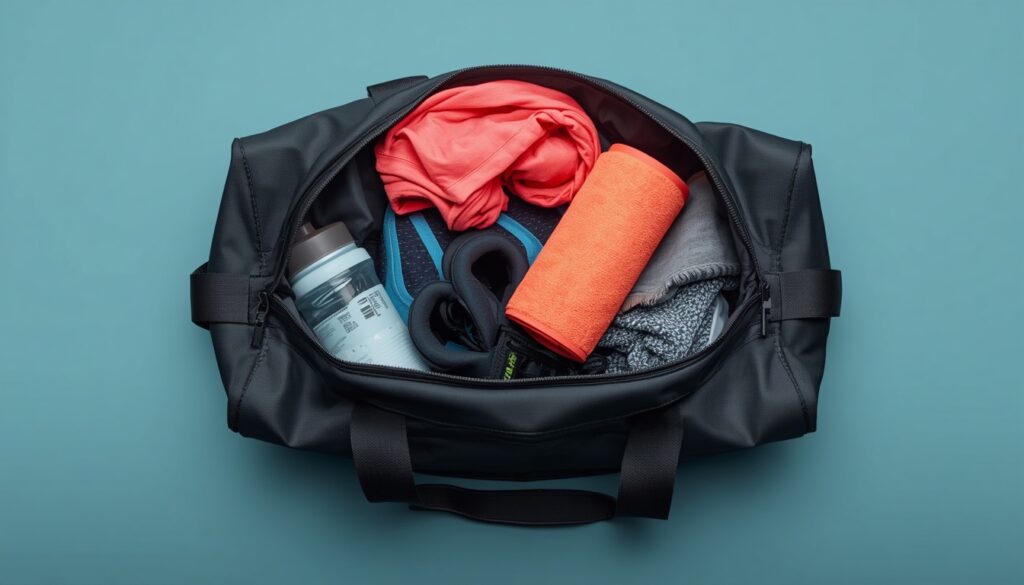
What to Bring on Your First Day at the Gym
Packing the right essentials will help you feel more prepared and comfortable.
Item
Why You Need It
Water Bottle
Stay hydrated
Workout Clothes
Comfort and flexibility
Athletic Shoes
Proper support and safety
Small Towel
Hygiene
Gym Gloves (Optional)
Better grip and hand protection
Lock
Secure locker storage
Headphones
Personal motivation
Notebook or Fitness App
Track workouts
Don’t worry about buying expensive accessories before you start. Comfortable clothing, supportive shoes, and a water bottle are enough for most beginners.
Beginner Tip 💡
Focus on learning, not impressing. Your first few weeks at the gym should be about building confidence, mastering proper technique, and creating a consistent routine—not lifting the heaviest weights.
Quick Self-Assessment Checklist
Before your first workout, ask yourself:
✅ What is my primary fitness goal?
✅ Have I chosen a gym that fits my lifestyle?
✅ Do I have comfortable workout clothes and shoes?
✅ Am I prepared to train consistently for at least 8–12 weeks?
✅ Do I understand that progress takes time?
✅ Am I willing to learn proper exercise technique before increasing weight?
Answering “yes” to these questions will help you start your fitness journey with the right mindset.
Your First Workout, Gym Equipment & Nutrition Basics
You’ve chosen a gym, packed your essentials, and set your fitness goals. Congratulations—you’ve already completed the hardest part: getting started.
Now comes the next challenge: understanding how the gym works.
Many beginners feel overwhelmed by unfamiliar equipment, confusing workout routines, and experienced lifters who seem to know exactly what they’re doing. The good news is that you don’t need to learn everything on your first day. Focus on mastering the basics, and your confidence will grow with every workout.
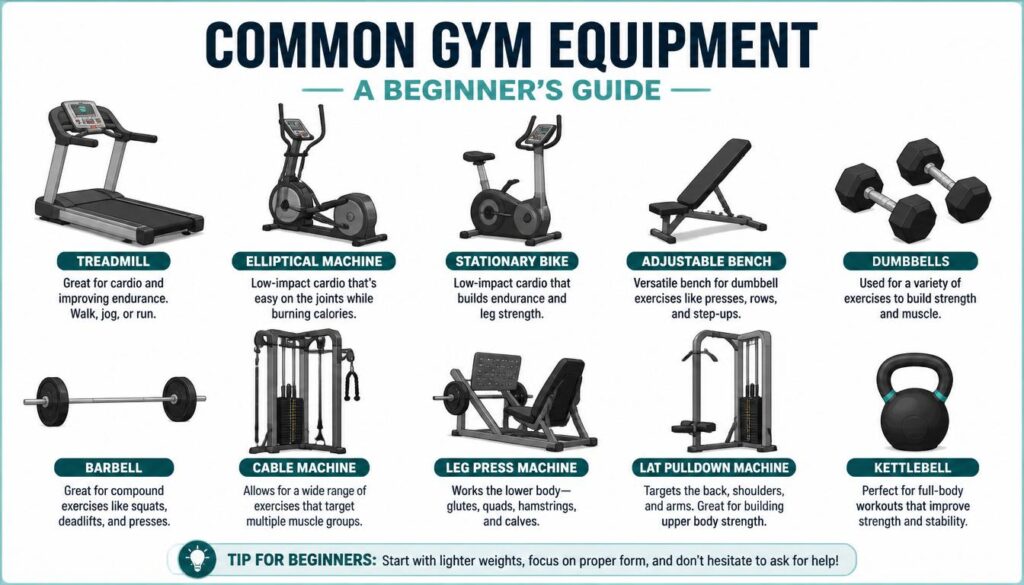
Understanding Basic Gym Equipment
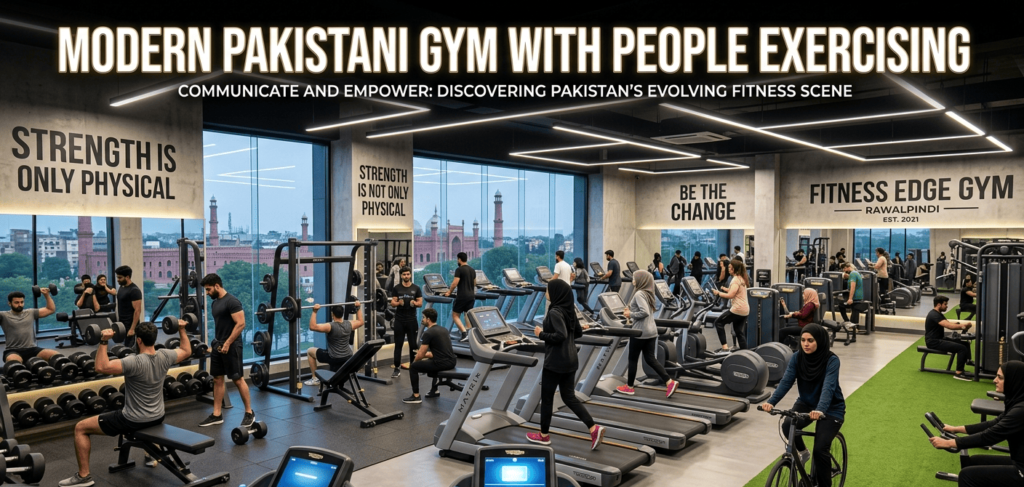
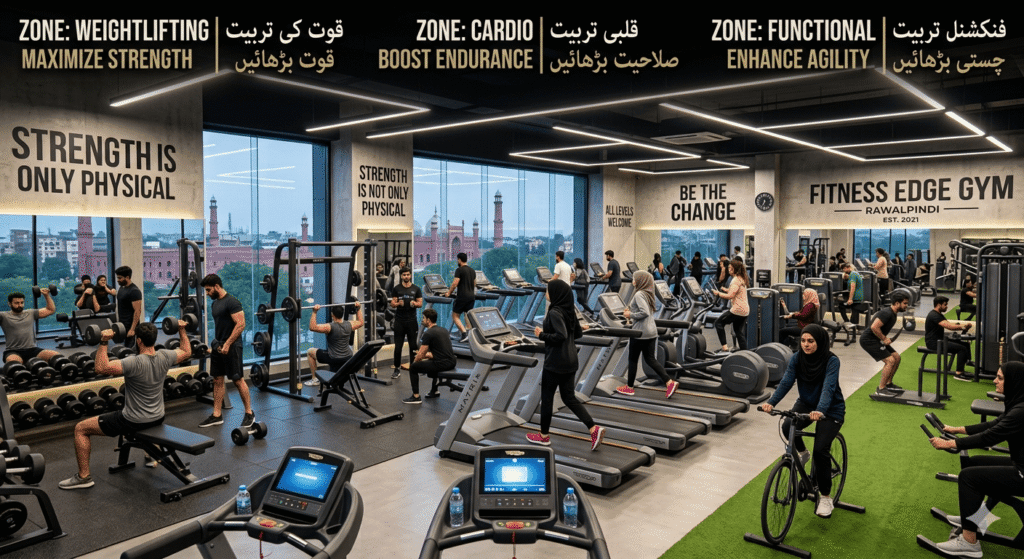
Most gyms have several training areas, each designed for a different purpose. Knowing what each area is used for will help you train more confidently.
1. Cardio Machines
Cardio equipment improves heart health, burns calories, and increases endurance.
Common Cardio Machines
Treadmill
Stationary Bike
Elliptical Trainer
Rowing Machine
Stair Climber
Best For
Weight loss
Warm-ups
Improving cardiovascular fitness
Active recovery
Beginner Tip: Start with 5–10 minutes of light cardio before your workout to increase blood flow and prepare your muscles.
2. Free Weights
Free weights allow your body to move naturally while engaging multiple muscle groups.
Examples include:
Dumbbells
Barbells
Weight Plates
Kettlebells
Benefits
Builds strength
Improves coordination
Activates stabilizing muscles
Allows progressive overload
Free weights are highly effective, but beginners should focus on learning proper form before increasing weight.
3. Resistance Machines
Resistance machines guide your movement, making them an excellent choice for beginners.
Popular machines include:
Leg Press
Chest Press
Lat Pulldown
Seated Row
Shoulder Press
Leg Extension
Leg Curl
Why Beginners Like Machines
Easier to learn
Reduced injury risk
Better muscle isolation
Controlled movement
4. Cable Machines
Cable machines provide constant resistance throughout an exercise.
Common cable exercises:
Triceps Pushdowns
Cable Rows
Face Pulls
Cable Chest Fly
Bicep Curls
These machines are versatile and suitable for both beginners and advanced gym-goers.
5. Functional Training Area
Many modern gyms include an open space equipped with:
Battle Ropes
Resistance Bands
Medicine Balls
TRX Suspension Trainers
Plyometric Boxes
This area is ideal for improving balance, coordination, athletic performance, and overall fitness.
Quick Equipment Guide
Equipment
Best For
Beginner Friendly
Treadmill
Cardio
✅
Stationary Bike
Cardio
✅
Dumbbells
Strength
✅ (Light weights)
Barbell
Strength
⚠️ Learn proper technique first
Resistance Machines
Strength
✅
Cable Machine
Strength
✅
Kettlebells
Functional Fitness
⚠️ Learn correct form
Battle Ropes
Conditioning
✅
Basic Gym Etiquette Everyone Should Know
Good gym etiquette creates a respectful environment for everyone.
Following these simple rules shows consideration for fellow members and helps keep the gym clean and safe.
Wipe Equipment After Use
Use the cleaning supplies provided to wipe down benches, machines, and cardio equipment after your workout.
Re-Rack Your Weights
Always return dumbbells, barbells, and weight plates to their proper place.
Leaving weights on the floor creates safety hazards for other members.
Share Equipment
During busy hours, avoid occupying multiple machines at once.
If someone asks to “work in” between your sets, be polite if it’s practical to do so.
Respect Personal Space
Avoid standing too close to someone while they’re exercising.
Everyone deserves enough room to train safely.
Keep Phone Use Minimal
Using your phone to track workouts or change music is fine.
However, avoid sitting on equipment while scrolling through social media.
Wear Appropriate Clothing
Choose comfortable workout clothes and supportive athletic shoes.
Avoid clothing that restricts movement or creates safety risks.
Pro Tip: Good gym etiquette is just as important as good workout technique. Respectful members contribute to a positive gym culture that benefits everyone.
A Beginner-Friendly 3-Day Workout Plan
If you’re new to strength training, a simple full-body routine is one of the best ways to build confidence and learn proper movement patterns.
Aim to train on non-consecutive days (for example, Monday, Wednesday, and Friday) to give your muscles time to recover.
Day 1 – Full Body
Exercise
Sets
Reps
Bodyweight Squats
3
10–12
Chest Press Machine
3
10–12
Lat Pulldown
3
10–12
Seated Shoulder Press
2
12
Plank
3
20–30 seconds
Brisk Walk
10–15 minutes
—
Day 2 – Full Body
Exercise
Sets
Reps
Leg Press
3
10–12
Dumbbell Bench Press
3
10–12
Seated Cable Row
3
10–12
Dumbbell Bicep Curl
2
12
Triceps Pushdown
2
12
Stationary Bike
10–15 minutes
—
Day 3 – Full Body
Exercise
Sets
Reps
Goblet Squat
3
10
Dumbbell Romanian Deadlift
3
10
Incline Chest Press Machine
3
10
Assisted Pull-Up Machine or Lat Pulldown
3
10
Standing Dumbbell Shoulder Press
2
12
Walking
15–20 minutes
—
Important Notes
Rest 60–90 seconds between sets.
Use a weight that feels challenging but still allows good technique.
Stop each set with 1–2 repetitions left in reserve instead of training to complete failure.
Increase weight only when you can complete all prescribed repetitions comfortably with proper form.
Always Warm Up Before Training
Skipping your warm-up is one of the most common beginner mistakes.
A proper warm-up prepares your muscles, joints, and nervous system for exercise while reducing the risk of injury.
5–10 Minute Warm-Up Routine
Brisk walking
Light cycling
Arm circles
Leg swings
Bodyweight squats
Hip circles
Shoulder rolls
The goal isn’t to get tired—it’s to prepare your body for movement.
Don’t Forget to Cool Down
After finishing your workout:
Walk for 3–5 minutes
Perform gentle stretching
Focus on slow, deep breathing
Drink water
Cooling down helps your heart rate return to normal and promotes flexibility.
Beginner Nutrition Basics
Your workouts are only part of the equation.
Nutrition plays a major role in helping you recover, build muscle, lose fat, and improve overall performance.
Protein
Protein supports muscle repair and growth.
Examples include:
Chicken
Fish
Eggs
Greek yogurt
Lentils
Beans
Cottage cheese
Carbohydrates
Carbohydrates provide energy for your workouts.
Healthy sources include:
Rice
Oats
Whole wheat bread
Potatoes
Fruits
Healthy Fats
Healthy fats support hormone production and overall health.
Choose foods such as:
Nuts
Seeds
Avocados
Olive oil
Hydration
Drink water throughout the day, not just during your workout.
Staying hydrated supports exercise performance and recovery.
Simple Pre-Workout Meal Ideas
Time Before Workout
Example Meal
2–3 hours
Grilled chicken, rice, vegetables
1 hour
Banana with peanut butter
30–45 minutes
Fruit or yogurt (light snack if needed)
Simple Post-Workout Meal Ideas
Goal
Meal Example
Muscle Gain
Chicken, rice, vegetables
Weight Loss
Grilled fish with salad
General Fitness
Eggs with whole-grain toast and fruit
Expert Advice: Don’t overcomplicate nutrition in your first few weeks. Focus on eating balanced meals consistently, staying hydrated, and getting enough protein rather than chasing perfect diets.
Common Beginner Mistakes to Avoid
Many beginners slow their progress by making avoidable mistakes.
Watch out for these common pitfalls:
❌ Skipping warm-ups
❌ Using weights that are too heavy
❌ Comparing yourself to experienced lifters
❌ Ignoring proper technique
❌ Following random workouts from social media
❌ Not eating enough protein
❌ Expecting immediate results
❌ Training every day without adequate rest
Avoiding these mistakes will help you stay healthy, motivated, and consistent.
Staying Consistent, Recovery, FAQs & Final Thoughts
Starting the gym is an achievement—but staying consistent is what transforms your body and improves your health.
Many beginners feel highly motivated during the first few weeks. They buy new workout clothes, watch fitness videos, and rarely miss a session. However, as the excitement fades, life gets busy, workouts become challenging, and motivation naturally fluctuates.
The secret to long-term success isn’t staying motivated every day—it’s building habits that keep you going even when motivation is low.
How to Stay Motivated at the Gym
Motivation is helpful, but it’s not enough on its own. Successful gym-goers rely on routines and realistic expectations rather than waiting to “feel motivated.”
Set Small, Achievable Goals
Instead of saying:
❌ “I want to lose 20 kg.”
Break it into manageable milestones:
Lose the first 2 kg
Complete 12 gym sessions this month
Increase your squat by 5 kg
Drink enough water every day
Small wins build confidence and momentum.
Track Your Progress
Progress isn’t always visible in the mirror.
Keep track of:
Body weight
Waist measurements
Strength improvements
Workout consistency
Energy levels
Progress photos (every 4 weeks)
You’ll often notice improvements in strength and endurance before seeing major physical changes.
Follow a Routine
Decide exactly when you’ll train.
Examples:
Monday, Wednesday, Friday at 6 PM
Tuesday, Thursday, Saturday at 7 AM
Treat your workouts like important appointments.
Find a Workout Partner
Training with a friend can:
Increase accountability
Make workouts more enjoyable
Improve consistency
Provide encouragement during difficult sessions
Choose someone who motivates you rather than distracts you.
Celebrate Progress
Reward consistency instead of perfection.
Examples:
New workout clothes
Better training shoes
Healthy meal at your favorite restaurant
Fitness accessories
Avoid using junk food as a reward for exercising.
When Should Beginners Increase Weight?
One of the biggest mistakes beginners make is trying to lift heavier every workout.
Progressive overload is important—but so is patience.
Increase the Weight When:
You complete every set with proper technique.
The last few repetitions no longer feel challenging.
You maintain full control throughout the movement.
Your trainer agrees your technique is solid.
For most exercises, increasing the weight by 2.5–5 kg (or the smallest available increment) is a sensible approach.
Never sacrifice form just to lift heavier.
Expert Tip: Good technique today prevents injuries tomorrow.
Recovery Is Just as Important as Training
Muscles don’t grow during your workout—they recover and adapt afterward.
Ignoring recovery can slow your progress and increase your risk of injury.
Prioritize Sleep
Aim for 7–9 hours of quality sleep each night.
Good sleep supports:
Muscle recovery
Hormone balance
Energy levels
Mental focus
Athletic performance
Take Rest Days
Rest days allow your muscles and joints to recover.
Light activities such as walking, stretching, or yoga can help you stay active without overloading your body.
Remember: rest is part of the training process, not a sign of laziness.
Manage Muscle Soreness
Feeling sore after your first few workouts is normal. This is often called Delayed Onset Muscle Soreness (DOMS).
To ease soreness:
Stay hydrated
Walk or do light movement
Stretch gently
Eat enough protein
Get adequate sleep
If you experience sharp or severe pain, stop exercising and consult a qualified healthcare professional.
Should Beginners Take Supplements?
Supplements are often one of the first things beginners ask about.
The truth is that supplements should never replace a balanced diet.
Most beginners can make excellent progress by focusing on whole foods, regular exercise, and proper recovery.
Protein Powder
Protein powder is simply a convenient way to increase your protein intake if you struggle to meet your daily needs through food.
It is not required for building muscle.
Creatine Monohydrate
Creatine is one of the most researched sports supplements available and has been shown to support improvements in strength and high-intensity exercise performance when used appropriately.
If you’re considering creatine or any supplement, it’s a good idea to speak with a qualified healthcare professional or registered dietitian—especially if you have any medical conditions.
Multivitamins
A multivitamin may help fill nutritional gaps, but it should not be viewed as a substitute for a varied, nutrient-rich diet.
Important: Supplements are optional. Consistent training, balanced nutrition, and quality sleep will have a much greater impact on your results.
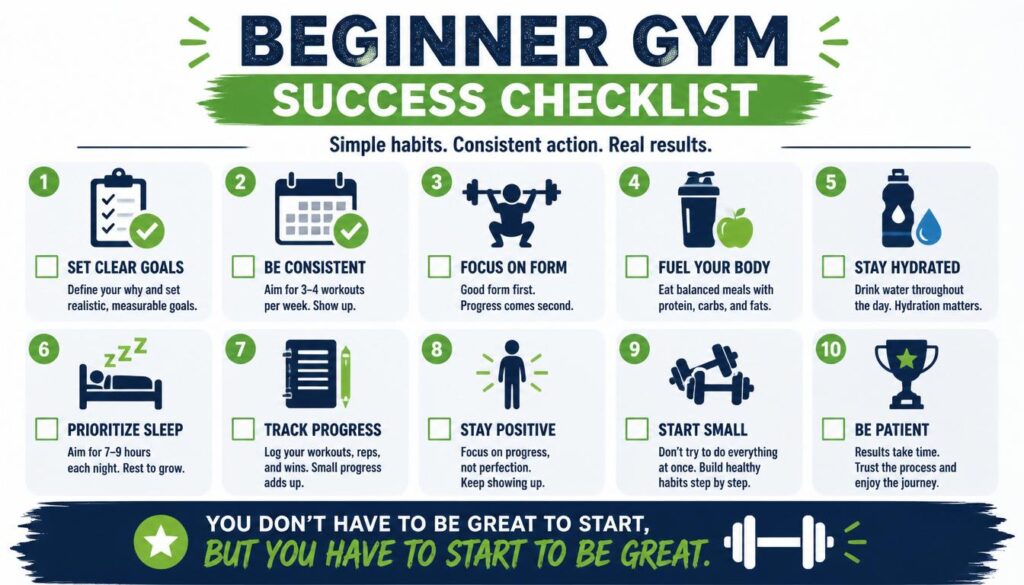
Your Complete Beginner Gym Checklist
Before you begin your fitness journey, make sure you’ve covered these essentials.
Mindset
✅ Set realistic goals
✅ Be patient with your progress
✅ Focus on consistency
Gym Preparation
✅ Choose the right gym
✅ Pack your gym essentials
✅ Learn basic equipment
Training
✅ Warm up before every workout
✅ Prioritize proper form
✅ Follow a structured workout plan
✅ Increase weight gradually
Nutrition
✅ Eat enough protein
✅ Stay hydrated
✅ Include balanced meals
Recovery
✅ Sleep 7–9 hours
✅ Take rest days
✅ Stretch after workouts
If you consistently follow this checklist, you’ll build a strong foundation for long-term success.
Frequently Asked Questions (FAQs)
1. What should I do on my first day at the gym?
Start with a simple full-body workout using light weights or machines. Focus on learning proper technique rather than lifting heavy. If available, ask a trainer to show you how to use the equipment safely.
2. How many days a week should a beginner go to the gym?
For most beginners, 3–4 workouts per week is enough to build consistency while allowing adequate recovery between sessions.
3. Should beginners do cardio or weight training?
Both are valuable. Strength training helps build muscle and maintain bone health, while cardio supports heart health and endurance. A balanced routine that includes both is ideal for most beginners.
4. How long should a beginner workout last?
A workout of 45–60 minutes is generally sufficient. Focus on quality rather than spending hours in the gym.
5. Can I build muscle without supplements?
Yes. Many people build muscle successfully through progressive strength training, balanced nutrition, sufficient protein, and proper recovery.
6. What should I eat before going to the gym?
A balanced meal containing carbohydrates and protein 1–3 hours before your workout can provide energy. If you’re short on time, a light snack such as fruit and yogurt may be suitable.
7. What should I eat after a workout?
Aim for a meal that includes protein to support muscle recovery and carbohydrates to replenish energy stores.
8. Is muscle soreness normal?
Mild muscle soreness after starting a new workout routine is common. However, severe pain, swelling, or pain that worsens should be evaluated by a healthcare professional.
9. How long does it take to see results?
Everyone progresses at a different pace. With consistent training, balanced nutrition, and good recovery, many beginners notice improvements in energy, strength, and fitness within several weeks, while visible physical changes often take longer.
10. Do I need a personal trainer?
A trainer isn’t essential for everyone, but beginners often benefit from professional guidance to learn proper technique, build confidence, and create a structured workout plan.
11. What should I wear to the gym?
Wear comfortable, breathable athletic clothing and supportive training shoes that allow you to move safely and comfortably.
12. Is it okay to feel nervous at the gym?
Absolutely. Almost everyone feels nervous when starting. As you become familiar with the environment and your routine, your confidence will naturally grow.
13. Should I work out if I’m very sore?
Light soreness is usually manageable, but if you’re experiencing significant soreness, consider a rest day or light activity. Avoid training through severe pain.
14. Can I lose weight and build muscle at the same time?
For many beginners, especially those new to resistance training, it’s possible to improve body composition by building some muscle while losing fat. Consistent training, a balanced diet, and sufficient protein are key.
15. What’s the biggest mistake beginners make?
Trying to do too much too soon. Start with manageable workouts, focus on proper technique, and increase the intensity gradually.
Starting a journey toward a healthier version of yourself can feel overwhelming, especially when balancing traditional Pakistani culinary habits with modern wellness goals. You are not alone in this struggle. Many of us find it difficult to reconcile our love for rich, flavorful meals with the need for sustainable health changes.
This Complete Weight Loss Guide is designed to bridge that gap. By focusing on practical weight loss tips that respect our local culture, you can achieve lasting results without giving up the foods you love. Success is not about restriction; it is about finding balance.
We will explore effective weight loss strategies tailored to your unique metabolic profile and daily routine. By making small, consistent adjustments, you can transform your lifestyle and feel more energized every single day.
Key Takeaways
Understand how to balance traditional Pakistani meals with nutritional needs.
Focus on long-term lifestyle habits rather than temporary fixes.
Learn how to tailor fitness routines to your specific daily schedule.
Discover the importance of metabolic health in your personal journey.
Implement small, consistent changes for sustainable results.
Understanding the Science of Weight Loss
Mastering the biology of your body is essential for implementing proven weight loss techniques effectively. Many people view weight management as a mystery, but it is actually rooted in clear biological processes that dictate how we store and burn energy.
The Caloric Deficit Principle
At its core, weight loss relies on the principle of energy balance. When you consume fewer calories than your body requires to maintain its current weight, you create a caloric deficit. This forces your system to tap into stored fat reserves to bridge the energy gap.
To achieve this safely, consider these foundational steps:
Track your daily intake to understand your current habits.
Focus on nutrient-dense foods that keep you full longer.
Avoid extreme restrictions that can slow down your progress.
Metabolism and Basal Metabolic Rate
Your Basal Metabolic Rate (BMR) represents the number of calories your body burns at rest just to keep your organs functioning. It is a major component of your total daily energy expenditure. Understanding your BMR helps you apply proven weight loss techniques that align with your body’s unique needs.
Factors that influence your metabolic rate include:
Muscle Mass: Higher muscle content increases your resting calorie burn.
Age and Gender: These biological factors naturally shift your metabolic requirements over time.
Activity Levels: Daily movement adds to your base metabolic needs.
The Role of Hormones in Fat Storage
Hormones act as chemical messengers that tell your body whether to store fat or burn it for fuel. For instance, insulin levels play a massive role in how your body manages blood sugar and fat storage. When insulin is consistently high, your body finds it much harder to access stored fat.
Managing stress is another vital part of using proven weight loss techniques. High levels of cortisol, the stress hormone, can lead to increased fat storage, particularly around the midsection. By balancing your hormones through proper nutrition and rest, you create an environment where your body is primed for success.
Setting Realistic and Sustainable Goals
Creating a sustainable weight loss plan begins with understanding that your goals should be personal and realistic. Many people fall into the trap of chasing arbitrary numbers that do not reflect their unique body composition. By focusing on health rather than just a number on a scale, you set yourself up for long-term success.
Defining Your Target Weight
Your ideal weight is not a one-size-fits-all figure found in a textbook. Instead, it is a range where your body feels energized, strong, and healthy. Consulting with a professional can help you determine a target that respects your muscle mass and bone density.
When you define your goals, consider how your body functions at different weights. A sustainable weight loss plan prioritizes how you feel during daily activities in Pakistan, such as walking to the market or playing with your children. Focus on these functional markers to keep your motivation high.
Tracking Progress Beyond the Scale
The scale often fails to tell the whole story of your transformation. You might be losing fat while gaining muscle, which keeps your weight stable even as your body shape changes. Pay attention to these non-scale victories to stay encouraged:
Your clothes fit more comfortably around the waist.
You experience higher energy levels throughout the day.
Your sleep quality improves significantly.
You feel less winded after climbing stairs.
The Importance of Patience and Consistency
True transformation requires time and a steady approach. Many people quit because they expect rapid results, but a sustainable weight loss plan is built on small, daily habits. Consistency is the bridge between your current state and your future health goals.
Goal Type
Focus Area
Expected Outcome
Short-term
Daily Habits
Building Routine
Mid-term
Body Composition
Improved Fitness
Long-term
Lifestyle Change
Lasting Health
Remember that patience is your greatest ally. Even when progress feels slow, your body is adapting to healthier patterns. Stay committed to your plan, and you will see the results you desire over time.
Adapting Traditional Pakistani Cuisine for Weight Loss
Achieving a healthy weight while eating authentic Pakistani dishes is entirely possible with the right approach. You do not need to abandon your cultural heritage to see results on the scale. By using proven weight loss techniques, you can enjoy the flavors you love while maintaining a caloric deficit.
Portion Control with Roti and Rice
The secret to enjoying staples like roti and rice lies in mindful portion management. Instead of serving large heaps of white rice, try using a smaller bowl to measure your intake. This simple shift helps you stay within your calorie goals without feeling deprived of your favorite meals.
Consider swapping one large roti for a smaller, whole-wheat version. Consistency is key when you are learning to balance your plate. By focusing on these proven weight loss techniques, you can still enjoy a satisfying meal with your family.
Healthier Cooking Methods for Desi Dishes
Traditional cooking often involves heavy use of oil or ghee, which can quickly increase the calorie count of a dish. You can significantly reduce these calories by opting for non-stick cookware or using a measured amount of healthy fats. Grilling, steaming, or baking your proteins instead of deep-frying them preserves the flavor while keeping the meal light.
Try using yogurt-based marinades for your meats to add moisture without the need for excess oil. These small adjustments make a big difference in your daily energy balance. Embracing these proven weight loss techniques allows you to keep the authentic taste of desi cuisine intact.
Incorporating More Fiber-Rich Vegetables
Adding more fiber-rich vegetables to your curries and stews is a fantastic way to increase satiety. Vegetables like spinach, cauliflower, and okra add volume to your plate, helping you feel full for longer periods. This approach naturally reduces the need for larger portions of carbohydrates.
Try to fill half of your plate with seasonal vegetables before adding your main dish. This habit ensures you get essential vitamins while supporting your weight management goals. Below is a comparison of how simple changes can improve your daily meals.
Cooking Method
Traditional Approach
Healthier Alternative
Oil Usage
Deep-frying in ghee
Light sautéing or steaming
Carbohydrates
Large portions of white rice
Controlled portions of brown rice
Vegetable Prep
Cooked in heavy cream
Lightly spiced with fresh herbs
Protein
Fried meat curries
Grilled or roasted lean meats
Building a Balanced Healthy Meal Plan
Creating a sustainable diet starts with understanding how to build healthy meal plans for weight loss. When you organize your meals with intention, you provide your body with the fuel it needs to function optimally while shedding excess weight. A structured approach removes the guesswork from your daily routine.
Prioritizing Protein for Satiety
Protein is the most important macronutrient for keeping hunger at bay. By including high-quality sources like chicken, lentils, or eggs in your meals, you stay full for longer periods. This satiety helps prevent unnecessary snacking between meals.
Focusing on protein also supports muscle maintenance during your weight loss journey. When you preserve lean muscle mass, your body continues to burn calories efficiently throughout the day. Aim to include a palm-sized portion of protein in every meal you consume.
Choosing Complex Carbohydrates Over Refined Options
Complex carbohydrates are essential for providing sustained energy levels. Unlike refined options, such as white bread or sugary snacks, complex carbs digest slowly. This process prevents the sharp blood sugar spikes that often lead to energy crashes and cravings.
Opt for whole grains like brown rice, oats, or whole-wheat roti to keep your metabolism steady. These fiber-rich choices improve digestion and keep you feeling satisfied. Making this simple switch is a cornerstone of effective healthy meal plans for weight loss.
“Food is not just fuel; it is information that tells your body how to function, grow, and repair itself every single day.”
— Anonymous
The Role of Healthy Fats in Your Diet
Many people mistakenly fear fats, but they are vital for your overall health. Healthy fats, such as those found in nuts, seeds, and olive oil, support hormonal balance. They also assist in the absorption of essential vitamins like A, D, E, and K.
Including moderate amounts of these fats ensures your body functions at its peak. Do not shy away from healthy sources, as they contribute to long-term success. Use the following table to guide your food choices for a balanced plate.
Nutrient Category
Best Choices
Limit/Avoid
Protein
Grilled Chicken, Lentils, Fish
Processed Meats, Fried Nuggets
Carbohydrates
Brown Rice, Oats, Vegetables
White Bread, Pastries, Soda
Healthy Fats
Almonds, Walnuts, Olive Oil
Vanaspati Ghee, Trans Fats
Hydration and Its Impact on Metabolism
Proper hydration acts as a silent partner in your weight loss efforts by regulating appetite and improving metabolic efficiency. Many people focus heavily on food choices while neglecting the liquid calories and hydration levels that dictate how well their body burns fat. When you are well-hydrated, your body can process nutrients more effectively and maintain higher energy levels throughout the day.
Water Intake Requirements for Weight Loss
There is no single magic number for water intake, but a good rule of thumb is to aim for at least eight glasses daily. Your specific needs may vary based on your activity level, the hot climate in Pakistan, and your current body weight. Staying consistent with your water intake helps your kidneys function optimally and prevents the body from confusing thirst with hunger signals.
Drinking a glass of water before each meal can also help you feel fuller, which naturally leads to smaller portion sizes. This simple habit is a powerful tool for anyone looking to manage their caloric intake without feeling deprived. Make sure to keep a reusable bottle nearby to remind yourself to sip regularly.
Avoiding Sugary Drinks and Traditional Sweetened Teas
In many households, sugary sodas and heavily sweetened chai are staples that can quickly derail your progress. These drinks are often packed with empty calories that spike your blood sugar levels and lead to fat storage. Cutting out these beverages is one of the fastest ways to reduce your daily calorie count without changing your solid food intake.
Even traditional teas, when loaded with sugar or condensed milk, act more like a dessert than a hydrating beverage. Transitioning away from these high-sugar options is essential for long-term success. You might find it difficult at first, but your palate will eventually adjust to less sweetness.
The Benefits of Herbal Teas and Infusions
If you find plain water boring, herbal teas and infusions offer a flavorful, calorie-free alternative to keep you hydrated. Options like green tea, peppermint, or ginger tea provide antioxidants that can further support your metabolic health. Choosing these natural infusions allows you to enjoy a warm, comforting drink without the negative impact of added sugars.
Beverage Type
Calorie Content
Impact on Weight Loss
Plain Water
Zero
Excellent (Boosts Metabolism)
Sweetened Chai
High
Negative (Spikes Insulin)
Herbal Tea
Negligible
Positive (Antioxidant Support)
Sugary Soda
Very High
Poor (Promotes Fat Storage)
Effective Physical Activity Strategies
Physical activity serves as a cornerstone for anyone looking to transform their body composition. By combining consistent movement with a healthy diet, you create the perfect environment for your body to shed excess weight. Finding the best exercises for weight loss is a personal journey that should align with your current fitness level and lifestyle.
Cardiovascular Exercises for Fat Burning
Cardio is highly effective for increasing your heart rate and burning calories during your workout. Activities like brisk walking, jogging, or cycling are excellent choices for those living in Pakistan, as they require minimal equipment. Consistency is key when it comes to cardiovascular training, so choose an activity you genuinely enjoy.
Aim for at least 150 minutes of moderate-intensity aerobic activity each week to see significant improvements. You can break this down into smaller, manageable sessions throughout the day if your schedule is tight. Remember that the goal is to keep your heart rate elevated enough to challenge your cardiovascular system.
Strength Training to Boost Metabolic Rate
Many people overlook resistance training, yet it is one of the most vital weight loss strategies available. When you lift weights or perform bodyweight exercises, you build lean muscle mass. This increase in muscle tissue helps boost your resting metabolic rate, meaning you burn more calories even while you are at rest.
https://fitnessadda.pk/blogsYou do not need a fancy gym membership to get started with strength training. Simple movements like squats, lunges, and push-ups can be done in the comfort of your own home. Focusing on compound movements that engage multiple muscle groups will provide the most efficient results for your time.
Incorporating Daily Movement in a Busy Schedule
Life can get incredibly busy, but staying active does not always require a dedicated hour at the gym. You can integrate movement into your day by taking the stairs instead of the elevator or walking during your phone calls. These small, intentional choices add up significantly over time.
Try to find pockets of time during your morning or evening routine to move your body. Even a quick 15-minute walk after dinner can improve digestion and help you stay on track with your goals. By prioritizing movement, you are investing in your long-term health and vitality.
The Complete Weight Loss Guide to Lifestyle Changes
Lifestyle habits are the hidden pillars of any successful weight loss journey. While diet and exercise are essential, this Complete Weight Loss Guide emphasizes that your daily routines dictate your long-term results. Small adjustments in how you rest, handle pressure, and organize your home can lead to significant health improvements.
Prioritizing Quality Sleep for Weight Management
Sleep is often the most neglected factor in health. When you do not get enough rest, your body struggles to regulate hunger hormones like ghrelin and leptin. This hormonal imbalance often triggers intense cravings for high-calorie, sugary snacks.
Aim for seven to nine hours of quality sleep every night. Establishing a consistent bedtime routine helps your body recover and keeps your metabolism functioning at its peak. Quality rest is truly the foundation of your success.
Managing Stress Levels to Prevent Emotional Eating
High stress levels lead to increased cortisol production, which encourages the body to store fat, especially around the midsection. Many people turn to comfort foods as a way to cope with daily pressures. This emotional eating can quickly derail your progress.
Try incorporating mindfulness techniques such as deep breathing or light stretching into your day. Finding healthy outlets for stress is a core component of this Complete Weight Loss Guide. By managing your mental well-being, you reduce the urge to snack mindlessly.
Building a Supportive Environment at Home
Your surroundings significantly influence your daily choices. If your kitchen is stocked with processed snacks, you are more likely to eat them. Start by clearing your pantry of unhealthy temptations and replacing them with whole, nutritious options.
Involve your family in your journey to create a shared culture of health. When your home environment supports your goals, staying consistent becomes much easier. A supportive household is a powerful tool in your Complete Weight Loss Guide.
Lifestyle Factor
Negative Impact
Positive Outcome
Sleep Duration
Increased hunger hormones
Better appetite control
Stress Levels
High cortisol and cravings
Improved emotional balance
Home Environment
Easy access to junk food
Sustainable healthy habits
Navigating Social Gatherings and Dining Out
Navigating the vibrant social scene of Pakistan while staying committed to your health goals is entirely possible with the right approach. In our culture, food is the heart of every celebration, which can sometimes make sticking to a diet feel like a lonely task. However, you can enjoy these moments without compromising your progress by making informed decisions.
Making Smart Choices at Weddings and Events
Weddings in Pakistan are famous for their elaborate buffets and endless dessert tables. Instead of feeling overwhelmed, try to survey the entire spread before picking up a plate. Prioritize protein and vegetables first, filling half your plate with these options to ensure you feel satisfied.
You can still enjoy your favorite traditional dishes by practicing portion control. Take small spoonfuls of rich curries or biryani rather than piling them high. By choosing one small treat instead of sampling everything, you keep your calorie intake in check while still participating in the festivities.
Strategies for Eating Out Without Overindulging
Dining out at restaurants is a common way to connect with friends, but it often leads to hidden calories. Before you head out, check the menu online to identify healthier options like grilled kebabs or tandoori dishes. This simple step prevents impulsive ordering when you are hungry and surrounded by tempting smells.
When you arrive, consider ordering a salad or a clear soup as a starter to curb your appetite. Mindful eating is your best tool; chew slowly and savor every bite to recognize when you are full. If the portion size is large, do not hesitate to ask for a takeaway box immediately to avoid overeating.
Dish Type
High-Calorie Option
Healthier Alternative
Main Course
Deep-fried Chicken Karahi
Grilled Chicken Tikka
Side Dish
Butter Naan
Whole Wheat Roti
Beverage
Sweetened Lassi
Fresh Lemonade (No Sugar)
Dessert
Gulab Jamun
Fresh Fruit Salad
Communicating Your Goals to Friends and Family
Sharing your health journey with your inner circle can be a game-changer for your long-term success. Many people in your life may not realize you are trying to lose weight and might offer extra helpings out of kindness. Be honest and polite when explaining that you are focusing on your health.
Most friends and family will be supportive once they understand your commitment. You can even suggest activities that do not revolve around food, such as going for a walk or visiting a park. Clear communication helps build a supportive environment where you feel encouraged rather than pressured.
Common Pitfalls and How to Overcome Them
Every path to a healthier body is filled with unexpected twists and turns. It is important to remember that your journey is unique, and encountering challenges does not mean you have failed. By applying practical weight loss tips, you can navigate these moments with confidence and stay focused on your long-term health.
Dealing with Weight Loss Plateaus
A plateau occurs when your body adapts to your current routine, causing weight loss to stall. This is a natural physiological response, not a sign that you should give up. Consistency is your greatest ally during these times.
To break through, try slightly increasing the intensity of your workouts or adjusting your daily caloric intake. Sometimes, simply adding more variety to your physical activities can shock your metabolism back into action. Keep tracking your food intake to ensure you are still maintaining a deficit.
Handling Cravings and Occasional Setbacks
Cravings are a normal part of life, especially when you are surrounded by delicious traditional foods. If you indulge occasionally, do not let it spiral into a cycle of guilt. One meal will not undo your hard work.
“Success is not final, failure is not fatal: it is the courage to continue that counts.”
Winston Churchill
Instead of restricting yourself, practice moderation and get back to your healthy habits at the very next meal. Acknowledge the setback, learn from the trigger, and move forward with a positive mindset.
Avoiding Fad Diets and Unrealistic Promises
Many people fall into the trap of seeking quick weight loss methods that promise dramatic results in just a few days. These programs are often unsustainable and can lead to nutrient deficiencies or muscle loss. True health is built on slow, steady progress rather than temporary fixes.
Be wary of any plan that requires extreme restriction or eliminates entire food groups. Relying on quick weight loss methods often leads to regaining the weight once you return to normal eating patterns. Focus on building habits that you can maintain for a lifetime.
The Role of Supplements and Natural Aids
Navigating the world of health supplements requires a clear understanding of what your body truly needs. While many people search for a quick fix, it is important to remember that supplements are not a magic solution. Instead, they function best as a supportive tool within an effective weight loss program.
Understanding When Supplements Are Necessary
Supplements should primarily be used to address specific nutrient deficiencies that hinder your progress. If your diet lacks essential vitamins or minerals, your metabolism may not function at its peak. Identifying these gaps through blood tests is the most reliable way to determine if you need extra support.
You might consider supplementation if you have restricted food groups or struggle with low energy levels during exercise. However, always prioritize whole foods first. Supplements are meant to complement a balanced diet, not replace the nutrients found in fresh, wholesome meals.
Natural Ingredients Commonly Used in Pakistan
Pakistan is home to many traditional ingredients that have been used for centuries to support metabolic health. Incorporating these into your daily routine can be a gentle way to enhance your wellness journey. Many of these items are likely already in your kitchen pantry.
Ingredient
Primary Benefit
Usage Tip
Ginger
Aids digestion
Add to warm water or tea
Turmeric
Reduces inflammation
Use in curries or golden milk
Green Tea
Boosts metabolism
Drink without added sugar
Cinnamon
Regulates blood sugar
Sprinkle on oatmeal or yogurt
Safety Precautions and Consulting Professionals
Before adding any new product to your regimen, you must prioritize your safety. Not all supplements are regulated, and some may interact negatively with existing medications or health conditions. Always consult with a healthcare professional or a registered dietitian before starting a new supplement.
A qualified expert can help you tailor your choices to fit your unique body chemistry. This personalized approach ensures that your effective weight loss program remains safe and sustainable. Never rely on marketing claims alone; base your decisions on professional medical advice and scientific evidence.
Tracking Your Journey for Long-Term Success
Consistent data collection acts as one of the most powerful weight loss resources available to individuals today. By keeping a record of your daily habits, you gain the clarity needed to make informed decisions about your health. This practice turns abstract goals into concrete, manageable steps that lead to lasting change.
Using Food Journals and Mobile Applications
Logging your meals is a highly effective way to build awareness of your daily caloric and macronutrient intake. Whether you prefer a traditional handwritten journal or a modern smartphone app, the act of recording what you eat helps you identify hidden patterns in your diet. Consistency is the key to unlocking the full potential of these tools.
Many people find that using digital apps simplifies the process by providing instant nutritional data for common Pakistani dishes. When you track your intake, you can easily adjust your portions to ensure you stay within your target range. This level of detail is essential for anyone serious about mastering their nutrition.
Measuring Body Composition and Waist Circumference
While the scale is a common tool, it often fails to tell the whole story of your physical transformation. Focusing solely on weight can be misleading because it does not distinguish between fat loss and muscle gain. Instead, consider using these more accurate indicators of health:
Waist circumference: A simple tape measure can track reductions in abdominal fat, which is a key health marker.
Body composition: Monitoring changes in body fat percentage provides a clearer picture of your progress.
Clothing fit: Notice how your clothes feel, as this is often a more reliable sign of success than a number on a scale.
Reflecting on Non-Scale Victories
Staying motivated becomes much easier when you celebrate the small wins that happen every day. These non-scale victories are vital weight loss resources that keep you focused on your long-term vision. They remind you that your hard work is paying off in ways that go beyond simple weight reduction.
As you continue following your healthy meal plans for weight loss, take time to acknowledge improvements in your energy levels and mood. You might notice that you have more stamina during your daily walks or that you feel less sluggish after meals. These positive changes are significant milestones on your path to a healthier lifestyle.
Mindful Eating Practices for Better Digestion
Transforming your relationship with food starts with how you approach every single bite. Many people focus solely on what they eat, but how you eat is equally vital for long-term success. By practicing mindfulness, you can improve your digestion and make better use of available weight loss resources to reach your goals.
The Importance of Chewing Thoroughly
Digestion begins in the mouth, not the stomach. When you chew your food thoroughly, you break it down into smaller particles, which makes it much easier for your body to absorb essential nutrients. This simple habit also gives your brain enough time to receive signals that you are becoming full.
Many of us rush through our meals, barely tasting our food. By slowing down and chewing properly, you naturally reduce the amount of food you consume. This practice is a cornerstone of effective weight management.
Recognizing Hunger and Satiety Cues
Learning to distinguish between physical hunger and emotional triggers is a skill that takes time to develop. Physical hunger usually comes on gradually and is felt in the stomach. In contrast, emotional cravings often appear suddenly and are linked to specific moods or stress.
Pay close attention to your body’s signals. Stop eating when you feel comfortably satisfied rather than overly full. Listening to these internal cues helps prevent overeating and fosters a healthier connection with your daily meals.
Removing Distractions During Meal Times
In our busy lives, it is common to eat while watching television or scrolling through a phone. These distractions prevent you from truly appreciating your food and recognizing when you have had enough. When you remove these interruptions, you become more present during your meal.
Focusing entirely on your plate allows you to enjoy the flavors and textures of your food. Utilizing these mindful weight loss resources will help you build sustainable habits that last a lifetime. Take the time to savor every meal, and you will likely find that your digestion and overall satisfaction improve significantly.
Integrating Intermittent Fasting into Your Routine
While many people search for quick weight loss methods, sustainable results often come from changing how and when you eat. Intermittent fasting is not just a diet; it is a structured approach to timing your meals to support your body’s natural metabolic processes.
By giving your digestive system a break, you allow your body to focus on repair and energy regulation. This practice can easily fit into a busy lifestyle in Pakistan, provided you approach it with patience and a focus on nutrient-dense foods.
Understanding Different Fasting Protocols
The most popular approach is the 16:8 method, which involves fasting for 16 hours and eating during an 8-hour window. For example, you might finish your dinner by 8:00 PM and have your first meal at 12:00 PM the next day.
Other protocols include the 5:2 method, where you eat normally for five days and restrict calories on two non-consecutive days. It is essential to choose a schedule that aligns with your daily responsibilities and social commitments to ensure long-term success.
Benefits of Fasting for Insulin Sensitivity
One of the primary physiological advantages of fasting is the improvement of insulin sensitivity. When you fast, your body lowers insulin levels, which encourages the burning of stored fat for energy.
This metabolic shift is why many consider it one of the most effective quick weight loss methods available today. By keeping insulin levels stable, you reduce the likelihood of fat storage and help your body manage blood sugar levels more efficiently.
Tips for Staying Consistent During Fasting Windows
Consistency is the key to success when adopting any new health habit. Start by gradually shortening your eating window rather than jumping into a strict schedule immediately.
Stay hydrated during your fasting hours by drinking water, black coffee, or unsweetened herbal teas. Remember that the quality of your food during the eating window remains just as important as the timing itself. Focus on whole, unprocessed ingredients to maximize the benefits of these quick weight loss methods.
The Importance of Professional Guidance
Seeking professional guidance can be the missing link in your quest for long-term health and fitness. While personal motivation is vital, expert support provides the structure needed for lasting success. Collaborating with specialists ensures that your strategy is both safe and effective.
When to Consult a Nutritionist or Dietitian
A registered nutritionist or dietitian can help you navigate the complexities of dietary changes. They provide customized meal plans that respect your cultural preferences and nutritional needs. If you feel stuck despite your best efforts, a professional can identify hidden gaps in your current eating habits.
Working with Fitness Trainers for Personalized Plans
Fitness trainers play a crucial role in helping you move safely and efficiently. They assess your current physical capabilities to design a routine that minimizes injury risk. By working with a professional, you can discover the best exercises for weight loss that align with your specific body type and fitness level.
Identifying Underlying Health Conditions
Sometimes, weight management challenges stem from internal factors rather than just lifestyle choices. It is essential to undergo medical screenings to rule out hormonal imbalances or metabolic issues. Early detection of these conditions allows for a more targeted and successful approach to your health journey.
Professional Role
Primary Focus
Key Benefit
Nutritionist
Dietary Planning
Sustainable Eating
Fitness Trainer
Physical Activity
Optimized Movement
Medical Doctor
Health Screening
Safety & Diagnosis
Maintaining Your Weight Loss Results
Reaching your goal weight is a massive achievement, but the real journey begins now. Many people view the end of a diet as a return to old habits, but that is a common mistake. Instead, you should view this phase as the foundation of your new lifestyle.
An effective weight loss program is designed to be a permanent change rather than a temporary fix. By shifting your mindset, you can protect the progress you have worked so hard to earn.
Transitioning from Weight Loss to Maintenance
When you move into maintenance, your caloric needs will naturally shift. You are no longer in a strict deficit, which means you can slowly increase your intake to find your energy balance point. This is the time to focus on nutrient density rather than just counting every single calorie.
“Success is not final, failure is not fatal: it is the courage to continue that counts.”
Winston Churchill
Building a sustainable weight loss plan requires patience as you experiment with portion sizes. Listen to your body’s hunger cues and prioritize whole foods that keep you satisfied throughout the day.
Preventing Weight Regain Through Habit Formation
Habits are the strongest defense against weight regain. When healthy choices become automatic, you no longer need to rely on willpower alone. Consistency is the key to ensuring that your healthy behaviors remain a permanent part of your daily routine.
Try to maintain your exercise schedule even when life gets busy. Small, daily movements like walking after dinner or taking the stairs can make a significant difference in your long-term success.
Adjusting Your Strategy as Your Body Changes
Your body is dynamic, and your needs will evolve over time. As you age or change your activity levels, you must be willing to adjust your strategy accordingly. Do not be afraid to tweak your routine if you notice your weight creeping up or your energy levels dipping.
Staying flexible is a hallmark of a truly sustainable weight loss plan. By remaining mindful and proactive, you ensure that your effective weight loss program continues to serve your health goals for years to come.
Conclusion
Achieving your ideal weight requires a shift in perspective rather than a temporary change in habits. True health emerges from the small, daily choices you make regarding your nutrition and activity levels.
Sustainable success relies on consistency over intensity. By focusing on balanced meals and mindful movement, you build a foundation that supports your body for years to come.
Your journey is unique and personal. Be patient with your progress and treat yourself with kindness during every step of this transformation.
You now possess the tools to navigate challenges and maintain your results. Trust the process and stay committed to the healthy lifestyle you are creating today.
FAQ
How can I start a complete weight loss guide that actually works for my lifestyle?
Starting a complete weight loss guide involves more than just a diet; it requires a holistic approach that balances your physiological needs with your daily habits. In a cultural context like Pakistan, success comes from integrating weight loss tips into your routine, such as prioritizing protein and staying consistent with your goals. By focusing on both your metabolic profile and your lifestyle, you can build a foundation for long-term health.
What is the most important scientific principle behind an effective weight loss program?
The cornerstone of any effective weight loss program is the caloric deficit principle—consuming fewer calories than your body burns. Understanding your Basal Metabolic Rate (BMR) and how hormones like insulin and cortisol affect fat storage is crucial. By utilizing these proven weight loss techniques, you can make smarter decisions about your activity levels and food intake to ensure your body is efficiently burning fat.
How do I set goals that are part of a sustainable weight loss plan?
To create a sustainable weight loss plan, you must move beyond the number on the scale. Define your target weight based on body composition and focus on “non-scale victories,” such as having more energy or your clothes fitting better. Patience and consistency are your best friends here; small, steady progress is much more effective than chasing quick weight loss methods that are hard to maintain.
Can I still enjoy traditional Pakistani cuisine while trying to lose weight?
Absolutely! You don’t have to give up your favorites like Biryani or Karahi. The key is practicing weight loss strategies like portion control with roti and rice. Try healthier cooking methods, such as using a Philips Airfryer or switching to heart-healthy oils like Oliva. Adding more fiber-rich vegetables to your desi dishes will help you stay full while maintaining a caloric deficit.
What should I look for when building healthy meal plans for weight loss?
When designing healthy meal plans for weight loss, prioritize high-quality proteins like lentils, chicken, or fish to keep you satiated. Swap refined grains for complex carbohydrates like whole-wheat Atta from Sunridge, and don’t fear healthy fats found in nuts and seeds. This balance supports your hormones and provides the sustained energy you need to stay active.
Does hydration really impact my metabolism?
Yes, proper hydration is a vital part of any complete weight loss guide. Drinking enough water helps regulate your appetite and supports metabolic function. To see the best results, avoid sugary sodas and traditional sweetened teas. Instead, try flavorful, calorie-free alternatives like Tapal Green Tea or infused water to keep your hydration levels high throughout the day.
What are the best exercises for weight loss if I have a busy schedule?
The best exercises for weight loss involve a combination of cardiovascular activities, like brisk walking or cycling, and strength training to boost your resting metabolic rate. If you are short on time, try incorporating short bursts of movement, such as taking the stairs or following a 20-minute cult.fit workout at home, to keep your energy expenditure high.
How do sleep and stress affect my weight loss strategies?
Quality sleep and stress management are often the “missing links” in weight loss strategies. Poor sleep can disrupt hunger hormones, leading to cravings for high-calorie snacks, while high stress can trigger emotional eating. Building a supportive home environment and practicing relaxation techniques can help you stay on track and avoid these common hurdles.
How can I navigate Pakistani weddings and social events without overeating?
Social gatherings are a big part of life, but they don’t have to ruin your effective weight loss program. Try eating a small, healthy snack before you go, and practice mindful portion control at the buffet. Focus on the social aspect of the event rather than just the food, and don’t be afraid to communicate your health goals to your friends and family—they might even join you!
What should I do if I hit a weight loss plateau?
Plateaus are a natural part of the journey. To break through, try refreshing your weight loss tips by slightly increasing your exercise intensity or re-evaluating your caloric intake. Avoid the temptation of quick weight loss methods or fad diets that promise instant results, as these can lead to muscle loss and metabolic slowdown. Stay patient and trust the process.
Are supplements necessary for a successful weight loss journey?
While not a magic fix, some supplements can support your goals if you have specific nutrient deficiencies. Natural ingredients like ginger or green tea extract are popular in Pakistan for metabolic support. However, always consult with a professional at a clinic like Shifa International Hospital before starting any new regimen to ensure it is safe and right for your body.
What are the most helpful weight loss resources for tracking progress?
Some of the best weight loss resources include digital tools like MyFitnessPal or Lose It! to track your daily food intake. Beyond the scale, use a measuring tape to track changes in your waist circumference and body composition. Reflecting on how much stronger and more energetic you feel is a great way to stay motivated for the long haul.
How does mindful eating help with long-term success?
Mindful eating is a powerful practice that involves chewing your food thoroughly and paying attention to your body’s hunger and fullness cues. By removing distractions like your phone or the TV during meals, you can enjoy your food more and naturally prevent overeating, making it a key component of a sustainable weight loss plan.
Is intermittent fasting a safe option for me?
Intermittent fasting, such as the 16:8 method, can be a very effective way to improve insulin sensitivity and manage weight. While some see it as one of the quick weight loss methods, it is most effective when used as a long-term lifestyle change. Ensure you are still eating nutrient-dense foods during your eating window to maintain your energy levels.
When should I seek professional help for my weight loss?
If you feel stuck or have underlying health conditions like PCOS or thyroid issues, it is wise to consult a registered dietitian or a nutritionist at an institution like the Aga Khan University Hospital. A professional can help you create a personalized effective weight loss program and ensure you are losing weight in a way that is safe and tailored to your specific needs.
Walking into a gym for the first time can feel intimidating. You might look at the rows of heavy equipment and wonder where to start your journey. Please know that every person you see lifting heavy weights once stood exactly where you are today.
Building a stronger physique is a marathon, not a sprint. You will likely see visible changes within 6 to 12 weeks if you stay consistent. By choosing the best exercises for muscle gain, you can make your time in the gym much more productive.
Focusing on effective muscle gain workouts helps you avoid wasting hours on movements that do not serve your goals. When you follow proven strength training routines, you provide your body with the right stimulus to grow. Consistency is the secret ingredient that turns simple effort into real, lasting results.
Key Takeaways
Building a physique requires patience and a consistent schedule.
Visible progress typically appears after 6 to 12 weeks of training.
Selecting the right movements maximizes your efficiency in the gym.
Structured plans prevent wasted time and keep you motivated.
Focusing on compound movements builds a solid foundation for growth.
Understanding the Fundamentals of Muscle Hypertrophy
Building a stronger physique starts with understanding how your muscles actually grow. At its core, muscular hypertrophy is the biological process where your muscle fibers experience microscopic tears during intense activity. When you rest, your body repairs these fibers, making them thicker and stronger than they were before.
Choosing the best exercises for muscle gain is the first step in triggering this adaptation. By consistently challenging your body, you create the necessary environment for long-term growth. This process is the foundation of all effective muscle-building exercises.
The Science of Progressive Overload
To keep seeing results, you must apply the principle of progressive overload. This means you need to gradually increase the difficulty of your workouts over time. If you lift the same weight for the same number of repetitions every week, your body will eventually stop changing.
You can achieve this by adding more weight, performing more repetitions, or improving your control during each movement. By constantly pushing your limits, you prevent plateaus and ensure your muscles continue to adapt. This is a vital component of any routine focused on hypertrophy exercises.
Why Compound Movements Are Essential for Beginners
For those just starting their fitness journey, compound movements are the most efficient way to train. These exercises involve multiple joints and muscle groups working together at the same time. Because they recruit more muscle mass, they provide a greater stimulus for growth compared to isolation movements.
Incorporating these muscle-building exercises into your routine allows you to build a solid foundation of strength quickly. They teach your body how to move as a single, coordinated unit. Focusing on these movements is widely considered one of the best exercises for muscle gain for anyone new to the gym.
The King of Lower Body Strength: The Barbell Squat
The barbell squat stands alone as the ultimate test of lower body power and stability. It is widely regarded as one of the most effective muscle-building exercises because it recruits multiple muscle groups simultaneously. By engaging your quads, hamstrings, glutes, and core, this movement creates a powerful stimulus for growth.
Proper Form and Technique for Beginners
To get the most out of your muscle growth workouts, you must prioritize your mechanics before adding heavy weight. Start by placing the barbell across your upper traps, keeping your feet shoulder-width apart. As you descend, push your hips back as if sitting into an invisible chair, ensuring your chest remains upright.
For optimal hypertrophy, aim for 3-4 sets of 8-12 reps. Consistency in your range of motion is the key to long-term success. Remember these essential cues:
Keep your weight distributed evenly across your entire foot.
Maintain a neutral spine throughout the entire movement.
Drive through your heels to return to the starting position.
“The squat is the perfect analogy for life; it’s about getting back up after something heavy weighs you down.”
Unknown
Common Mistakes to Avoid During Squats
Even among the top exercises for building muscle, the squat can be dangerous if performed incorrectly. Many beginners struggle with depth, often cutting their reps short to avoid the challenge of the bottom position. Always aim to reach at least parallel, where your hip crease drops below your knee.
Another frequent error is allowing the knees to cave inward, which places unnecessary stress on your joints. Focus on pushing your knees outward to maintain stability and protect your ligaments. Finally, avoid rounding your lower back, as this compromises your spine and shifts the focus away from your target muscles.
Building a Powerful Back with Deadlifts
The deadlift stands as a pillar among the most effective muscle-building exercises. This movement is not just about lifting heavy weight; it is about building a foundation of raw, functional strength that translates to every other area of your training.
The Benefits of Conventional Deadlifts
Conventional deadlifts are essential for anyone serious about muscle growth workouts. By engaging the entire posterior chain, this lift targets your back, glutes, and hamstrings simultaneously. It is one of the few movements that forces your body to work as a single, cohesive unit.
When you perform this lift, you stimulate significant hormonal responses that aid in overall hypertrophy. Because it recruits so many muscle fibers, it remains one of the top exercises for building muscle in the entire body.
Muscle Group
Primary Benefit
Growth Potential
Erector Spinae
Spinal Stability
High
Gluteus Maximus
Power Output
Very High
Hamstrings
Leg Drive
High
Safety Tips for Protecting Your Lower Back
While the deadlift is powerful, you must prioritize safety to ensure long-term progress. Always maintain a neutral spine throughout the entire range of motion to prevent unnecessary strain on your vertebrae.
“Strength does not come from physical capacity. It comes from an indomitable will.”
— Mahatma Gandhi
Proper bracing is your best defense against injury. Before you initiate the pull, take a deep breath into your abdomen and tighten your core muscles as if you are preparing for a punch. This creates internal pressure that stabilizes your spine and allows you to lift with confidence.
Remember to keep the barbell close to your shins during the ascent. If the bar drifts away from your body, the leverage shifts, placing excessive stress on your lower back. Focus on perfecting your form before adding significant weight to the bar.
Developing Upper Body Mass with Bench Presses
Mastering the bench press is a rite of passage for anyone serious about muscle development exercises. This movement serves as the gold standard for building a thick, powerful chest, shoulders, and triceps. By utilizing free weights, you force your body to recruit stabilizing muscles that machines simply cannot activate.
Mastering the Flat Barbell Bench Press
To perform the movement safely, start by lying flat on the bench with your feet planted firmly on the floor. Maintain a slight arch in your lower back while keeping your shoulder blades retracted and pinned against the pad. This position creates a stable foundation for your press.
Lower the bar slowly to your mid-chest, keeping your elbows tucked at a slight angle rather than flared out. Once the bar touches your chest, drive it upward with explosive power while exhaling. Focus on these key technical cues to ensure progress:
Keep your core tight throughout the entire repetition.
Ensure your wrists remain straight to avoid unnecessary strain.
Control the descent to maximize time under tension.
Variations for Different Muscle Focus
Incorporating variety into your muscle growth workouts allows you to target specific muscle fibers for a more aesthetic look. Changing your grip or the angle of the bench shifts the emphasis to different areas of your upper body. These adjustments help prevent plateaus and ensure balanced development.
For instance, an incline bench press shifts the focus toward your upper chest and front deltoids. Conversely, a close-grip bench press places more demand on your triceps, which is essential for overall arm size. These are widely considered among the top exercises for building muscle because they allow for heavy loading and consistent progression. Consistency is the secret to unlocking your full potential in the gym.
Shoulder Development Through Overhead Pressing
Few movements challenge your shoulder stability and strength quite like the overhead press. This vertical pushing pattern is one of the most effective muscle development exercises for building broad, powerful deltoids. By moving weight from your shoulders to a locked-out position overhead, you force your upper body to work in unison.
Standing Versus Seated Overhead Press
Choosing between a standing or seated variation depends on your specific training goals. The standing press requires significant full-body coordination, as you must balance the weight while keeping your torso upright. This version is excellent for functional strength and total body integration.
Conversely, the seated press removes the legs from the equation, allowing you to isolate the shoulders more effectively. Because the bench provides back support, you can often push heavier loads with less risk of lower back strain. Both variations are staples in resistance training for muscle gain, so consider rotating them to keep your progress moving forward.
Engaging Your Core for Stability
Proper core engagement is the secret to a safe and successful overhead press. Before you initiate the upward drive, take a deep breath into your abdomen and brace your core as if you are preparing for a punch. This creates internal pressure that protects your spine under heavy loads.
Remember that progressive overload is key to long-term growth. You should aim to increase your weight, repetitions, or intensity over time to avoid plateaus. By mastering your bracing technique, you ensure that your muscle development exercises remain safe while you continue to push your limits in the gym.
The Best Exercises for Muscle Gain Using Bodyweight
Mastering your own body is the ultimate test of strength and control. You do not always need heavy gym equipment to build significant muscle, as bodyweight movements offer a versatile and effective alternative. These best exercises for muscle gain are perfect for beginners who want to build a solid foundation of strength at home or in the gym.
Mastering the Pull-Up for Back Width
The pull-up is widely considered one of the most effective hypertrophy exercises for developing a wide, V-tapered back. By gripping the bar with your palms facing away, you engage your latissimus dorsi muscles through a full range of motion. If you are just starting, focus on controlled negatives or use a resistance band to assist your ascent.
Consistency is key when learning this movement. As you get stronger, try to increase your volume by adding one extra repetition each week. This progressive approach ensures your muscles continue to adapt and grow over time.
Perfecting the Push-Up for Chest and Triceps
The push-up remains a staple for building upper-body mass because it targets the chest, shoulders, and triceps simultaneously. To maximize your results, keep your core tight and your body in a straight line from head to heels. Proper form is essential to ensure you are stimulating the target muscle groups rather than relying on momentum.
If standard push-ups become too easy, you can scale the difficulty by elevating your feet or slowing down the tempo of each repetition. By focusing on the eccentric phase, or the lowering portion of the movement, you create more mechanical tension. This simple adjustment makes bodyweight training a powerful tool for anyone seeking consistent muscle growth.
Targeting the Posterior Chain with Lunges
Incorporating unilateral movements like lunges is a game-changer for your fitness journey. These movements are highly effective hypertrophy exercises that specifically target your glutes, hamstrings, and quadriceps. By training one leg at a time, you force your body to work harder to maintain stability.
Why Lunges Improve Balance and Symmetry
Many beginners struggle with strength imbalances where one side of the body is naturally stronger than the other. Lunges act as a corrective tool, ensuring that both legs receive equal stimulus during your workouts. Achieving true symmetry requires you to address these weak points directly.
Beyond muscle growth, lunges significantly enhance your core stability and coordination. Because you must balance your entire body weight on a single leg, your stabilizer muscles are constantly engaged. This functional benefit translates well into everyday activities and other athletic movements.
Weighted Versus Unweighted Variations
If you are just starting, begin with unweighted bodyweight lunges to master your form. Focus on keeping your torso upright and ensuring your front knee stays aligned with your ankle. Once you feel confident, you can introduce external resistance to continue your resistance training for muscle gain.
You can progress by holding dumbbells at your sides or a barbell across your shoulders. Adding weight increases the mechanical tension on your muscles, which is vital for long-term growth. Always prioritize perfect technique over the amount of weight you lift to stay safe and effective.
Incorporating Rows for a Thick and Wide Back
A wide, thick back is the ultimate sign of a strong physique. To achieve this, you must prioritize muscle development exercises that target the lats, rhomboids, and traps. Rows serve as the foundation for building a powerful posterior frame.
Bent-Over Barbell Rows Explained
The bent-over barbell row is a classic movement that allows for heavy loading. By hinging at the hips and pulling the bar toward your lower chest, you recruit significant muscle fibers across your entire back. This exercise is a staple in resistance training for muscle gain because it forces your core to stabilize while your back muscles perform the heavy lifting.
Focus on keeping your spine neutral throughout the movement to ensure safety. Pull the weight with intent, squeezing your shoulder blades together at the top of the rep. This controlled contraction is key to maximizing growth.
Utilizing Cable Rows for Constant Tension
While free weights are excellent for raw strength, cable rows offer a unique advantage. The cable system maintains constant tension on your muscles throughout the entire range of motion. This prevents the “rest” periods that can occur at the bottom of a barbell row.
You can adjust your grip and handle attachments to target different areas of the back. Using a wide bar can emphasize width, while a close-grip handle helps build thickness in the middle back. Incorporating these variations ensures comprehensive development.
Exercise Type
Primary Benefit
Muscle Focus
Equipment
Bent-Over Row
Heavy Loading
Overall Back Mass
Barbell
Seated Cable Row
Constant Tension
Mid-Back Thickness
Cable Machine
Single-Arm Row
Unilateral Balance
Lat Development
Dumbbell
Structuring Your Weekly Strength Training Routine
If you want to see real results, you need to move beyond random workouts and embrace a structured routine. A well-organized plan turns individual movements into a cohesive path toward your fitness goals. By following effective muscle gain workouts, you ensure that your time in the gym is never wasted.
Balancing Volume and Recovery
To maximize growth, aim for a schedule that includes three to six days of activity per week. This frequency allows you to hit each major muscle group at least twice, which is ideal for stimulating consistent hypertrophy. You must remember that muscle is built during rest, not just while lifting.
Finding the right balance between intensity and downtime is crucial for long-term success. If you train too hard without enough recovery, your progress will stall. Always listen to your body and prioritize sleep and nutrition to support your strength training routines.
How to Track Your Progress Effectively
Tracking your performance is the only way to guarantee that you are applying progressive overload. You should keep a detailed log of every session, including the specific weights, sets, and repetitions you complete. This data acts as a roadmap for your future gains.
When you look back at your notes, you can easily see where you need to increase the challenge. Small, incremental improvements in your strength training routines lead to significant changes over time. By staying disciplined with your records, you turn effective muscle gain workouts into a reliable system for building a stronger, more muscular physique.
Conclusion
Building a stronger body is a rewarding journey that demands patience and a steady commitment to your goals. You now possess the knowledge to implement effective muscle gain workouts that target every major muscle group. Success relies on your ability to stay consistent with your training plan over the long term.
Integrating proven strength training routines into your weekly schedule creates the foundation for lasting physical change. Focus on the quality of your movement patterns rather than just the weight on the bar. Small improvements made during each session accumulate into significant results over time.
Keep a detailed log of your lifts to monitor your growth and adjust your intensity as needed. Proper nutrition and adequate rest remain vital components of your overall success. Your dedication to these principles will define the speed and quality of your transformation.
Begin your path toward a more powerful physique today. Track your personal records, stay focused on your long-term vision, and enjoy the process of becoming a stronger version of yourself. Your commitment to these habits will yield the results you desire.
FAQ
The Science of Progressive Overload
To keep your progress from stalling, you must implement progressive overload. This means consistently challenging your body by increasing the weight, adding more repetitions, or shortening rest periods. Organizations like the National Academy of Sports Medicine (NASM) emphasize that without this constant challenge, your muscles have no reason to grow further.
Why Compound Movements Are Essential for Beginners
For those just starting out, compound movements are the most efficient way to stimulate growth. These exercises, such as those performed with Rogue Fitness equipment, involve multiple joints and muscle groups working in unison. By focusing on these, beginners can maximize their time in the gym and build a solid foundation of functional strength.The barbell squat is widely considered the gold standard of muscle-building exercises for the lower body. Because it recruits a massive amount of muscle mass—including the quads, hamstrings, and glutes—it triggers a significant hormonal response conducive to growth.
Proper Form and Technique for Beginners
Mastering the squat requires a focus on depth and stability. Keep your chest up, your back flat, and ensure your knees track over your toes. High-performance coaches at Gold’s Gym often recommend starting with just the bar to perfect your movement pattern before adding heavy plates.
Common Mistakes to Avoid During Squats
One of the most frequent errors is “ego lifting,” which leads to shallow depth or a rounded back. Both mistakes can hinder your progress and increase the risk of injury. Prioritizing proper form ensures you are actually targeting the intended muscles for maximum hypertrophy.Deadlifts are a fundamental part of any effective muscle gain workouts. This movement targets the entire posterior chain, helping you build a thick, powerful back and strong glutes.
The Benefits of Conventional Deadlifts
The conventional deadlift is a powerhouse for building total-body strength. By pulling weight directly from the floor, you engage your grip, lats, and legs simultaneously, making it one of the top exercises for building muscle mass quickly.
Safety Tips for Protecting Your Lower Back
Safety is paramount when deadlifting. You must maintain a neutral spine and use proper bracing techniques—similar to those taught by Starting Strength coaches—to protect your vertebrae. Engaging your core and “pulling the slack” out of the bar helps stabilize the lift.The bench press is the most iconic movement for developing the chest, shoulders, and triceps. It is a staple in most muscle growth workouts due to its ability to handle heavy loads.
Mastering the Flat Barbell Bench Press
To maximize power, tuck your shoulder blades back and down and maintain a slight arch in your lower back. This position provides a stable platform to push from, allowing you to move more weight safely using Hammer Strength or standard barbell racks.
Variations for Different Muscle Focus
While the flat bench is great for overall mass, variations like the incline press target the upper chest, while the close-grip press places more emphasis on the triceps. Using these variations helps create a balanced and aesthetic physique.Broad shoulders are a hallmark of a well-developed upper body. The overhead press is the primary tool for building the deltoids and improving overhead stability.
Standing Versus Seated Overhead Press
While the seated press allows you to lift heavier by removing leg involvement, the standing version requires significant core engagement. Many athletes prefer the standing press for its ability to improve overall resistance training for muscle gain and functional balance.
Engaging Your Core for Stability
When pushing heavy weight overhead, your core acts as a bridge between your upper and lower body. Bracing your abdominals prevents your back from over-arching, ensuring the stress stays on your shoulders where it belongs.You don’t always need a fully equipped gym to see results. Bodyweight exercises are versatile and highly effective for building a foundation of strength.
Mastering the Pull-Up for Back Width
The pull-up is an elite movement for building back width and bicep strength. If you cannot perform a full pull-up yet, using TRX suspension trainers or resistance bands can help you build the necessary strength to eventually move your own body weight.
Perfecting the Push-Up for Chest and Triceps
Push-ups are a fundamental hypertrophy exercise that can be done anywhere. By focusing on a full range of motion—touching your chest to the floor—you maximize the engagement of your pectoral muscles and triceps.Lunges are a critical unilateral exercise, meaning they work one leg at a time. This is vital for ensuring your lower body grows evenly.
Why Lunges Improve Balance and Symmetry
Most people have one leg stronger than the other. Lunges force each leg to carry the load independently, which corrects these imbalances and improves your performance in larger lifts like the squat.
Weighted Versus Unweighted Variations
Beginners should start with unweighted lunges to master the balance. Once comfortable, holding Bowflex adjustable dumbbells or a kettlebell can increase the intensity and further stimulate muscle growth.While pull-ups focus on width, rowing movements focus on the thickness of the middle and upper back.
Bent-Over Barbell Rows Explained
The bent-over row is a powerhouse for building the lats and rhomboids. It requires a strong core to hold the hinged position, making it a true full-body effort that fits perfectly into strength training routines.
Utilizing Cable Rows for Constant Tension
Cable rows, often performed on Life Fitness machines, offer the advantage of constant tension. Unlike free weights, where the resistance can vary throughout the move, cables keep the muscle working hard from the stretch all the way to the contraction.Individual exercises are only as good as the program they are placed in. A successful routine must balance hard work with recovery.
Balancing Volume and Recovery
To optimize growth, aim to hit each muscle group at least twice a week. This ensures a high frequency of protein synthesis while still allowing time for the microscopic tears to heal.
How to Track Your Progress Effectively
Logging your workouts in an app like Strong or a simple notebook is essential. Recording your weights and repetitions allows you to verify that you are actually achieving progressive overload week after week.
How long does it take to see results from these muscle-building exercises?
Most beginners will notice strength gains within the first 2 to 4 weeks, while visible muscle growth typically takes 8 to 12 weeks of consistent strength training routines and proper nutrition.
Can I achieve a great physique using only bodyweight muscle growth workouts?
Yes! By using advanced variations of pull-ups, push-ups, and dips, you can build significant mass. However, eventually, you may want to incorporate resistance training for muscle gain with external weights to continue the progressive overload process.
What are the most effective muscle gain workouts for someone with a busy schedule?
Focus on “Full Body” sessions three times a week. By prioritizing the top exercises for building muscle—like squats, deadlifts, and presses—you can stimulate all major muscle groups in a single hour-long session.
Why are compound movements prioritized over isolation moves in muscle development exercises?
Compound movements allow you to lift heavier weights and recruit more muscle fibers simultaneously. This creates a greater overall stimulus for growth compared to isolation exercises like bicep curls or leg extensions.
How do I know if I am using the right weight for hypertrophy exercises?
A general rule for muscle growth workouts is to choose a weight that allows you to complete 8 to 12 repetitions with good form, where the last two reps are challenging but still technically sound.
Is it necessary to go to a specialized gym like Gold’s Gym to get results?
While a well-equipped gym helps, you can perform the best exercises for muscle gain anywhere you have access to basic equipment like a barbell or dumbbells. Consistency and effort are more important than the brand of the gym.
Have you ever wondered if your fitness progress is stalling simply because your workout environment doesn’t feel quite right? Finding the perfect ladies gym near me is more than just a matter of convenience; it is about discovering a space where you feel empowered to push your limits.
For many women in Pakistan, the right atmosphere acts as a catalyst for long-term success. A supportive community helps you stay consistent, turning a daunting chore into a rewarding daily habit.
Choosing a facility that aligns with your personal goals can truly transform your health journey. When you prioritize a comfortable setting, your confidence grows alongside your physical strength. Searching for a ladies gym near me ensures you find a location that respects your privacy and encourages your unique wellness path.
Key Takeaways
Proximity to your home or office significantly increases your workout consistency.
A supportive environment fosters confidence and reduces social anxiety during exercise.
Tailored fitness spaces cater specifically to the unique health needs of women.
Quality facilities provide better equipment and professional guidance for your goals.
Investing in the right environment is a crucial step toward long-term physical health.
The Growing Importance of Women-Only Fitness Spaces in Pakistan
Across Pakistan, a significant cultural shift is changing how women approach their physical health and wellness. More women are now prioritizing their fitness goals, leading to a surge in demand for dedicated, female-only training environments. This movement reflects a broader desire for empowerment and autonomy in daily life.
General gyms often present challenges that can make women feel self-conscious or uncomfortable. In contrast, women-only fitness spaces provide a safe haven where members can focus entirely on their routines without the social pressures found in mixed-gender settings. This sense of security is vital for building long-term consistency in any fitness journey.
Beyond just privacy, these facilities foster a unique sense of community. When women train together in a supportive environment, they often find greater motivation and accountability. Sharing space with like-minded individuals helps break down barriers and encourages a more positive relationship with exercise.
Many women in Pakistan now view these specialized gyms as essential for their mental and physical well-being. By removing the distractions and anxieties of traditional gym environments, these spaces allow for a more focused and effective workout. Choosing a dedicated space is truly a powerful step toward achieving personal health milestones with confidence.
Why Searching for a Ladies Gym Near Me is a Game Changer
When you search for a ladies gym near me, you are prioritizing your personal wellness goals. Finding a facility that is conveniently located ensures that you can maintain consistency in your workout schedule without unnecessary travel stress. By choosing a girls only gym in the area, you remove the common barriers that often prevent women from staying active.
The Psychological Comfort of Female-Only Environments
Many women feel self-conscious in mixed-gender fitness centers. A dedicated space allows you to focus entirely on your movements and health progress rather than your surroundings. This sense of psychological comfort is essential for building long-term habits.
“A truly supportive fitness environment is one where every woman feels empowered to challenge herself without hesitation or judgment.”
When you train in a space designed specifically for women, you often find a more supportive community. This shared experience fosters motivation and makes the gym a place you actually look forward to visiting.
Safety and Privacy Considerations for Women
Privacy is a top priority for many women when selecting a place for daily physical activity. A girls only gym in the area provides a secure environment where you can exercise with complete peace of mind. Knowing that the facility is private allows you to concentrate on your form and intensity.
The following table highlights why specialized facilities are often preferred by women in Pakistan:
Feature
General Gym
Female-Only Gym
Privacy Levels
Moderate
High
Comfort Zone
Variable
Excellent
Community Support
Competitive
Collaborative
Safety Standards
Standard
Enhanced
Ultimately, finding a ladies gym near me is about creating a lifestyle that supports your needs. When you feel safe and comfortable, your fitness journey becomes much more enjoyable and sustainable.
How FitnessAdda.pk Simplifies Your Search for the Perfect Gym
Finding the right workout space in Pakistan can often feel like a daunting task. FitnessAdda.pk serves as a comprehensive resource designed to take the stress out of your search by prioritizing ladies’ gyms across the country.
Navigating the FitnessAdda.pk Platform
The platform is built with the user in mind, offering an intuitive interface that makes browsing simple. You can easily explore various facilities without leaving your home, allowing you to get a clear sense of the gym’s environment before you ever step foot inside.
By providing detailed profiles, the site ensures you have all the necessary information to make an informed choice. Whether you are looking for a high-energy space or a quiet, private area, you can find a female fitness studio close by that aligns with your personal preferences.
Filtering by Location and Amenities
Efficiency is key when you are trying to maintain a consistent fitness routine. The platform features powerful search tools that allow you to filter results based on your specific needs, such as proximity to your home or office.
You can narrow down your options by selecting specific amenities that matter most to your health journey. Utilizing these filters helps you identify the perfect female fitness studio close by in just a few clicks.
Consider these advantages when using the platform to refine your search:
Location-based results: Find gyms that are truly convenient for your daily commute.
Visual previews: View high-quality images of the facility to assess the atmosphere.
Amenity selection: Filter by features like swimming pools, yoga studios, or specialized strength equipment.
Verified reviews: Read feedback from other members to ensure the gym meets your standards.
Evaluating the Environment Before You Commit
Seeing a space in person reveals details that photos simply cannot capture. While online reviews provide a helpful starting point, nothing replaces the experience of walking through a women’s workout facility nearby to see if it matches your personal standards.
Taking the time to visit ensures that the environment is not just functional, but also a place where you feel truly comfortable and motivated to reach your goals. A quick tour allows you to observe the daily operations and the general upkeep of the equipment.
Assessing Cleanliness and Hygiene Standards
Hygiene is a non-negotiable aspect of any fitness center. When you tour a potential gym, pay close attention to the locker rooms, showers, and the condition of the exercise mats. A well-maintained facility will always prioritize the health of its members through regular cleaning schedules.
Use the following table to help you evaluate the maintenance levels during your visit. Checking these specific areas will give you a clear picture of the gym’s commitment to quality.
Area to Inspect
What to Look For
Rating (1-5)
Equipment Surfaces
No dust or sweat residue
High
Locker Rooms
Clean floors and fresh air
High
Ventilation
Good airflow, no odors
High
If you notice that equipment is frequently left uncleaned or the facility feels cluttered, it may be a sign of poor management. Consistency in cleanliness is a strong indicator of a professional and respectful environment.
Checking the Atmosphere and Community Vibe
Beyond the physical state of the building, the “vibe” of the gym plays a massive role in your long-term success. You want to find a space where you feel supported by both the staff and fellow members. Observe how people interact and whether the trainers are actively helping others.
“A gym is more than just a collection of machines; it is a community that fuels your progress and keeps you coming back for more.”
— Fitness Expert
Pay attention to the noise levels and the general energy of the room. Does the music volume feel appropriate for your workout style? Are the members encouraging one another, or does the space feel cold and unwelcoming?
Finding a women’s workout facility nearby that fosters a positive community can make all the difference in your consistency. When you feel like you belong, your fitness journey becomes much more enjoyable and sustainable over time.
Essential Equipment to Look for in a Women’s Fitness Center
When you search for a women’s fitness center nearby, the quality of the gear matters significantly. A top-tier facility provides a diverse range of tools designed to support your unique health journey. Having access to the right machines ensures that your time spent exercising is both efficient and enjoyable.
Cardio Machines and Strength Training Gear
Cardio equipment serves as the foundation for heart health and calorie burning. You should look for reliable treadmills, elliptical machines, and Arc Trainers that offer smooth, low-impact movement. These machines are excellent for boosting your metabolism and improving overall endurance.
Strength training is equally vital for long-term health. Engaging in regular resistance exercises helps you build lean muscle and effectively tone your body. A well-stocked gym should feature a variety of options to keep your routine fresh and challenging:
Adjustable dumbbells for versatile lifting.
Cable machines for controlled resistance movements.
Kettlebells to enhance core stability and power.
Weight benches for proper form during upper body exercises.
Specialized Equipment for Women’s Health Goals
Beyond standard machines, a high-quality women’s fitness center nearby should prioritize functional training gear. This type of training focuses on real-life movement patterns that you use every single day. By practicing these motions, you can significantly improve your quality of life and physical independence.
Look for equipment that supports natural body mechanics, such as:
Resistance bands for mobility and injury prevention.
Stability balls to engage your core during various exercises.
Squat racks or Smith machines to master essential movements like squatting and lunging.
Medicine balls for explosive, full-body coordination.
These specialized tools allow you to tailor your workouts to your specific needs. Whether you are focusing on strength, flexibility, or general wellness, having the right equipment makes reaching your goals much more attainable.
The Role of Personal Training in Your Fitness Journey
When you join a ladies gym with personal training, you gain more than just access to equipment. You enter a partnership designed to help you reach your peak physical potential. Professional coaches provide the structure and accountability needed to turn your fitness aspirations into a reality.
Benefits of Having a Dedicated Female Trainer
Working with a female trainer offers a unique level of empathy and understanding that is hard to replicate. These professionals recognize the specific physiological needs of women and can adjust intensity levels to match your current fitness stage. They create a safe space where you can ask questions without feeling intimidated.
A dedicated trainer ensures that your form remains perfect during every repetition. By correcting your posture and movement patterns, they help you avoid common injuries. This level of attention is a hallmark of a high-quality ladies gym with personal training.
“A coach is someone who tells you what you don’t want to hear, who has you see what you don’t want to see, so you can be who you have always known you could be.”
— Tom Landry
Customized Workout Plans for Long-Term Success
Generic workout routines rarely produce lasting results because every body is different. Your trainer will assess your current health, lifestyle, and specific goals to build a tailored roadmap for your progress. These plans evolve as you get stronger, ensuring you never hit a plateau.
The following table highlights why personalized coaching is often superior to following a standard, self-guided routine:
Feature
Self-Guided Routine
Personal Training
Form Correction
None
Real-time feedback
Goal Setting
Vague
Specific & Measurable
Safety
High risk of error
Minimized risk
Motivation
Internal only
Consistent support
By focusing on sustainable habits rather than quick fixes, your trainer helps you build a lifestyle you can maintain for years. They provide the encouragement necessary to keep showing up, even on days when your motivation feels low. With this level of support, you are far more likely to achieve the long-term success you deserve.
Understanding Membership Costs and Hidden Fees
Finding the right fitness center involves more than just checking the equipment; it requires a clear understanding of your financial commitment. Many gyms in Pakistan offer various packages, but the fine print can often be confusing for new members. Transparency is key to ensuring your fitness journey remains stress-free and budget-friendly.
Comparing Pricing Models in Local Gyms
Most facilities offer tiered pricing structures designed to cater to different commitment levels. You will typically find monthly, quarterly, and annual plans, with longer commitments often providing a better value for your investment. It is helpful to compare these models side-by-side to see which aligns best with your lifestyle and financial goals.
Plan Type
Payment Frequency
Best For
Cost Efficiency
Monthly
Every 30 Days
Beginners
Lower Initial Risk
Quarterly
Every 3 Months
Consistent Users
Moderate Savings
Annual
Once a Year
Dedicated Athletes
Highest Savings
What to Ask Before Signing a Contract
Before you put pen to paper, take a moment to speak directly with the management team. Never hesitate to ask about potential extra charges that might not be immediately obvious. Clarity at the start prevents frustration later on when you receive your billing statement.
“An investment in your health is the most important decision you can make, but always ensure the terms of that investment are clear and fair to your personal budget.”
To protect your interests, consider asking the following questions before finalizing your membership:
Are there any registration or initiation fees that are not included in the advertised price?
What is the exact process for cancellation if I need to pause or stop my membership?
Are there additional costs for group classes, locker rentals, or specialized training sessions?
Does the gym offer a grace period or a trial phase before the contract becomes legally binding?
By taking these steps, you ensure that your focus remains entirely on your health and wellness. Being informed allows you to enjoy your workouts without worrying about unexpected financial surprises.
The Value of Group Classes and Community Support
If you feel intimidated by the gym floor, local women’s fitness classes offer a welcoming entry point for your health journey. These sessions are designed to be inclusive, ensuring that women of any age or fitness level feel comfortable participating. By joining a group, you move away from the isolation of solo training and into a supportive environment where everyone works toward their personal best.
Popular Fitness Classes for Women in Pakistan
The fitness landscape in Pakistan has evolved significantly, offering a wide variety of engaging group activities. Whether you prefer high-intensity movements or mindful stretching, there is likely a class that fits your personality. Consistency becomes much easier when you look forward to the specific style of training offered in your area.
Zumba: A high-energy dance workout that makes burning calories feel like a party.
Yoga: Perfect for improving flexibility, balance, and mental clarity in a calm setting.
HIIT: Short, intense bursts of exercise that maximize efficiency for busy schedules.
Pilates: Focuses on core strength and posture, which is essential for long-term physical health.
Building Motivation Through Group Workouts
Participating in local women’s fitness classes creates a unique sense of accountability that is hard to replicate alone. When you see others pushing through their limits, you are naturally inspired to challenge yourself further. This shared energy helps you stay committed to your goals, even on days when your motivation feels low.
The social aspect of these classes often leads to lasting friendships, turning the gym into a place of community rather than just a place to sweat. You will find that the encouragement from peers and instructors makes the entire process of getting stronger much more enjoyable. Below is a comparison of common class types to help you decide which one might suit your current needs.
Class Type
Primary Benefit
Intensity Level
Zumba
Cardiovascular Health
Moderate to High
Yoga
Flexibility & Stress Relief
Low to Moderate
HIIT
Fat Loss & Endurance
Very High
Pilates
Core Stability
Low to Moderate
Location and Accessibility Factors
When you search for the best female gym near me, consider how travel time impacts your long-term motivation. Choosing a facility that is conveniently located is often the difference between a consistent habit and a lapsed membership. If your commute is too long, you are much more likely to skip sessions when life gets busy.
Why Proximity Matters for Consistency
Proximity is a major factor in building a sustainable fitness routine. When a gym is just a few minutes away, it becomes a natural part of your daily schedule rather than a major logistical hurdle. You can easily fit in a quick workout before work or during a lunch break without feeling rushed.
Consider these benefits of choosing a location close to your home or workplace:
Reduced travel stress: You avoid the frustration of traffic, which is common in major cities across Pakistan.
Increased flexibility: Shorter travel times allow you to adapt your workout schedule to your changing daily needs.
Higher attendance rates: You are statistically more likely to visit the gym when it requires minimal effort to reach.
Considering Operating Hours and Peak Times
Even the best female gym near me will not be effective if its hours do not align with your lifestyle. Before signing up, verify that the facility is open during the times you are most likely to exercise. Some women prefer early morning sessions, while others find late evening hours more manageable.
It is also wise to inquire about peak hours to ensure you have access to the equipment you need. Most gyms experience high traffic during the early evening, which can lead to waiting for machines. If you prefer a quieter environment, you might want to look for a gym that offers:
Extended weekend hours for more relaxed training sessions.
Off-peak membership options that provide a more private experience.
Clear communication regarding when the facility is busiest.
By checking these details, you ensure that your chosen gym supports your goals rather than creating new obstacles. A well-planned approach to accessibility makes your fitness journey much more enjoyable and highly effective.
Common Mistakes to Avoid When Choosing a Gym
Choosing a gym is a big commitment, yet many people overlook critical details that impact their daily experience. It is easy to get caught up in flashy marketing or low introductory prices, but these factors rarely tell the whole story. Taking your time to evaluate a facility can save you from frustration and wasted money in the long run.
Ignoring the Trial Period
Many individuals make the mistake of signing a long-term contract without ever stepping foot on the gym floor. A trial period is your best opportunity to see if the environment truly aligns with your personal fitness goals. You should use this time to observe the flow of the gym during your preferred workout hours.
During a trial, pay close attention to how the staff treats members and whether the equipment is easy to access. If you feel uncomfortable or find that the gym is consistently overcrowded, you will know it is not the right fit before you commit your hard-earned money. Never underestimate the value of a test run.
“The quality of your fitness environment directly dictates the consistency of your results. Always test the waters before you dive into a long-term commitment.”
Overlooking Facility Maintenance
Another frequent error is failing to inspect the condition of the equipment and the overall cleanliness of the space. A gym that neglects basic maintenance is not just frustrating; it can also pose serious safety risks to its members. You should look for signs of wear and tear, such as frayed cables, broken upholstery, or machines that are frequently out of order.
Hygiene is equally important in a shared fitness space. If the locker rooms, showers, or workout mats appear neglected, it is a clear red flag regarding the management’s standards. A well-maintained facility reflects a professional commitment to the health and comfort of every woman who walks through the door.
Selection Factor
Red Flag (Avoid)
Green Flag (Choose)
Trial Access
No trial offered
Free or paid day pass
Equipment
Rusty or broken gear
Modern, serviced machines
Cleanliness
Dusty floors and odors
Sanitized, fresh environment
Staff Support
Unresponsive or absent
Helpful and attentive
Conclusion
Prioritizing your health starts with choosing a space where you feel truly at home. Your journey toward a stronger version of yourself deserves a supportive environment that aligns with your personal needs.
FitnessAdda.pk serves as your primary resource for discovering the best local facilities across Pakistan. This platform removes the guesswork from your search by highlighting centers that value your privacy and comfort.
The right gym acts as a catalyst for long-term success. It provides the tools, guidance, and community atmosphere necessary to maintain your routine over time.
Visit FitnessAdda.pk today to explore options in your neighborhood. Start your transformation by selecting a facility that empowers you to reach your full potential every single day.
FAQ
How can I quickly find a high-quality ladies gym near me?
The most efficient way to find a ladies gym near me is by using FitnessAdda.pk. This comprehensive resource allows you to utilize intuitive search and filter tools to locate every type of facility, from high-end boutiques to budget-friendly options, specifically prioritizing women-only spaces.
What should I look for when visiting a female fitness studio close by for the first time?
When you visit a female fitness studio close by, prioritize assessing the cleanliness, hygiene standards, and the overall community vibe. It is essential to ensure the environment feels safe and private, offering the psychological comfort needed to workout confidently.
What kind of equipment is essential in a women’s fitness center nearby?
A premier women’s fitness center nearby, such as Shapes Health & Fitness, should provide a diverse range of gear. Look for strength training machines to build lean muscle, cardio equipment like treadmills and Arc Trainers to boost metabolism, and functional training areas for real-life movements like lunging and squatting.
Are there benefits to joining a ladies gym with personal training services?
Absolutely. Choosing a ladies gym with personal training allows you to work with dedicated female trainers who understand women’s specific physiological needs. Trainers at clubs like Structure Health & Fitness can create customized workout plans and modify exercises to ensure you progress safely and effectively.
How do I know if a girls only gym in the area is worth the membership cost?
Before signing a contract at any girls only gym in the area, always ask about hidden fees and compare pricing models. FitnessAdda.pk helps you evaluate these details upfront. Additionally, never ignore the trial period; use it to test the equipment maintenance and see if the operating hours align with your daily routine.
What makes local women’s fitness classes a good choice for beginners?
A: Local women’s fitness classes are designed to be inclusive for women of any age or fitness level. The shared energy of a group workout at studios like BodyBeat provides social support and motivation, making it easier to stay consistent and enjoy the process of getting stronger.
Why is proximity such a major factor when searching for a women’s workout facility nearby?
Proximity is the biggest driver of consistency. Finding a women’s workout facility nearby reduces travel time hurdles, making it much more likely that you will stick to your fitness routine even on busy days. Using a platform like FitnessAdda.pk ensures you find the most accessible options in your specific neighborhood.
How can I find the best female gym near me that offers a specialized environment?
To find the best female gym near me, use the filtering tools on FitnessAdda.pk to view gym environments online. This allows you to check for specialized equipment and privacy considerations—such as dedicated prayer areas or female-only locker rooms—before you commit to a physical visit.
Finding the right gym can be the difference between staying motivated and giving up after just a few weeks. Islamabad is home to a growing fitness community, with everything from budget-friendly neighborhood gyms to premium fitness clubs offering world-class equipment, certified trainers, recovery zones, and specialized fitness programs.
But with so many options available, choosing the right gym isn’t always easy.
Some gyms are ideal for beginners who want a welcoming environment, while others cater to bodybuilders, athletes, martial artists, or professionals looking for luxury fitness experiences. Factors like location, membership fees, trainer quality, equipment, cleanliness, and operating hours all play an important role in deciding which gym is right for you.
That’s where this guide comes in.
In this comprehensive guide, we’ll explore the best gyms in Islamabad for 2026, comparing their facilities, strengths, and ideal users. Whether your goal is weight loss, muscle building, improving overall health, or training for competitive sports, this guide will help you make an informed decision.
Note: The gyms featured in this guide were selected based on their facilities, reputation, coaching quality, available services, member experience, and publicly available information. The “best” gym for you ultimately depends on your personal goals, budget, and preferred location.
Why Join a Gym in Islamabad?
Over the last few years, Islamabad has become one of Pakistan’s leading cities for health and fitness. New gyms continue to open across major sectors, offering members access to modern equipment, qualified trainers, group classes, and wellness services that were once difficult to find.
Whether you’re a student, working professional, athlete, or someone simply looking to stay active, you’ll find gyms that cater to a wide range of fitness goals and budgets.
Opportunities to meet like-minded fitness enthusiasts
Recovery and wellness services at selected premium gyms
The key is finding a gym that aligns with your goals rather than choosing one based solely on price or popularity.
How We Selected the Best Gyms
Not every gym offers the same experience. To make this guide useful and balanced, we considered several important factors while selecting the gyms featured below.
This approach ensures that readers can compare gyms based on what truly matters rather than marketing claims alone.
Quick Comparison Table
Gym
Best For
Key Highlights
TriFit Plus
Luxury fitness
Large facility, recovery amenities, premium equipment
Vanguard Arena
24/7 training
Modern facilities, flexible access, women’s-friendly environment
Shapes Fitness Studio
General fitness
Trusted brand, cardio, weights, group classes
Fitness First (F-11)
Strength & convenience
Central location, balanced equipment
Metafitnosis
Personal transformation
Family-friendly programs, coaching
Vostro Fitness Academy
Advanced training
International coaching partnerships
1. TriFit Plus – Gulberg Greens
Best For
Luxury fitness, wellness, and premium training experiences
If you’re looking for a modern fitness destination that combines high-end equipment with wellness-focused amenities, TriFit Plus stands out as one of Islamabad’s most comprehensive options.
Located at AJ Towers, Gulberg Greens, the facility spans approximately 20,000 square feet, providing ample space for strength training, cardio, functional fitness, and recovery.
Unlike many traditional gyms, TriFit Plus focuses on creating a complete wellness experience rather than simply offering workout equipment.
Highlights
International-standard fitness equipment
Dedicated male and female workout floors
Five signature fitness studios
Functional training areas
Cold plunge facilities
Sauna
Massage chairs
Spacious workout environment
The separate workout areas also make it an attractive option for members who value additional privacy and comfort.
Pros
Premium equipment
Excellent recovery facilities
Spacious layout
Wide variety of training zones
Suitable for beginners and experienced members
Considerations
Premium pricing compared to many local gyms
Located in Gulberg Greens, which may require a longer commute for some residents
2. Vanguard Arena – F-10 & I-8
Best For
24/7 access, professionals, and flexible training schedules
For people with busy routines, flexibility matters just as much as equipment.
Vanguard Arena has built a strong reputation by offering 24/7 gym access, allowing members to train early in the morning, late at night, or whenever their schedule permits.
Its facilities emphasize cleanliness, modern equipment, and a comfortable workout experience.
Highlights
24-hour gym access
Modern strength and cardio equipment
Clean workout environment
Personal training
Safe and comfortable facilities for female members
Multiple Islamabad locations
Whether you’re a university student, office worker, or entrepreneur with unpredictable hours, Vanguard Arena’s round-the-clock access makes it a practical choice.
Pros
Flexible operating hours
Modern facilities
Professional environment
Multiple branches
Considerations
Membership costs may be higher than neighborhood gyms
3. Shapes Fitness Studio
Best For
General fitness and long-term memberships
Shapes Fitness Studio is one of Islamabad’s long-established fitness brands and continues to attract members looking for a dependable workout environment.
Instead of focusing exclusively on bodybuilding or luxury services, Shapes offers a balanced fitness experience suitable for a broad range of users.
Facilities
Weight training area
Cardio section
Group fitness classes
Yoga
Zumba
General fitness programs
For beginners, this variety can make workouts more enjoyable while helping maintain consistency.
Conveniently located in F-11 Markaz, Fitness First is a practical option for people living in the northern sectors of Islamabad.
Its focus is on providing members with a reliable selection of strength and conditioning equipment without unnecessary complexity.
Features
Free weights
Resistance machines
Cardio equipment
Strength training area
Personal training support
The gym is especially suitable for office workers and residents looking for a dependable facility close to home.
Pros
Convenient location
Balanced equipment
Good for daily workouts
Suitable for beginners and intermediate lifters
Considerations
May not offer the same luxury amenities as larger premium facilities
Which Gym Is Right for You?
If You Want…
Recommended Gym
Luxury experience
TriFit Plus
24/7 access
Vanguard Arena
Beginner-friendly workouts
Shapes Fitness Studio
Convenient daily training
Fitness First
Family-focused coaching
Metafitnosis
Advanced fitness education
Vostro Fitness Academy
Academy
💡 Beginner Tip
Don’t choose a gym just because it’s popular on social media. Visit the facility, inspect the equipment, meet the trainers, and ask for a trial session before committing to a long-term membership.You can use the FitnessAdda.pk to review the gyms facility by going on this url https://fitnessadda.pk/gyms
More of the Best Gyms in Islamabad (2026)
The gyms covered so far offer excellent choices for different fitness goals, but Islamabad’s fitness industry continues to grow with facilities that specialize in transformation programs, advanced coaching, and community-focused training.
In this section, we’ll look at more highly regarded gyms that deserve a place on your shortlist.
5. Metafitnosis – F-8 Markaz
Best For
Personal transformation, family fitness, and guided coaching
If you’re someone who needs accountability and structured coaching rather than simply access to gym equipment, Metafitnosis is worth considering.
Located in F-8 Markaz, the gym has built a strong reputation for helping members improve their overall fitness through personalized guidance and supportive coaching.
Instead of focusing only on lifting weights, Metafitnosis emphasizes sustainable lifestyle changes and long-term health improvements.
Highlights
Personalized fitness programs
Weight loss coaching
Family-friendly environment
Personal training
Modern strength and cardio equipment
Beginner-friendly atmosphere
Pros
Excellent for beginners
Strong coaching approach
Friendly community
Personalized guidance
Considerations
Members seeking advanced bodybuilding or powerlifting facilities may prefer a larger strength-focused gym.
Located in Banks Square Plaza, F-11 Markaz, Vostro Fitness Academy is a strong option for people who want to improve not only their fitness but also their knowledge of training techniques.
The academy is known for partnering with international coaching organizations, making it particularly attractive to aspiring trainers and members who value structured, evidence-based coaching.
Highlights
Advanced coaching programs
Modern resistance and cardio equipment
Personal training
International coaching partnerships
Strength and conditioning support
Pros
Professional coaching
Suitable for experienced lifters
Educational approach
Modern facilities
Considerations
Beginners may benefit from requesting an introductory assessment before starting advanced programs.
Best Gyms Based on Your Fitness Goals
Not every gym is designed for the same type of member. The right choice depends on what you want to achieve.
Fitness Goal
Recommended Gym
Why It Stands Out
Weight Loss
Metafitnosis
Structured coaching and transformation programs
Muscle Building
TriFit Plus
Extensive strength equipment and training space
General Fitness
Shapes Fitness Studio
Balanced facilities and group classes
Busy Professionals
Vanguard Arena
24/7 access and multiple locations
Strength Training
Fitness First
Strong free-weight and conditioning setup
Advanced Coaching
Vostro Fitness Academy
Professional coaching and education
Estimated Gym Membership Costs in Islamabad
Membership fees vary depending on the gym, location, facilities, and services offered. The following ranges are approximate and may change over time.
Gym Category
Estimated Monthly Cost (PKR)
Budget Gym
3,000–6,000
Mid-Range Gym
6,000–10,000
Premium Gym
10,000–18,000+
Personal Training (Per Session)
2,000–5,000+
Note: Always confirm the latest membership plans, promotional offers, and additional charges directly with the gym before joining.
What Facilities Should You Expect?
A quality gym should provide more than just weights and treadmills.
Essential Facilities
Free weights
Resistance machines
Cardio equipment
Functional training area
Clean washrooms
Drinking water
Changing rooms
Lockers
Premium Facilities
Sauna
Steam room
Cold plunge
Massage chairs
Group fitness studios
Recovery zones
Nutrition consultations
Fitness assessments
The facilities you need depend on your goals. For example, a beginner may prioritize supportive coaching, while an experienced athlete may value specialized strength equipment.
Best Gyms for Women in Islamabad
Many women prefer gyms that offer privacy, female trainers, or dedicated workout spaces.
When choosing a gym, consider:
Female-only workout areas
Certified female trainers
Group fitness classes
Yoga and Pilates sessions
Comfortable changing rooms
Clean and secure environment
Among the gyms featured in this guide, TriFit Plus and Vanguard Arena stand out for providing dedicated facilities that support a comfortable training experience for female members.
Best Gyms for Beginners
If you’re completely new to fitness, these gyms are especially beginner-friendly:
Shapes Fitness Studio
Welcoming atmosphere
Variety of classes
Suitable for all fitness levels
Metafitnosis
Personalized coaching
Transformation-focused programs
Strong support for beginners
Fitness First (F-11)
Balanced equipment
Easy-to-follow workout environment
Convenient location
Best Gyms for Muscle Building
If your goal is to increase strength and muscle mass, prioritize gyms with:
Heavy dumbbells
Squat racks
Olympic barbells
Cable machines
Bench press stations
Experienced strength coaches
Recommended options:
TriFit Plus
Vanguard Arena
Vostro Fitness Academy
Tips for Visiting a Gym Before Joining
Before signing a membership agreement, take time to explore the facility.
Check These Areas
Equipment condition
Trainer availability
Washroom cleanliness
Air conditioning and ventilation
Crowd levels during your workout time
Parking availability
Overall atmosphere
Ask if a trial session is available. A single workout often reveals far more than a guided tour.
Quick Comparison Checklist
Use this checklist when comparing gyms in Islamabad:
✅ Convenient location
✅ Membership within your budget
✅ Quality equipment
✅ Qualified trainers
✅ Clean environment
✅ Suitable operating hours
✅ Comfortable atmosphere
✅ Trial session available
✅ Facilities that match your goals
Choosing a gym based on these practical factors will help you find a place where you can stay consistent and enjoy your fitness journey.
Expert Tips, FAQs & Final Recommendations
By now, you’ve explored some of the most popular gyms in Islamabad and learned what each one offers. The final step is choosing the facility that best matches your fitness goals, budget, location, and lifestyle.
Remember, there isn’t a single “best” gym for everyone. The right choice depends on what will help you stay consistent.
Best Areas in Islamabad to Find a Gym
One advantage of Islamabad is that quality gyms are spread across multiple sectors, making it easier to find one close to home or work.
Area
Best For
What You’ll Find
F-8 Markaz
Personal coaching
Transformation programs, family-friendly gyms
F-10 Markaz
Premium fitness
Modern equipment, 24/7 facilities
F-11 Markaz
Daily training
Strength training, personal trainers, convenient access
I-8 Markaz
Flexible schedules
Modern gyms with quality equipment
Gulberg Greens
Luxury fitness
Premium clubs with recovery and wellness facilities
Choosing a gym within a 10–20 minute commute can significantly improve your consistency and long-term success.
Which Gym Should You Choose?
Here’s a quick recommendation based on different fitness needs.
If You Are…
Recommended Gym
Reason
A beginner
Shapes Fitness Studio
Friendly atmosphere and balanced facilities
A working professional
Vanguard Arena
24/7 access and flexible schedule
Looking for luxury
TriFit Plus
Premium equipment and wellness amenities
Focused on body transformation
Metafitnosis
Personalized coaching programs
Serious about strength training
Vostro Fitness Academy
Advanced coaching and structured training
Looking for convenience
Fitness First (F-11)
Accessible location and quality equipment
Questions to Ask Before Joining Any Gym
Before signing a membership agreement, ask the staff these important questions:
Membership
What is included in the membership fee?
Are there registration charges?
Can I freeze or pause my membership?
Is there a cancellation policy?
Are there student, corporate, or family discounts?
Trainers
Are trainers certified?
Is a fitness assessment included?
Can I book one-on-one coaching?
How much does personal training cost?
Facilities
What are the busiest hours?
Are lockers and showers included?
Is parking available?
Are group classes included in the membership?
The answers will help you compare gyms more objectively and avoid unexpected costs.
Common Mistakes People Make
Choosing a gym is an investment in your health. Avoid these common mistakes:
❌ Joining only because of a discount
❌ Buying a yearly membership without a trial
❌ Ignoring trainer qualifications
❌ Choosing a gym that’s too far away
❌ Not checking equipment quality
❌ Forgetting to visit during peak hours
❌ Overlooking cleanliness and hygiene
❌ Choosing based only on social media marketing
Expert Tips for Choosing the Right Gym
Expert Tip #1: Visit the gym during the time you normally plan to work out. A gym that seems quiet in the afternoon may be crowded in the evening.
Expert Tip #2: Don’t be afraid to ask for a trial session. One workout often tells you more than a sales presentation.
Expert Tip #3: Prioritize consistency over luxury. A nearby gym you’ll visit regularly is usually a better choice than a premium facility that’s difficult to reach.
Expert Tip #4: Speak with current members if possible. Their experiences can provide valuable insights into trainer quality, cleanliness, and customer service.
Quick Checklist Before Buying a Membership
Use this simple checklist before making your final decision:
✅ Convenient location
✅ Membership fits your budget
✅ Equipment supports your goals
✅ Certified trainers available
✅ Clean and hygienic environment
✅ Comfortable atmosphere
✅ Flexible operating hours
✅ Trial session completed
✅ Positive member reviews
✅ Clear membership terms
If you can check most of these boxes, you’ve likely found a gym that suits your needs.
Frequently Asked Questions (FAQs)
1. Which is the best gym in Islamabad in 2026?
There isn’t a single best gym for everyone. TriFit Plus, Vanguard Arena, Shapes Fitness Studio, Metafitnosis, Fitness First (F-11), and Vostro Fitness Academy each offer different strengths depending on your fitness goals, budget, and preferred location.
2. How much does a gym membership cost in Islamabad?
Monthly memberships generally range from PKR 3,000 to PKR 18,000 or more, depending on the gym, facilities, and services included. Premium clubs with wellness amenities typically charge higher fees.
3. Which gym is best for beginners?
Gyms with supportive trainers, clean facilities, and a welcoming environment—such as Shapes Fitness Studio, Metafitnosis, and Fitness First (F-11)—are excellent options for beginners.
4. Are there 24-hour gyms in Islamabad?
Yes. Vanguard Arena is known for offering 24/7 access, making it a popular choice for professionals, students, and anyone with an unpredictable schedule.
5. Which gym is best for weight loss?
A gym that combines quality equipment with experienced trainers is ideal. Metafitnosis is particularly well-known for its transformation-focused coaching programs.
6. Which gym is best for muscle building?
Members focused on strength and hypertrophy often prefer TriFit Plus, Vanguard Arena, or Vostro Fitness Academy due to their equipment and coaching.
7. Are there good gyms for women in Islamabad?
Yes. Several gyms offer dedicated workout spaces, female trainers, and group classes. TriFit Plus and Vanguard Arena provide facilities designed to support a comfortable training environment for women.
8. Should I choose the closest gym?
Location is important because convenience improves consistency. However, also consider equipment quality, trainer expertise, cleanliness, and membership value before making your decision.
9. Is personal training worth the extra cost?
For beginners or those with specific goals, personal training can be a worthwhile investment. A qualified trainer can help you learn proper technique, stay motivated, and reduce the risk of injury.
10. What should I check during a gym visit?
Inspect the equipment, cleanliness, trainer availability, crowd levels, locker rooms, ventilation, and overall atmosphere. If possible, ask for a trial session before committing.
11. Can I switch gyms if I’m not satisfied?
This depends on the gym’s membership policy. Before signing up, ask about cancellation terms, refunds, and membership freeze options.
12. How often should I go to the gym?
For most beginners, 3–4 workouts per week is a good starting point. As your fitness improves, you can adjust your routine based on your goals and recovery.
Choosing a gym seems simple at first. You find one nearby, sign up for a membership, and start working out. But after a few weeks, many people stop going. Some realize the gym doesn’t have the equipment they need. Others discover it’s too crowded, too expensive, or simply doesn’t match their fitness goals.
If that sounds familiar, you’re not alone.
Every year, thousands of Pakistanis invest in gym memberships with the hope of improving their health, losing weight, building muscle, or becoming stronger. Yet many lose motivation—not because they lack discipline, but because they chose the wrong gym.
The truth is that the best gym isn’t always the biggest, newest, or most expensive one. It’s the gym that supports your personal fitness journey.
Whether you’re taking your first step toward a healthier lifestyle, training for your first bodybuilding competition, preparing for a martial arts event, or simply looking for a place to stay active, finding the right environment can make all the difference.
In this guide, you’ll learn how to choose the right gym for your fitness goals, what features truly matter, common mistakes to avoid, and practical tips tailored for fitness enthusiasts in Pakistan. By the end, you’ll know exactly what to look for before investing your time and money in a gym membership.
Remember: A gym should help you stay consistent—not become another obstacle standing between you and your goals.
Why Choosing the Right Gym Matters
Joining a gym is more than paying a monthly membership fee—it’s making a commitment to your health, confidence, and long-term well-being.
The gym you choose can influence:
How often you work out
Your motivation levels
Your workout quality
Your progress
Your overall fitness experience
Imagine someone whose goal is to lose weight joining a gym that mainly focuses on bodybuilding. Or a powerlifter signing up for a boutique fitness studio that doesn’t even have squat racks or Olympic barbells.
Neither person is in the right environment to succeed.
When your gym matches your goals, you’ll naturally enjoy training more. You’ll feel comfortable, motivated, and encouraged to keep showing up.
The Cost of Choosing the Wrong Gym
Many people rush into buying a yearly membership because of a discount. Unfortunately, that decision often leads to:
Wasted money
Lack of motivation
Inconsistent workouts
Increased frustration
Slower progress
A gym membership is an investment. Like any investment, it should provide value over time—not become something you regret after a few visits.
A Good Gym Supports Consistency
Fitness isn’t about finding the perfect workout.
It’s about showing up consistently.
A gym that’s close to your home or workplace, has convenient operating hours, and offers a welcoming atmosphere makes it much easier to build a long-lasting fitness habit.
Small conveniences often have a bigger impact than fancy equipment.
Understanding Your Fitness Goals Before Choosing a Gym
Before comparing memberships or touring facilities, ask yourself one important question:
Why do I want to join a gym?
Your answer will shape every decision that follows.
Different goals require different training environments. Understanding what you want to achieve helps you narrow down your options and avoid paying for services you may never use.
Let’s explore the most common fitness goals and the type of gym that best supports each one.
1. Weight Loss
If your main objective is to lose body fat, look for a gym that offers a mix of cardio equipment and strength training facilities.
A well-rounded gym for weight loss should include:
Treadmills
Ellipticals
Stationary bikes
Rowing machines
Free weights
Resistance machines
Functional training area
Group fitness classes
Strength training helps preserve muscle while you’re losing fat, making your results healthier and more sustainable.
2. Muscle Building
Building muscle requires progressive overload and access to quality equipment.
Look for gyms that offer:
Heavy dumbbells
Squat racks
Bench press stations
Deadlift platforms
Cable machines
Plate-loaded equipment
Adjustable benches
A gym with experienced trainers who understand hypertrophy training can also help you improve your technique and avoid injuries.
3. General Fitness and Health
Not everyone dreams of becoming a bodybuilder.
Many people simply want to:
Feel healthier
Improve stamina
Reduce stress
Stay active
Sleep better
Increase energy levels
If that’s your goal, almost any well-maintained gym with a variety of equipment and a welcoming atmosphere can be a good fit.
Extra facilities like yoga, stretching zones, or group classes can make your workouts more enjoyable and help you stay consistent.
4. Strength and Powerlifting
Powerlifting requires specialized equipment that not every commercial gym provides.
Look for:
Olympic barbells
Calibrated weight plates
Power racks
Deadlift platforms
Bench press stations
Chalk-friendly environment (where permitted)
Some gyms may also have coaches experienced in powerlifting, which can be valuable if you’re training for competitions or aiming to improve your lifting technique.
5. Martial Arts and Combat Sports
If your goal is self-defense, discipline, or competitive fighting, a traditional gym may not meet your needs.
Instead, consider facilities that offer:
Boxing
Kickboxing
Muay Thai
Brazilian Jiu-Jitsu (BJJ)
MMA
Wrestling
These gyms often provide structured coaching, partner drills, and specialized equipment like punching bags, mats, and rings.
6. Women’s Fitness
Many women prefer gyms that provide a comfortable and supportive environment.
Features to look for include:
Women-only workout areas
Female trainers
Group fitness sessions
Clean changing rooms
Privacy
Flexible class schedules
The best gym is one where you feel confident, respected, and motivated to return.
Don’t choose a gym because your friends go there. Choose a gym that fits your goals, schedule, budget, and preferred workout style. A supportive environment tailored to your needs will keep you motivated long after the excitement of joining wears off.
Quick Self-Assessment Checklist
Before you even visit a gym, answer these questions:
✅ Do I want to lose weight, build muscle, or improve overall fitness?
✅ How many days per week can I realistically work out?
✅ What is my monthly fitness budget?
✅ Do I prefer working out alone or in group classes?
✅ Would I benefit from a personal trainer?
✅ How far am I willing to travel to the gym?
✅ Are flexible opening hours important for my schedule?
✅ Do I need specialized facilities, such as martial arts or women-only workout areas?
If you can answer these questions honestly, you’ll have a much clearer idea of the type of gym that suits your lifestyle.
What to Look for When Choosing a Gym
Now that you’ve identified your fitness goals, it’s time to evaluate gyms based on factors that will affect your day-to-day experience.
Many people get distracted by flashy interiors, expensive equipment, or promotional discounts. While these features can be appealing, they don’t always determine whether a gym is the right fit for you.
Instead, focus on the practical aspects that will keep you motivated, comfortable, and consistent over the long term.
Choose a Convenient Location
One of the biggest reasons people stop going to the gym is simple: it’s too far away.
At first, driving 30–40 minutes to a gym may seem manageable. But after a long workday, college classes, or family commitments, that commute can become a major obstacle.
The easier it is to reach your gym, the more likely you are to stick to your routine.
A Convenient Gym Should Be:
Close to your home
Near your workplace or university
Easy to access by public transport
Located in a safe area
Have adequate parking (if you drive)
Example:
Imagine two gyms:
Feature
Gym A
Gym B
Distance
3 km
15 km
Equipment
Good
Excellent
Travel Time
8 minutes
40 minutes
Although Gym B has better facilities, Gym A may help you stay more consistent simply because it’s easier to visit regularly.
Pro Tip: The “best” gym is often the one you’ll actually visit three to five times a week.
Compare Membership Costs—Not Just the Price
A cheaper membership isn’t always a better deal.
Similarly, an expensive gym doesn’t automatically provide better value.
Before signing up, understand exactly what you’re paying for.
Questions to Ask
What is the monthly membership fee?
Is there a registration fee?
Are personal training sessions included?
Are group classes included?
Are there cancellation charges?
Is there a contract or can you pay monthly?
Are there family or student discounts?
Many gyms advertise low introductory prices but charge additional fees later.
Always request a complete breakdown of costs.
Sample Membership Comparison
Membership Type
Best For
Pros
Cons
Monthly
Beginners
Flexible
Higher monthly cost
Quarterly
Regular users
Better value
Medium commitment
Annual
Experienced members
Lowest monthly price
Large upfront payment
Common Mistake: Never buy a yearly membership without trying the gym first.
Evaluate the Equipment
Equipment is the heart of any gym.
But quantity isn’t everything.
A smaller gym with well-maintained equipment can provide a better experience than a huge facility with broken machines and long waiting times.
Essential Cardio Equipment
Treadmills
Exercise bikes
Ellipticals
Rowing machines
Stair climbers
Essential Strength Equipment
Adjustable benches
Dumbbells
Barbells
Weight plates
Cable machines
Leg press
Smith machine
Squat racks
Functional Training Equipment
Kettlebells
Resistance bands
Battle ropes
Medicine balls
TRX straps
Plyometric boxes
Ask yourself:
Is the equipment clean?
Is it well maintained?
Is there enough equipment during busy hours?
Does it support your specific training style?
Check the Quality of Trainers
A great trainer doesn’t just count your repetitions.
They educate, motivate, and help you train safely.
If you’re a beginner, qualified trainers can significantly improve your progress while reducing the risk of injury.
Look for Trainers Who:
Assess your fitness level
Explain proper exercise technique
Create personalized workout plans
Understand nutrition basics
Monitor your progress
Communicate professionally
Ask These Questions
Are trainers certified?
How much experience do they have?
Do they specialize in weight loss, muscle building, or sports performance?
Can you book one-on-one sessions?
Are consultation sessions available?
Expert Advice: A knowledgeable trainer is an investment in your health, especially during your first few months at the gym.
Cleanliness and Hygiene Matter More Than You Think
A clean gym isn’t just pleasant—it helps reduce the spread of germs and creates a more comfortable workout environment.
Look Around Before Joining
Are machines wiped regularly?
Are washrooms clean?
Are locker rooms hygienic?
Is there proper ventilation?
Are sanitizing stations available?
Does the gym smell fresh?
Poor hygiene can quickly ruin your gym experience.
Consider Operating Hours
Life gets busy.
Your gym should fit your schedule—not the other way around.
Some people prefer early morning workouts before work, while others exercise late in the evening.
Ideal Gym Hours
Early morning opening
Late evening closing
Weekend availability
Public holiday schedules
Flexible access
If you frequently miss workouts because the gym closes too early, it’s probably not the right fit.
Assess the Gym Atmosphere
The environment inside a gym can greatly influence your motivation.
Some gyms feel welcoming and supportive, while others may feel intimidating—especially for beginners.
When visiting, observe:
Are members respectful?
Is the staff friendly?
Is loud music overwhelming?
Do people re-rack their weights?
Is the gym overcrowded?
A positive atmosphere encourages consistency and helps you feel comfortable regardless of your fitness level.
Visit During Peak Hours
A gym may seem perfect during a quiet afternoon visit, but your actual workout time could be completely different.
Try visiting during the hours you plan to exercise.
Pay attention to:
Waiting times for equipment
Parking availability
Locker room congestion
Trainer availability
Noise levels
This gives you a realistic picture of what your daily experience will be like.
Safety Should Never Be Overlooked
A safe gym protects both beginners and experienced members.
Check for:
Emergency exits
First-aid kit
Proper flooring
Secure lockers
Equipment maintenance
Staff supervision
Adequate lighting
Safety becomes especially important when lifting heavy weights or performing functional exercises.
Don’t Skip the Trial Session
One workout can reveal more than a sales tour.
Many gyms offer:
Free day passes
Trial memberships
Weekly packages
During your trial, evaluate:
Equipment quality
Staff attitude
Cleanliness
Crowd levels
Overall comfort
Take notes afterward and compare different gyms before making your final decision.
Comparison Checklist
Factor
Why It Matters
Questions to Ask
Location
Improves consistency
Is it close to home or work?
Price
Fits your budget
Are there hidden charges?
Equipment
Supports your goals
Does it have what you need?
Trainers
Better guidance
Are they certified?
Hygiene
Health and comfort
Is the gym clean?
Operating Hours
Fits your schedule
Can you train when you want?
Atmosphere
Motivation
Do you feel comfortable?
Safety
Injury prevention
Is equipment maintained?
Trial Session
Better decision
Can you try before joining?
?
🚫 Common Mistakes to Avoid
Many people regret their gym membership because they make decisions too quickly.
Avoid these common mistakes:
❌ Joining only because of a discount
❌ Choosing the closest gym without checking facilities
❌ Ignoring trainer qualifications
❌ Signing a long-term contract immediately
❌ Not visiting during peak hours
❌ Overlooking cleanliness
❌ Choosing based only on social media photos
❌ Not considering your actual fitness goals
Quick Summary
Before choosing a gym, make sure it:
✅ Matches your fitness goals
✅ Fits your budget
✅ Is conveniently located
✅ Has quality equipment
✅ Employs knowledgeable trainers
✅ Maintains high hygiene standards
✅ Offers suitable operating hours
✅ Feels welcoming and safe
✅ Provides a trial session before committing
Expert Tips, FAQs & Conclusion
By this point, you know that choosing the right gym isn’t about finding the most expensive membership or the gym with the flashiest equipment. It’s about finding a place that fits your goals, lifestyle, budget, and personality.
Before you sign that membership form, use the following expert advice to make a confident decision.
Compare Gyms Like an Expert
Instead of relying on advertisements or social media posts, compare gyms using objective criteria.
Gym Comparison Scorecard
Factor
Weight
Gym A
Gym B
Gym C
Location
⭐⭐⭐⭐⭐
Membership Cost
⭐⭐⭐⭐
Equipment
⭐⭐⭐⭐⭐
Trainer Quality
⭐⭐⭐⭐⭐
Cleanliness
⭐⭐⭐⭐⭐
Operating Hours
⭐⭐⭐⭐
Crowd Levels
⭐⭐⭐
Parking
⭐⭐⭐
Overall Atmosphere
⭐⭐⭐⭐⭐
Total Score
Print or save this table and rate every gym you visit. It makes comparing your options much easier.
Questions to Ask Before Joining Any Gym
Don’t hesitate to ask questions. A professional gym should be transparent about its services.
Membership Questions
Is there a joining fee?
What happens if I want to cancel?
Can I freeze my membership?
Are there any hidden charges?
Do you offer student or family discounts?
Trainer Questions
Are trainers certified?
Is an introductory fitness assessment included?
Can I choose my trainer?
What are the personal training fees?
Facility Questions
When are the busiest hours?
Is parking available?
Are lockers included?
Are showers and changing rooms available?
How often is equipment serviced?
Pro Tip: If the staff avoid answering simple questions, consider it a warning sign.
Red Flags That Should Make You Walk Away
Not every gym deserves your membership.
Watch out for these warning signs:
🚩 Dirty equipment
🚩 Broken machines
🚩 Poor ventilation
🚩 Unsafe lifting areas
🚩 Pushy sales tactics
🚩 Hidden membership fees
🚩 Trainers who don’t pay attention
🚩 Overcrowded workout areas
🚩 Poor customer reviews
🚩 Lack of emergency procedures
A quality gym should make you feel confident—not uncomfortable.
Beginner’s Checklist Before Buying a Membership
Use this checklist before making your final decision.
Location
✅ Easy to reach
✅ Safe neighborhood
✅ Parking available
Budget
✅ Membership fits my budget
✅ No hidden fees
✅ Flexible payment options
Equipment
✅ Supports my fitness goals
✅ Equipment is well maintained
✅ Enough machines during busy hours
Trainers
✅ Certified professionals
✅ Friendly and approachable
✅ Offer guidance when needed
Hygiene
✅ Clean washrooms
✅ Sanitizing stations
✅ Clean workout areas
Environment
✅ Comfortable atmosphere
✅ Friendly members
✅ Motivating environment
If you checked most of these boxes, you’ve likely found a gym worth joining.
Expert Advice
The best gym isn’t the one with the biggest Instagram following. It’s the one you’ll consistently visit for months and years.
Consistency beats perfection.
A modest gym close to home that keeps you motivated will usually deliver better results than a luxury facility you rarely visit.
Frequently Asked Questions (FAQs)
1. How do I choose the right gym for my fitness goals?
Start by identifying your primary goal, whether it’s weight loss, muscle building, improving endurance, or overall health. Then compare gyms based on equipment, trainers, location, cleanliness, operating hours, and cost.
2. Is an expensive gym always better?
No. A higher price doesn’t always mean better quality. Many affordable gyms provide excellent equipment, experienced trainers, and a supportive environment.
If your budget allows, yes. A trainer can teach proper exercise technique, create a structured workout plan, and help you avoid common beginner mistakes.
4. How many days per week should I go to the gym?
For most beginners, 3–4 sessions per week is enough to build a consistent routine. As your fitness improves, you can gradually increase frequency based on your goals and recovery.
5. What should I look for during a gym tour?
Pay attention to:
Equipment quality
Cleanliness
Trainer availability
Crowd levels
Locker rooms
Overall atmosphere
6. Is location really that important?
Absolutely. A conveniently located gym increases the likelihood that you’ll stick to your workout routine consistently.
For many women, yes. They can provide greater privacy, a more comfortable environment, and access to female trainers and specialized classes.
12. How do I stay motivated after joining a gym?
Set realistic goals, follow a structured workout plan, track your progress, and choose a gym where you genuinely enjoy spending time.
Final Thoughts
Choosing the right gym is one of the smartest investments you can make in your health—but only if it matches your goals and encourages consistency.
A clean facility, supportive environment, qualified trainers, and convenient location will contribute far more to your long-term success than fancy interiors or aggressive marketing.
Remember that your fitness journey is personal. Take the time to visit different gyms, ask questions, compare your options, and choose a place where you feel comfortable and motivated to return.
The perfect gym isn’t the one with the most machines—it’s the one that helps you become the healthiest version of yourself.
Conclusion
Every fitness journey begins with a single decision, and choosing the right gym is one of the most important ones you’ll make.
Whether your goal is to lose weight, build muscle, improve your endurance, or simply live a healthier life, the right environment can make staying consistent much easier.
Don’t rush into a membership because of discounts or marketing promises. Visit multiple gyms, compare their facilities, meet the trainers, and make sure the gym aligns with your lifestyle and fitness goals.
If you’re looking for trusted gyms, experienced personal trainers, martial arts clubs, fitness events, and expert fitness resources across Pakistan, FitnessAdda.pk is here to help you make informed decisions and stay motivated throughout your journey.
Your future self will thank you for starting today.
Strong Muscles Aren’t Built in the Gym Alone Imagine spending months lifting heavier weights, pushing yourself through every workout, and still seeing only small changes in the mirror.
It’s frustrating—and surprisingly common.
Many people assume the solution is to train harder. In reality, the biggest obstacle often isn’t your workout at all. It’s what happens after you leave the gym.
Your muscles don’t grow while you’re lifting weights. They grow afterward, during recovery. And recovery depends heavily on one nutrient: protein.
Protein provides the amino acids your body needs to repair the tiny muscle fibers damaged during exercise. Without enough of it, even the most intense training program can’t deliver the results you’re hoping for.
The good news? You don’t need expensive supplements or imported foods. Pakistan offers plenty of affordable, protein-rich options that can help you build lean muscle naturally.
In this guide, you’ll discover the 10 best high-protein foods for muscle gain, how much protein they contain, the best time to eat them, and practical ways to include them in your daily meals.
Let’s start with the food that almost every successful bodybuilder relies on.
Why Protein Is Essential for Muscle Growth
Protein is made up of amino acids, often called the building blocks of muscle.
Every strength-training session creates tiny tears in your muscle fibers. This sounds alarming, but it’s a normal part of the muscle-building process.
When you consume enough high-quality protein, your body repairs those fibers, making them thicker and stronger than before. Over time, this leads to increased muscle size, improved strength, and faster recovery.
Protein also helps:
Preserve muscle during weight loss
Reduce post-workout soreness
Support hormone production
Improve immune function
Keep you feeling full for longer
Increase your metabolism slightly due to its higher thermic effect
Without adequate protein, progress slows—even if your workouts are excellent.
Quick Tip: Most active adults aiming to build muscle benefit from consuming around 1.6–2.2 grams of protein per kilogram of body weight per day, alongside consistent strength training and sufficient calories.
How Much Protein Do You Really Need?
The exact amount depends on your body weight, training intensity, and overall calorie intake.
Body Weight
Daily Protein Goal
50 kg
80–110 g
60 kg
96–132 g
70 kg
112–154 g
80 kg
128–176 g
90 kg
144–198 g
Instead of eating all your protein in one meal, aim to spread it across three to five meals throughout the day to support muscle protein synthesis.
1. Chicken Breast – The Gold Standard for Muscle Building
Protein: ~31 g per 100 g (cooked)
If you ask ten experienced bodybuilders to name one food they never skip, chicken breast will almost certainly top the list.
There’s a good reason for that.
Chicken breast offers an excellent balance of high protein, low fat, affordability, and versatility. It contains all nine essential amino acids, making it a complete protein source that’s ideal for muscle repair and growth.
Why It Stands Out
High protein-to-calorie ratio
Low in saturated fat (skinless)
Easy to prepare in many ways
Widely available across Pakistan
Suitable for bulking and cutting phases
Best Ways to Eat It
Grilled with vegetables
Chicken tikka (prepared with minimal oil)
Stir-fried with rice
Whole wheat chicken wraps
Added to salads
Homemade chicken sandwiches
Common Mistake
Deep-frying chicken or coating it in heavy batter adds unnecessary calories and unhealthy fats, reducing its nutritional value.
2. Eggs – Nature’s Perfect Protein Package
Protein: ~6–7 g per large egg
Eggs have long been a favorite among athletes, and for good reason.
They provide complete protein, healthy fats, vitamins, and minerals in one convenient package. The yolk, often misunderstood, contains important nutrients such as choline, vitamin D, and healthy fats that support overall health.
Benefits
Rich in leucine, an amino acid that plays a key role in stimulating muscle protein synthesis
Affordable and easy to cook
Ideal for breakfast or post-workout meals
Highly bioavailable protein
Meal Ideas
Boiled eggs
Vegetable omelet
Egg bhurji with whole wheat roti
Egg sandwiches
Scrambled eggs with oats
Expert Tip
Unless your healthcare provider has advised otherwise, most healthy individuals can enjoy whole eggs as part of a balanced diet. The yolk contributes valuable nutrients alongside the protein in the egg white.
3. Fish – Lean Protein with Heart-Healthy Fats
Protein: 20–25 g per 100 g (varies by type)
Fish is one of the most underrated muscle-building foods in Pakistan.
Varieties such as rohu, pomfret, tuna, and salmon (where available) provide high-quality protein, while oily fish also supply omega-3 fatty acids that support heart health and may help reduce exercise-related inflammation.
Why Fish Deserves a Place on Your Plate
Complete protein source
Rich in vitamins and minerals
Easy to digest
Supports recovery after intense training
Best Cooking Methods
Grilled
Baked
Steamed
Lightly pan-seared
Avoid
Frequent deep-fried fish, which can significantly increase calorie intake.
4. Greek Yogurt (or Thick Plain Yogurt)
Protein: ~10 g per 100 g (Greek yogurt); traditional yogurt typically contains less
Yogurt is already a staple in many Pakistani households, making it an easy addition to a muscle-building diet.
Greek yogurt is especially rich in protein because much of the liquid whey has been strained away. If Greek yogurt isn’t readily available, plain thick yogurt can still be a nutritious option.
Benefits
Supports muscle recovery
Contains calcium for bone health
Provides probiotics that support gut health
Makes a convenient snack or breakfast
Easy Meal Ideas
Yogurt with fruit and nuts
Smoothies
Raita alongside grilled chicken
Yogurt bowls with oats
5. Lentils (Daal) – Budget-Friendly Plant Protein
Protein: ~9 g per 100 g (cooked)
If you’re looking for an affordable, everyday protein source, lentils are hard to beat.
Masoor daal, moong daal, chana daal, and mash daal are widely available across Pakistan and provide not only protein but also fiber, iron, and complex carbohydrates.
While lentils aren’t complete proteins on their own, pairing them with foods like rice, whole wheat roti, or dairy helps create a more balanced amino acid profile.
Why They’re Great
Extremely affordable
High in fiber
Filling and satisfying
Easy to cook in large batches
Suitable for vegetarians
Pro Tip
Combine daal with yogurt or a serving of eggs or chicken to increase the overall protein quality of your meal and better support muscle growth.
6. Chickpeas (Chana) – A Protein-Packed Everyday Superfood
Protein: ~9 g per 100 g (cooked)
Walk through any Pakistani market, and you’ll find chickpeas everywhere. They’re inexpensive, filling, and surprisingly rich in protein.
While chickpeas don’t provide as much protein as chicken or fish gram for gram, they’re an excellent choice for anyone looking to increase their daily protein intake without spending a fortune.
But that’s only part of the story.
Chickpeas are also loaded with complex carbohydrates and fiber, which provide long-lasting energy for workouts and help keep you full for hours.
Why Chickpeas Are Great for Muscle Gain
Rich in plant-based protein
Excellent source of dietary fiber
Supports digestive health
Provides slow-release carbohydrates
Budget-friendly and widely available
Best Ways to Eat Chickpeas
Boiled black chana as a snack
Chana chaat with vegetables
Mixed into salads
Homemade hummus
Chana curry with brown rice
Expert Tip
Pair chickpeas with yogurt, milk, or eggs to improve the overall protein quality of your meal.
7. Lean Beef – Protein Plus Iron for Strength
Protein: ~26 g per 100 g (cooked)
If your goal is to gain muscle while increasing strength, lean beef can be an excellent addition to your diet.
Besides being high in complete protein, beef naturally contains iron, zinc, vitamin B12, and creatine—nutrients that play important roles in energy production, oxygen transport, and muscle function.
Benefits
Complete protein
Naturally contains creatine
Rich in iron and zinc
Helps maintain muscle mass
Highly satisfying
Healthy Cooking Ideas
Beef kebabs
Grilled steak
Homemade beef mince with vegetables
Beef stir-fry
Common Mistake
Choose lean cuts and moderate portion sizes. Processed meats and fatty cuts are higher in saturated fat and sodium, so they shouldn’t make up the bulk of your protein intake.
8. Paneer (Cottage Cheese) – Slow-Digesting Protein
Protein: ~18–20 g per 100 g (varies by recipe)
Paneer is popular across South Asia and is a valuable protein source for vegetarians.
One of its biggest advantages is that it’s rich in casein, a slow-digesting protein. That means it releases amino acids gradually over several hours, making it a satisfying option between meals or in the evening.
Benefits
High-quality dairy protein
Rich in calcium
Keeps you feeling full
Easy to prepare
Suitable for vegetarians
Meal Ideas
Grilled paneer
Paneer tikka
Paneer with vegetables
Whole wheat paneer wraps
Pro Tip
If you’re buying paneer, compare labels when possible, as protein and fat content can vary by brand and preparation method.
9. Soy Chunks – The Budget Champion
Protein: ~50–52 g per 100 g (dry)
Many people overlook soy chunks because they’re inexpensive.
That’s a mistake.
Gram for gram (dry weight), soy chunks are among the richest protein sources available and are especially useful for vegetarians or anyone trying to increase protein intake on a budget.
Why They’re Popular
Very high in protein
Low in fat
Long shelf life
Affordable
Versatile in cooking
Easy Meal Ideas
Soy chunk curry
Stir-fried soy with vegetables
Soy pulao
Mixed with minced meat for extra protein
Important Note
Because soy chunks absorb water during cooking, their weight increases significantly after soaking. Keep this in mind when estimating serving sizes and protein intake.
10. Milk – More Than Just a Breakfast Drink
Protein: ~3.4 g per 100 ml
Milk is one of the easiest ways to increase your daily protein intake.
Although it doesn’t contain as much protein per serving as chicken or eggs, it’s a complete protein and also provides calcium, phosphorus, potassium, and vitamins that support bone health.
For people struggling to eat enough calories during a muscle-gain phase, milk can be a practical addition to smoothies, oats, or snacks.
Best Times to Drink Milk
Breakfast
Post-workout shakes
Evening snack
Before bed (if it fits your routine and digestion)
Comparison Table: Top 10 High-Protein Foods
Food
Protein (Approx.)
Best For
Chicken Breast
31 g / 100 g
Lean muscle gain
Lean Beef
26 g / 100 g
Strength and recovery
Fish
20–25 g / 100 g
Lean muscle + omega-3s
Paneer
18–20 g / 100 g
Vegetarian muscle gain
Soy Chunks (Dry)
50–52 g / 100 g
Budget-friendly protein
Eggs
6–7 g each
Everyday meals
Greek Yogurt
10 g / 100 g
Recovery and snacks
Lentils
9 g / 100 g cooked
Affordable plant protein
Chickpeas
9 g / 100 g cooked
Energy and protein
Milk
3.4 g / 100 ml
Convenient daily protein
A Sample Muscle-Gain Meal Plan
Here’s how you might combine these foods into a balanced day. Adjust portions based on your calorie and protein needs.
Breakfast
3 whole eggs
Oats cooked with milk
1 banana
Mid-Morning Snack
Plain yogurt
Handful of peanuts or almonds
Lunch
Grilled chicken breast
Brown rice or chapati
Mixed vegetables
Pre-Workout
Boiled chickpeas
Fruit
Post-Workout
Milk-based smoothie with yogurt and fruit
Or grilled fish with potatoes
Dinner
Lean beef or paneer
Salad
Chapati
Before Bed
Plain yogurt or a glass of milk
Common Protein Mistakes That Slow Muscle Growth
Even with a good workout routine, these habits can limit your progress.
1. Not Eating Enough Overall
Protein is important, but if you’re trying to gain muscle and consistently eat too few calories, your body has less energy available to support growth.
2. Depending Only on Protein Shakes
Supplements can be convenient, but they shouldn’t replace balanced meals. Whole foods provide vitamins, minerals, fiber, and healthy fats that powders don’t fully replicate.
3. Ignoring Carbohydrates
Protein repairs muscles, while carbohydrates help fuel your workouts and replenish energy stores. Both play important roles in a muscle-building diet.
4. Skipping Meals
Going long periods without eating can make it harder to meet your daily protein target.
5. Expecting Overnight Results
Building muscle takes consistency. Focus on steady progress over weeks and months rather than chasing quick fixes.
Frequently Asked Questions
Can I build muscle without protein powder?
Yes. Many people meet their protein needs through foods such as chicken, eggs, fish, dairy, lentils, chickpeas, and soy products. Protein powder is simply a convenient supplement, not a requirement.
Which protein food is best for beginners?
Chicken breast, eggs, yogurt, and lentils are excellent starting points because they’re nutritious, easy to prepare, and widely available.
Is a vegetarian muscle-building diet possible?
Absolutely. Foods like paneer, soy chunks, lentils, chickpeas, yogurt, and milk can provide substantial protein when planned well.
Should I eat protein before or after a workout?
Including protein within a few hours before or after training can support muscle recovery. What’s most important is meeting your total daily protein goal consistently.
How many meals should contain protein?
Aim to include a good source of protein in every main meal and, if helpful, in one or two snacks throughout the day.
Key Takeaways
Protein provides the building blocks your muscles need to recover and grow.
Whole foods should form the foundation of your muscle-building diet.
Pakistan offers many affordable, high-protein options—no expensive imports required.
Spread your protein intake across the day rather than eating it all at once.
Combine consistent strength training, adequate sleep, and balanced nutrition for the best long-term results.
Final Thoughts
Muscle gain doesn’t come from one “superfood.” It comes from consistently eating enough high-quality protein, training with purpose, and giving your body time to recover.
Whether you’re just starting your fitness journey or looking to take your progress to the next level, you don’t need a complicated diet. A plate filled with chicken, eggs, fish, lentils, yogurt, or other protein-rich foods—paired with regular exercise and healthy habits—can make a meaningful difference over time.
The most effective diet is the one you can follow consistently. Start with a few of the foods on this list, build meals you genuinely enjoy, and focus on steady improvement rather than perfection.
Ready to Build Muscle Smarter?
If you’re serious about reaching your fitness goals, nutrition is only one piece of the puzzle. The right training environment and expert guidance can make your efforts even more effective.
On FitAdda.pk, you can:
Find gyms near you
Connect with certified personal trainers
Explore fighting clubs and martial arts academies
Discover fitness events in your city
Learn more through practical fitness and nutrition guides
Choose one or two protein-rich foods from this list, include them in your meals this week, and stay consistent. Small, sustainable habits often lead to the biggest transformations over time.